The Nizari–Musta’li split was the succession dispute that followed the death of the Fatimid caliph-Imam al-Mustansir in Dhu’l-Hijja 487 / December 1094. It divided the Ismailis into two lasting branches. The Musta’lians followed al-Mustansir’s younger son Ahmad, enthroned in Cairo as al-Musta’li. The Nizaris followed his eldest son, Nizar, whose revolt in Alexandria was crushed in 1095.1
Before 1094 there had been one Ismaili da’wa, directed from Cairo. After it there were two, each regarding the other as illegitimate. The Musta’lian line survives today in the Tayyibi Bohra communities (see Musta’lians, Tayyibis and Bohras). The Nizari line survives in the Nizari Ismailis led by the Aga Khans.2
Al-Mustansir’s succession
Al-Mustansir had reigned since 427/1036. In the last decades of his reign real power lay with his military vizier, the Armenian commander Badr al-Jamali, who held the titles of vizier and “commander of the armies” (amir al-juyush). A few months before al-Mustansir’s death, Badr was succeeded in these offices by his son al-Afdal, whom Daftary calls “the all-powerful vizier”.3
Nizar, born in 437/1045, was about fifty years old and al-Mustansir’s eldest son. Daftary states that he had received the designation (nass) as heir. This is the position of the Nizari sources, and it was conceded in substance even by the later Musta’lian refutation, which claimed only that the designation had been revoked.4 Al-Afdal favoured Abu’l-Qasim Ahmad (b. 467/1074), a much younger son of about twenty who was married to al-Afdal’s sister and would depend on him.4
The coup of 1094
The day after al-Mustansir’s death, al-Afdal placed Ahmad on the throne with the title al-Musta’li bi’llah. He quickly obtained the allegiance of the court and of the leaders of the Ismaili da’wa in Cairo. Daftary notes that the sources give conflicting accounts of how this was done, and that the Musta’lian versions were circulated later to justify it.5
The Musta’lians later held that al-Mustansir had changed his designation on his deathbed. In Shawwal 516 / December 1122 the Fatimid court held an assembly at which Nizar’s full sister, speaking from behind a screen, testified that on his deathbed al-Mustansir had designated al-Musta’li and confided this to his own sister, her aunt.6
Nizar’s revolt
Nizar fled to Alexandria with his half-brother ’Abd Allah. Early in 488/1095 he rose in revolt with the support of the governor of the city, the Turkish commander Nasir al-Dawla Aftakin, the Ismaili qadi Ibn ’Ammar and the local Arab population. He received the oath of allegiance as caliph with the title al-Mustafa li-Din Allah.7
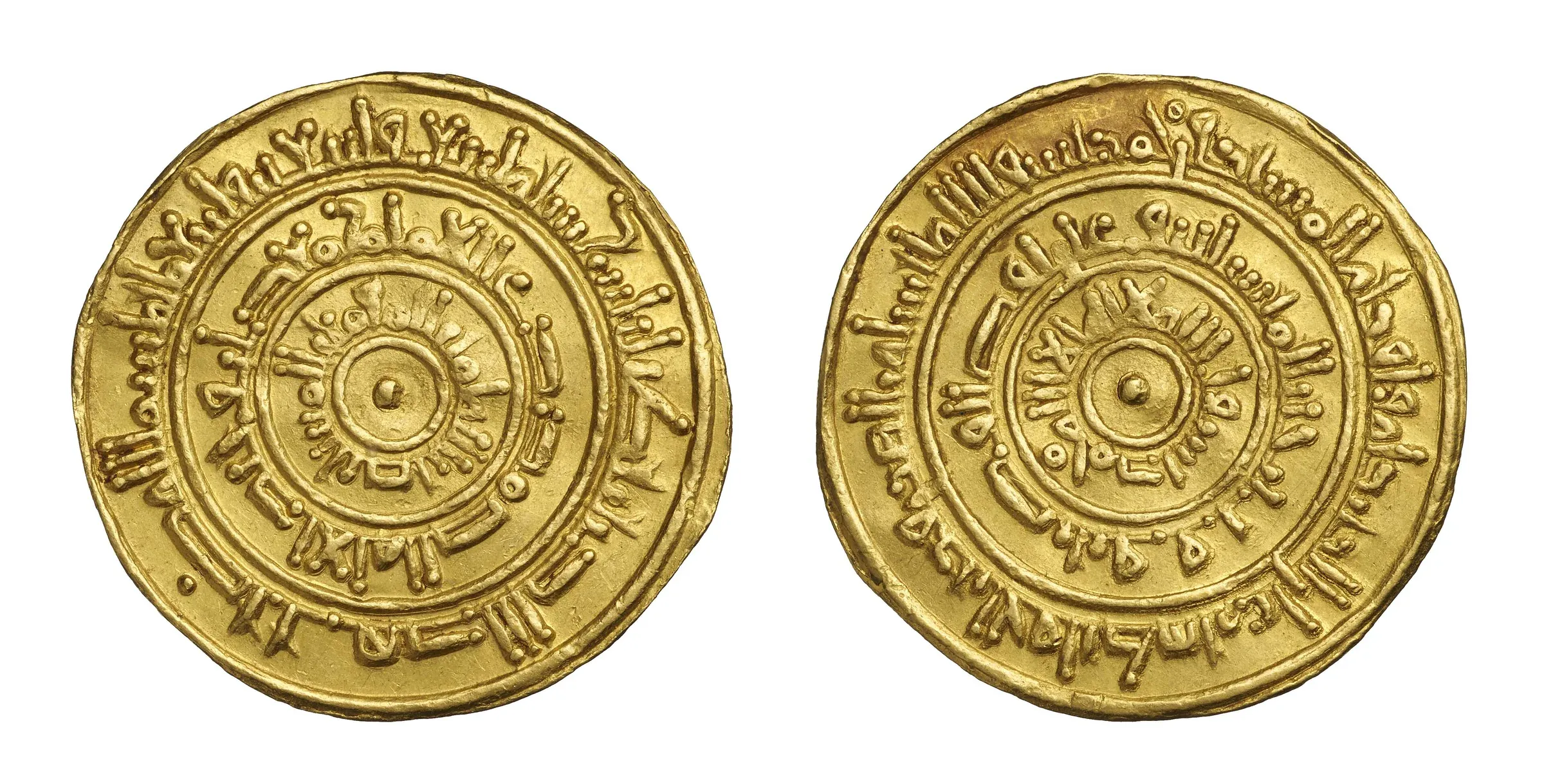
The revolt at first succeeded. Nizar’s forces drove back al-Afdal and advanced almost to Cairo. A gold dinar minted at Alexandria in 488 AH in Nizar’s name, discovered in 1994 and now in the library of the Institute of Ismaili Studies in London, is physical evidence of his short-lived caliphate.7
Towards the end of 488/1095 al-Afdal besieged Alexandria. Nizar surrendered, was taken to Cairo and was imprisoned. He was immured, walled up in a cell, and died there before the end of the year.7 Later Nizari tradition held that a son or grandson of Nizar had been smuggled to Persia. Nizar’s descendants led several revolts against the later Fatimids, the last in 556/1161 by a grandson.8
Who followed whom
Daftary’s summary of the division is this. Al-Musta’li was recognised by the da’wa in Cairo, most of Egypt, many Ismailis in Syria, all of Yemen and the communities of western India. He became the nineteenth Imam in the Musta’lian reckoning.9 Nizar was recognised by the Ismailis of the Saljuq lands, Persia and Iraq, under Hasan-i Sabbah, and by a faction in Syria. For them he was the nineteenth Imam.10
The Ismailis of Persia were unanimous. Hasan-i Sabbah had already succeeded ’Abd al-Malik b. ’Attash as head of the da’wa in the Saljuq realm. He broke with Cairo and founded an independent Nizari da’wa. The Ismailis of Central Asia and Badakhshan, the region of Nasir Khusraw, remained outside the dispute for some time.10 In Syria, Ridwan of Aleppo at first recognised al-Musta’li, and the dispute continued for decades. By 524/1130 the Syrian Ismailis were largely Nizari.10
Why the Musta’lians prevailed in Egypt
The outcome in 1094 was decided by power, not doctrine. Al-Afdal controlled the army and the court, and the da’wa organisation in Cairo depended on the Fatimid state. The Ismailis of Yemen and India, who were tied to Cairo through the Sulayhid dynasty and Queen Arwa, followed the decision of the capital.11
In Persia, by contrast, the Ismailis had been an underground movement in Saljuq territory for decades. Hasan-i Sabbah had seized Alamut in 1090 and was already independent of Cairo in practice. Recognising Nizar allowed him to reject al-Afdal’s puppet caliph and lead a movement of his own.12
The polemic
The split produced the first open polemic between Ismailis. In 516/1122 the Fatimid court issued al-Hidaya al-Amiriyya, drafted by the secretary Ibn al-Sayrafi in the name of the caliph al-Amir. It was the earliest Musta’lian refutation of the Nizari claims, written about twenty-eight years after the schism.6 It conceded that al-Mustansir had originally designated Nizar but argued that the designation had been revoked, and it ridiculed the belief that Nizar’s son had been smuggled to Persia.13
The epistle was circulated in Syria and caused uproar among the Nizaris of Damascus. A Nizari leader wrote a refutation, and al-Amir replied with a further epistle, Iqa’ sawa’iq al-irgham.6 It was in this literature that the Syrian Nizaris were first called hashishiyya, the term that later became “Assassins” (see the Assassins legend).14
The hidden Imam of the Nizaris
For the Nizaris the split created a problem: their Imam was dead or in prison, and no successor appeared. For about seventy years the Nizaris struck coins at Alamut (Kursi al-Daylam) in Nizar’s name with the title al-Mustafa li-Din Allah. His descendants were blessed anonymously. These coins were struck as late as the reign of Muhammad b. Buzurg-Ummid (1138–1162).8
Hasan-i Sabbah and his first two successors named no Imam. They led the Nizaris as the hujja, the representative of a hidden Imam, in a period of concealment (dawr al-satr).8 The concealment ended in 1164, when Hasan II proclaimed the Qiyama. He and his successors were later recognised as Imams descended from Nizar. The intervening hidden Imams are listed in the Nizari tradition as Ali al-Hadi, Muhammad al-Muhtadi and Hasan al-Qahir.15
The Musta’lian line after 1094
Al-Musta’li remained a puppet of al-Afdal until his death in Safar 495 / December 1101. He was succeeded by his five-year-old son al-Amir, who reigned until 524/1130. Al-Afdal was assassinated in 515/1121; Nizari sources claim the killing for themselves, though Daftary notes that al-Amir seems to have been behind it.16
Al-Amir himself was killed by Nizari fida’is in Dhu’l-Qa’da 524 / October 1130.16 His death produced a second split, between the Hafizis, who followed his cousin al-Hafiz, and the Tayyibis, who followed his infant son al-Tayyib. By 526/1132 the once unified Ismaili movement had divided into Nizaris, Hafizis and Tayyibis.17
The split in Syria
Syria was the one region where the two parties competed for decades. The Nizari mission there was led by Persians sent from Alamut. Its first leader, known as al-Hakim al-Munajjim, “the physician-astrologer”, worked at Aleppo under the Saljuq prince Ridwan, who had briefly recognised al-Musta’li in 490/1097 and later allowed the Nizaris a mission house (dar al-da’wa) in the city.18 The Musta’lians kept followers in Damascus and the coastal towns, which is why al-Hidaya al-Amiriyya was addressed to the Syrian Ismailis in 1122. By 524/1130 most Syrian Ismailis were Nizaris, and in the following decades they built their own network of castles in the Jabal Bahra’.19
The sources
The dispute is known mainly from one side. The Musta’lian case survives in al-Hidaya al-Amiriyya and in the later Tayyibi histories of Yemen, above all the ’Uyun al-akhbar of the da’i Idris ’Imad al-Din (d. 872/1468).20 The Fatimid chronicles of the period, used by Egyptian historians such as Ibn Muyassar, survive only in fragments and later extracts. Ibn Muyassar’s account of the assembly of 1122 is the main source for the testimony of Nizar’s sister. Most Fatimid chronicles, by Ismaili and non-Ismaili authors alike, did not survive the fall of the dynasty in 1171, and the Ayyubids destroyed the Fatimid libraries of Cairo.21
The Nizari side has to be reconstructed from the Nizari chronicles of Alamut, now lost, as they were quoted by the Persian historians Juvayni and Rashid al-Din after 1256, and from the few surviving Nizari texts such as the Haft bab-i Baba Sayyidna.22 Daftary stresses that both traditions were written to justify a claim, and that the conflicting accounts of what al-Mustansir intended cannot now be fully reconciled from the surviving evidence.5
Names and numbering
The two branches are named after the rival claimants: Nizariyya and Musta’liyya, or Musta’lawiyya. Both count al-Mustansir as their eighteenth Imam, and the numbering diverges from the nineteenth.9 Hostile Sunni writers had their own names. The Nizaris were called malahida, “heretics”, in Persian sources and hashishiyya in some Arabic ones.14
Footnotes
-
Farhad Daftary, The Isma’ilis: Their History and Doctrines, 2nd ed. (Cambridge University Press, 2007), pp. 241–242. ↩
-
Daftary, The Isma’ilis, pp. 242–243, 248; Farhad Daftary, Historical Dictionary of the Ismailis (Scarecrow Press, 2012), s.v. “Musta’lians, Musta’liyya”. ↩
-
Daftary, The Isma’ilis, pp. 241–242. ↩
-
Daftary, The Isma’ilis, p. 241; Daftary, Historical Dictionary, s.v. “Musta’lians, Musta’liyya”. ↩ ↩2
-
Daftary, The Isma’ilis, pp. 242–243; Daftary, Historical Dictionary, s.v. “Musta’lians, Musta’liyya”. ↩ ↩2
-
Daftary, The Isma’ilis, pp. 241–243, 263. ↩
-
Daftary, The Isma’ilis, pp. 314, 324. ↩
-
Daftary, The Isma’ilis, pp. 245, 326. ↩
-
Daftary, The Isma’ilis, pp. 326, 358–363. ↩
-
Daftary, The Isma’ilis, pp. 246–248. ↩
-
Daftary, The Isma’ilis, p. 332. ↩
-
Daftary, The Isma’ilis, pp. 245, 325, 349. ↩
-
Daftary, The Isma’ilis, p. 240. ↩
-
Daftary, The Isma’ilis, pp. 6, 245. ↩
-
Daftary, The Isma’ilis, pp. 303–306, 326. ↩