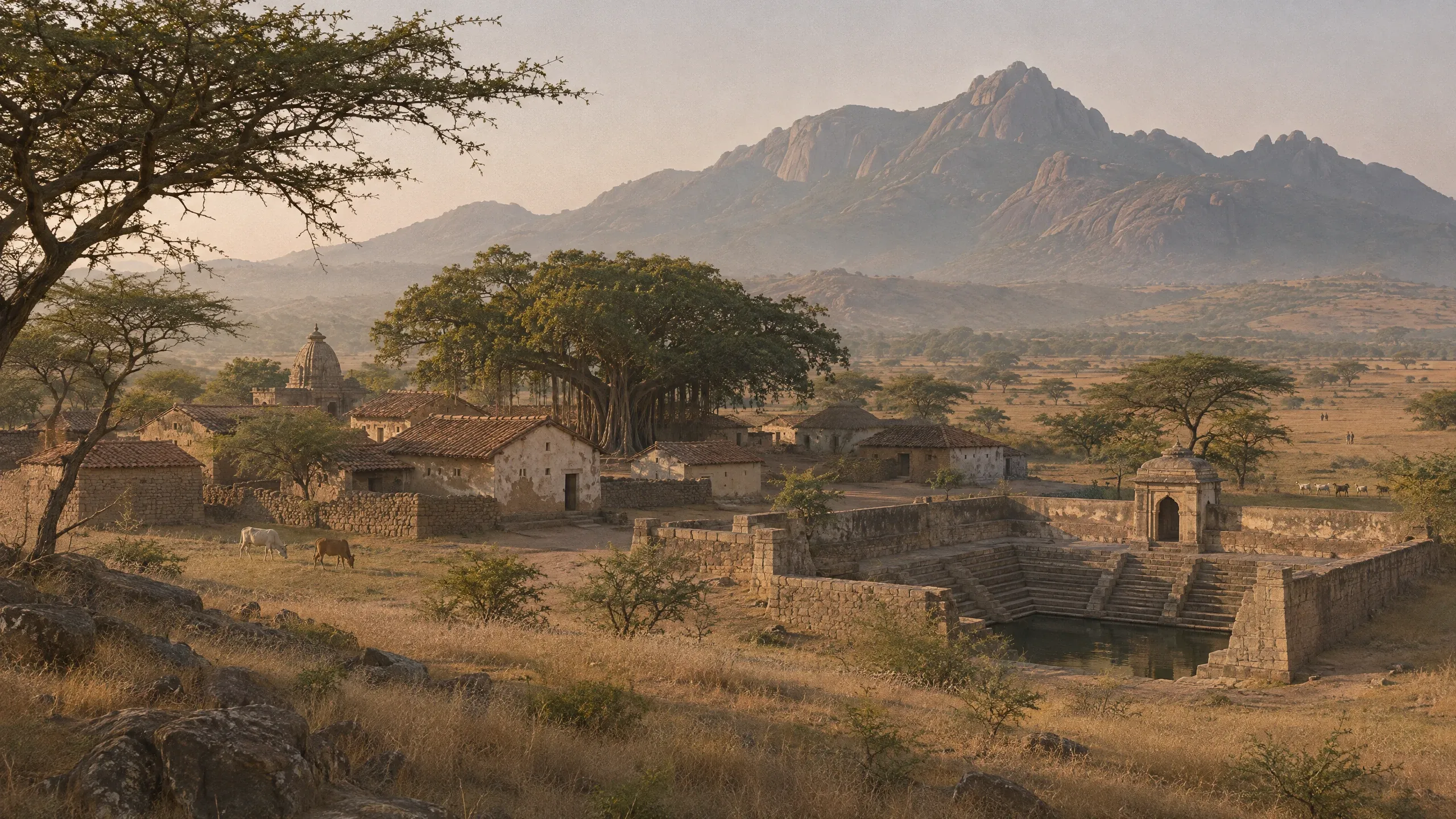
Kathiawar, also called Saurashtra, is the peninsula in south-western Gujarat. The Little Rann of Kachchh lies to its north, the Gulf of Khambhat to its east, the Arabian Sea to its south-west and the Gulf of Kachchh to its north-west. It covers about 60,000 km². In Ismaili history it is a land of Khoja and Momna villages and ports. Hasan Pir, the saint of the Nizari Momnas, is buried there. Aga Khan I spent a year there before settling in Bombay. Its Khojas made up much of the emigration to East Africa. Nineteenth-century records also show its Khojas keeping the customs of the Lohana caste from which the tradition says they came.12
The peninsula
Britannica dates settlement in Kathiawar to the third millennium BCE, with Harappan sites at Lothal and Prabhasa Patan (Somnath). The region was under Mauryan influence in the third century BCE. Later it passed to the Shakas and the Kshatrapa dynasties, and in the fifth century CE to the Valabhis. It suffered early Muslim raids, culminating in Mahmud of Ghazna’s campaigns and the sack of Somnath, which Britannica dates to 1024, the same Ghaznavid campaigns that destroyed the Ismaili states of Multan and Mansura. Mughal rule followed. After 1820 the peninsula’s many small princely states accepted British paramountcy. Its main port is Bhavnagar. The Girnar Hills, at 1,117 m the highest point in Gujarat, and the Gir forest, the last home of the Asiatic lion, are in the peninsula.34
Satpanth in Kathiawar
Kathiawar lay at the southern edge of the Satpanth da’wa. Moir and Khan describe a large expansion of Satpanthi followers in the sixteenth and seventeenth centuries “across Gujarat and beyond, from Khandesh and Burhanpur to Kathiawar and Kacch”. It was often led by the sayyids of Pirana themselves, and protected, they argue, by a thorough practice of taqiyya. Their account of Nur Muhammad Shah, the son of Imam Shah, records the tradition that he married two daughters of a Hindu Ahir leader of Bhavnagar.56
The Nizari line in Kathiawar centres on Hasan Pir, son of the Kadiwala Sayyid Fadil Shah of Kutch. Daftary records that while his brother Pir Mashayikh broke with the Imam in Ahmadabad, Hasan Pir, “who was active in Kathiawar, remained loyal to the Nizari imam and became the saint of the Nizari Momnas”. His mausoleum is at Thanapipli near Junagadh. In 1129/1717 the Nizari Khojas and Momnas built a second shrine in his honour at Ganod in Gujarat. Daftary notes that the Momnas of Gujarat later divided into groups following Sunnism, Twelver Shi’ism, Nizari Shi’ism and mixtures of these traditions.7
Lohana customs
Asani draws on the Gazetteer of the Bombay Presidency to show how close the Khojas stayed to their caste roots. In north-east Kathiawar, Khojas “were still addressed by the Lohana title thakkur and wore their waistcoats in the Lohana fashion”. The Khojas worked as an endogamous caste. A crier called adult men to meetings where disputes were settled and excommunications voted on. They kept caste-owned cooking utensils for communal dinners, wrote in Khojki, a form of the Lohanas’ script, and followed Hindu customary law in inheritance and widow remarriage.8
Aga Khan I in Kathiawar
After leaving Sindh by way of Karachi in Ramadan 1260/October 1844, Aga Khan I travelled through Kutch into Kathiawar. He arrived in Muharram 1261/January 1845. Daftary writes that he “spent a year at Kathiawar and visited the Khoja communities of the area, as he had done all along his route”. He then went on through Surat and Daman and reached Bombay in Safar 1262/February 1846. The Persian government demanded his extradition, and the British refused it. His stay in Kathiawar came just before the decades of litigation, culminating in the Aga Khan Case of 1866, that settled his authority over the community.910
Emigration
Kathiawar was one of the main sources of the Khoja diaspora. Daftary writes that the first Nizari Khoja immigrants to East Africa came “mainly from Cutch, Kathiawar, Surat and Bombay” and first settled on Zanzibar, where a small community existed by 1820. Settlement there grew significantly between 1840 and the 1870s. Droughts and famines in Gujarat drove many Khoja farmers to join the traders. By the First World War there were Nizari jamats of Indian origin in many parts of East Africa. Daftary also notes that the Bohras, who came mainly from Kutch and Kathiawar, were the second-largest group of Indian immigrants after the Khojas.1112
Asani’s sources also show the double inheritance that Kathiawari emigrants took with them. The thakkur title and Lohana dress survived into the period when the community was tying itself more closely to the Imam in Bombay. In the twentieth century, many such caste customs, and the Indic elements of the liturgy, were given up as the community redefined itself as Shia Imami Ismaili Muslim.1313
Footnotes
-
“Kathiawar Peninsula,” Encyclopaedia Britannica, https://www.britannica.com/place/Kathiawar-Peninsula. ↩
-
Farhad Daftary, The Isma’ilis: Their History and Doctrines, 2nd ed. (Cambridge: Cambridge University Press, 2007), pp. 448, 472, 485. ↩
-
“Kathiawar Peninsula,” Encyclopaedia Britannica. ↩
-
“Gujarat,” Encyclopaedia Britannica, land section, https://www.britannica.com/place/Gujarat. ↩
-
Zawahir Moir and Dominique-Sila Khan, “New Light on the Satpanthi Imamshahis of Pirana,” South Asia: Journal of South Asian Studies n.s. 33, no. 2 (2010), p. 219, https://doi.org/10.1080/00856401.2010.494824. ↩
-
Moir and Khan, “New Light on the Satpanthi Imamshahis,” p. 216. ↩
-
Daftary, The Isma’ilis, p. 448. ↩
-
Ali S. Asani, “From Satpanthi to Ismaili Muslim: The Articulation of Ismaili Khoja Identity in South Asia,” in Farhad Daftary (ed.), A Modern History of the Ismailis (London: I.B. Tauris, 2011), section “Locating Khoja Identity within Changing Contexts,” citing the Gazetteer of the Bombay Presidency. ↩
-
Daftary, The Isma’ilis, p. 472. ↩
-
Daftary, The Isma’ilis, pp. 472–476. ↩
-
Daftary, The Isma’ilis, p. 485. ↩
-
Daftary, The Isma’ilis, p. 291. ↩
-
Asani, “From Satpanthi to Ismaili Muslim,” sections “Locating Khoja Identity within Changing Contexts” and “Reorienting understanding and practice of faith.” ↩ ↩2