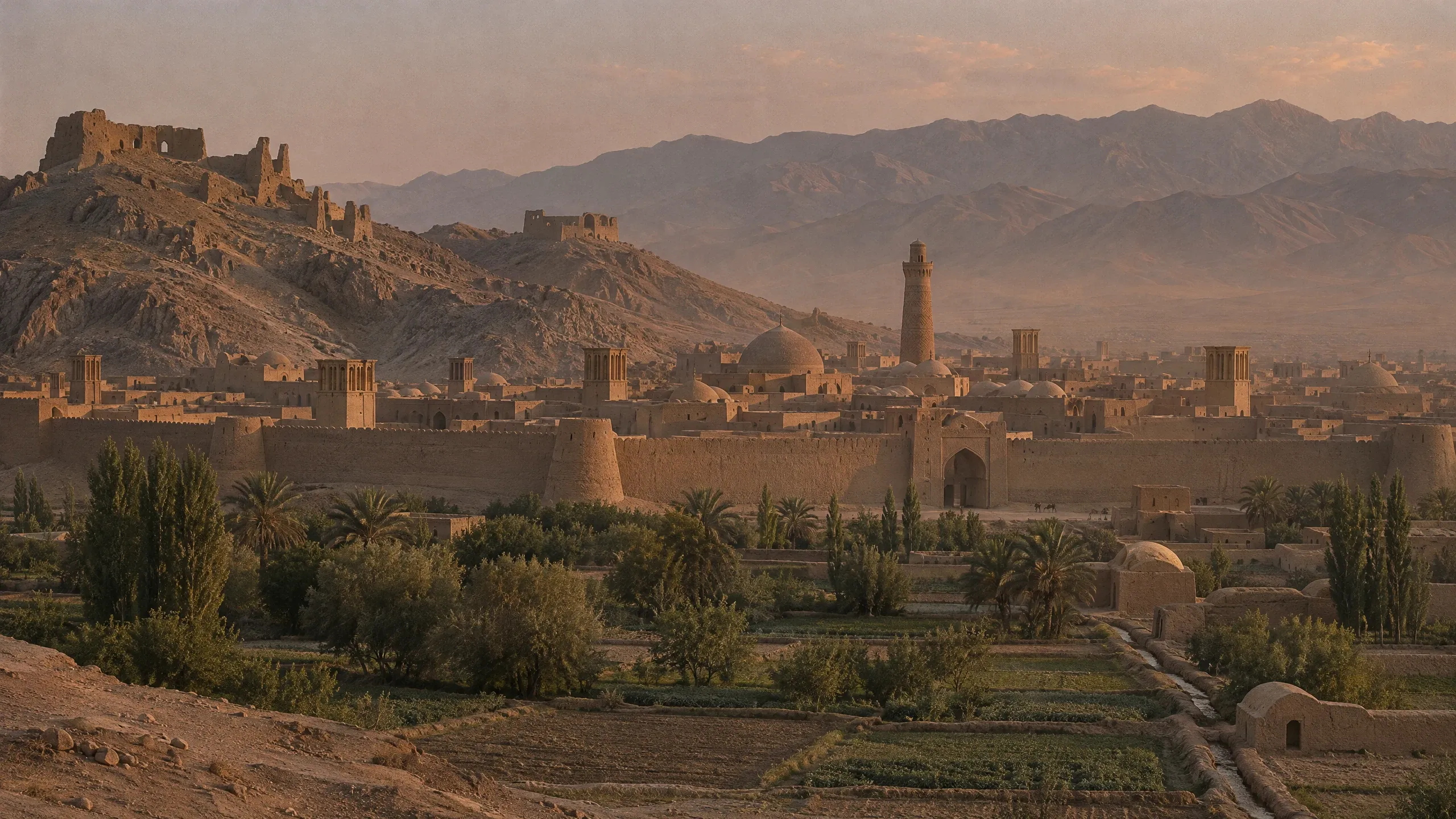
A new centre in the south-east
Kerman, a city on the edge of the deserts of south-eastern Iran and the capital of the province of the same name, became the second home of the Nizari Imams in the eighteenth century. Beben and Mohammad Poor note that there is no evidence of Ismaili activity in the province in the centuries after the Mongol conquest before the time of Shah Nizar II. Over the following century the Imams moved their residence from the region of Qumm and Mahallat, where it had been since at least the fifteenth century, to the province of Kerman. The main sources for this period are the works of the Kerman historian Vaziri (d. 1295/1878), his Tarikh-i Kirman, completed in 1874, and his Jughrafiya-yi Kirman.1
The Ata Allahis
The first link was a body of followers. Shah Nizar II (d. 1134/1722) used the Ni’mat Allahi name Ata Allah, and some of his followers, Khurasani nomads who had been resettled in Sirjan and elsewhere in the province, became known as the Ata Allahis. Vaziri says they were personal followers of the Imam as a sayyid, “like the Haydarabadis neither Sevener Shi’as nor Isma’ilis”. Their communities still existed in Kerman in the 1960s. The Ata Allahi and Khurasani tribesmen were to provide the Imams with armed support in Kerman for more than a century.2
Why the Imams moved
The Khoja pilgrims who came from India to visit the Imam and bring their dues suffered on the road to central Persia. Vaziri relates that in the disorder after the fall of the Safavids they were often plundered and killed by Bakhtiyari tribesmen between Na’in and Yazd, besides being extorted by officials. Towards the end of Nadir Shah’s reign, Hasan Ali, the forty-second Imam, moved to Shahr-i Babak, about 180 kilometres south-west of Kerman, near the overland routes to India and the port of Bandar Abbas, and used Kerman city as his winter residence. He became a major landowner in the province.3
Hasan Ali was close to Shahrukh Khan, Nadir Shah’s grandson and governor of Kerman, and one of his daughters married Shahrukh’s son Lutf Ali Khan. Later family sources say Nadir Shah appointed him beglerbegi of Kerman.4
Abu’l-Hasan Ali, governor of Kerman
Hasan Ali’s grandson Abu’l-Hasan Ali was treated with great respect by the Zand governor Mirza Husayn Khan, who placed Sirjan, Zarand and other districts under him. He rose to be beglerbegi of the city of Kerman, a title by which he was still known after Karim Khan Zand made him governor of the whole province around 1170/1756. He is reported to have received some 20,000 tumans a year in dues from his followers in India, which let him buy more property in Kerman and spend generously on its people, and his popularity allowed him to remain governor when the Zand state disintegrated on Karim Khan’s death in 1193/1779. From then on he ruled Kerman largely independently, supporting Karim Khan’s brother Sadiq Khan in the succession struggle. He built a public square next to the Friday mosque and other buildings in the city.5
The Afghan border was his chief danger. He lost Narmashir and the citadel of Bam, and the Afghan and Baluchi forces of Azam Khan, an amir from Qandahar, overran the border districts. An army of 7,000 under the Imam’s cousin Mirza Sadiq defeated Azam Khan; when he returned and ravaged the province as far as the gates of Kerman, Abu’l-Hasan led his own forces from Shahr-i Babak and defeated him outside the city. Muhammad Hasan Khan Sistani, who held Bam independently, then encouraged the Zand prince Lutf Ali Khan to invade Kerman.6
In Safar 1205/October 1790, when the Zand prince Lutf Ali Khan marched on Kerman, Abu’l-Hasan Ali, who had switched his support to the Qajar Agha Muhammad Khan, refused him admittance; with his Ata Allahi followers he held out until the siege was lifted in bad weather in Jumada I 1205/January 1791. He also supported the revived Ni’mat Allahi order. Its masters Nur Ali Shah and Mushtaq Ali Shah had settled in Kerman, and in Ramadan 1206/May 1792, while the Imam was away fighting tribes near Shahr-i Babak and Sirjan, the mujtahid Mulla Abd Allah had Mushtaq Ali Shah stoned to death in the Friday mosque. His tomb, the Mushtaqiyya, still stands in Kerman. Daftary says Abu’l-Hasan Ali died later that year and was evidently buried there; Beben and Mohammad Poor say he retired to Kahak and died there.7
The Qajar conquest, 1794
Lutf Ali Khan seized Kerman, and in 1209/1794 Agha Muhammad Khan took it from him. The city’s inhabitants were massacred, but the Nizaris were spared. Lutf Ali Khan fled to Bam, where he was captured, blinded and later executed. The Nizari sayyids of Shahr-i Babak were allowed to move to Kahak and were given new lands as compensation, and a few hundred Ata Allahi families were settled outside Kerman. The Imams then left the province for about forty years.8
Aga Khan I as governor
In 1251/1835 Muhammad Shah appointed Hasan Ali Shah, Aga Khan I, governor of Kerman, the post his grandfather had held. Kerman was then held by the rebellious sons of the pretender Shuja al-Saltana and raided by Afghan and Baluchi bands. The Aga Khan restored order without payment from the treasury and recovered Bam and Narmashir with the help of Ata Allahi and Khurasani tribesmen; his brother Abu’l-Hasan Khan, the Sardar, led his forces.9
He was dismissed in 1252/1837 and replaced by the shah’s brother Firuz Mirza Nusrat al-Dawla. Refusing the decision, he held the citadel of Bam for fourteen months. When he surrendered, through the intercession of the governor of Fars, he was seized and plundered and held in Kerman for eight months, where he was nonetheless permitted to receive the religious dues brought by deputations from Khurasan, Badakhshan and India.10
The last campaign, 1840–1841
In 1256/1840 the Aga Khan returned to the province with documents, later declared spurious, reinstating him as governor. From Shahr-i Babak he fought the forces of the governor Fadl Ali Khan Qarabaghi through the winter of 1840–1841, defeating a force of 4,000 near Dashtab, but was decisively beaten at Rigan on the Baluchistan border. He fled across the desert to Afghanistan. The family’s properties in Kerman remained, and under Nasir al-Din Shah they were managed with those at Mahallat by the Sardar’s son Mirza Isma’il Khan I’tibar al-Saltana.11
Footnotes
-
Daniel Beben and Daryoush Mohammad Poor, The First Aga Khan: Memoirs of the 46th Ismaili Imam (I.B. Tauris / Institute of Ismaili Studies, 2018), Introduction, pp. 24–25; Farhad Daftary, The Isma’ilis: Their History and Doctrines, 2nd ed. (Cambridge University Press, 2007), p. 460. ↩
-
Daftary, The Isma’ilis, 2nd ed. (Cambridge University Press, 2007), p. 457; Beben and Mohammad Poor, The First Aga Khan (2018), Introduction, pp. 25–26, citing Vaziri, Jughrafiya-yi Kirman, p. 265, and Peter Willey, Eagle’s Nest: Ismaili Castles in Iran and Syria (2005), pp. 205–206. ↩
-
Daftary, The Isma’ilis, 2nd ed. (Cambridge University Press, 2007), pp. 459–460; Beben and Mohammad Poor, The First Aga Khan (2018), Introduction, pp. 25–27, citing Vaziri, Tarikh-i Kirman, pp. 698–699. ↩
-
Beben and Mohammad Poor, The First Aga Khan (2018), Introduction, pp. 23, 27. ↩
-
Daftary, The Isma’ilis, 2nd ed. (Cambridge University Press, 2007), pp. 459–460; Beben and Mohammad Poor, The First Aga Khan (2018), Introduction, pp. 27–28. ↩
-
Daftary, The Isma’ilis, 2nd ed. (Cambridge University Press, 2007), p. 460. ↩
-
Daftary, The Isma’ilis, 2nd ed. (Cambridge University Press, 2007), pp. 461–462; Beben and Mohammad Poor, The First Aga Khan (2018), Introduction, pp. 28–29. ↩
-
Daftary, The Isma’ilis, 2nd ed. (Cambridge University Press, 2007), p. 462. ↩
-
Daftary, The Isma’ilis, 2nd ed. (Cambridge University Press, 2007), p. 464; Beben and Mohammad Poor, The First Aga Khan (2018), Introduction, pp. 29–30. ↩
-
Daftary, The Isma’ilis, 2nd ed. (Cambridge University Press, 2007), p. 465. ↩
-
Daftary, The Isma’ilis, 2nd ed. (Cambridge University Press, 2007), pp. 468–469, 472. ↩