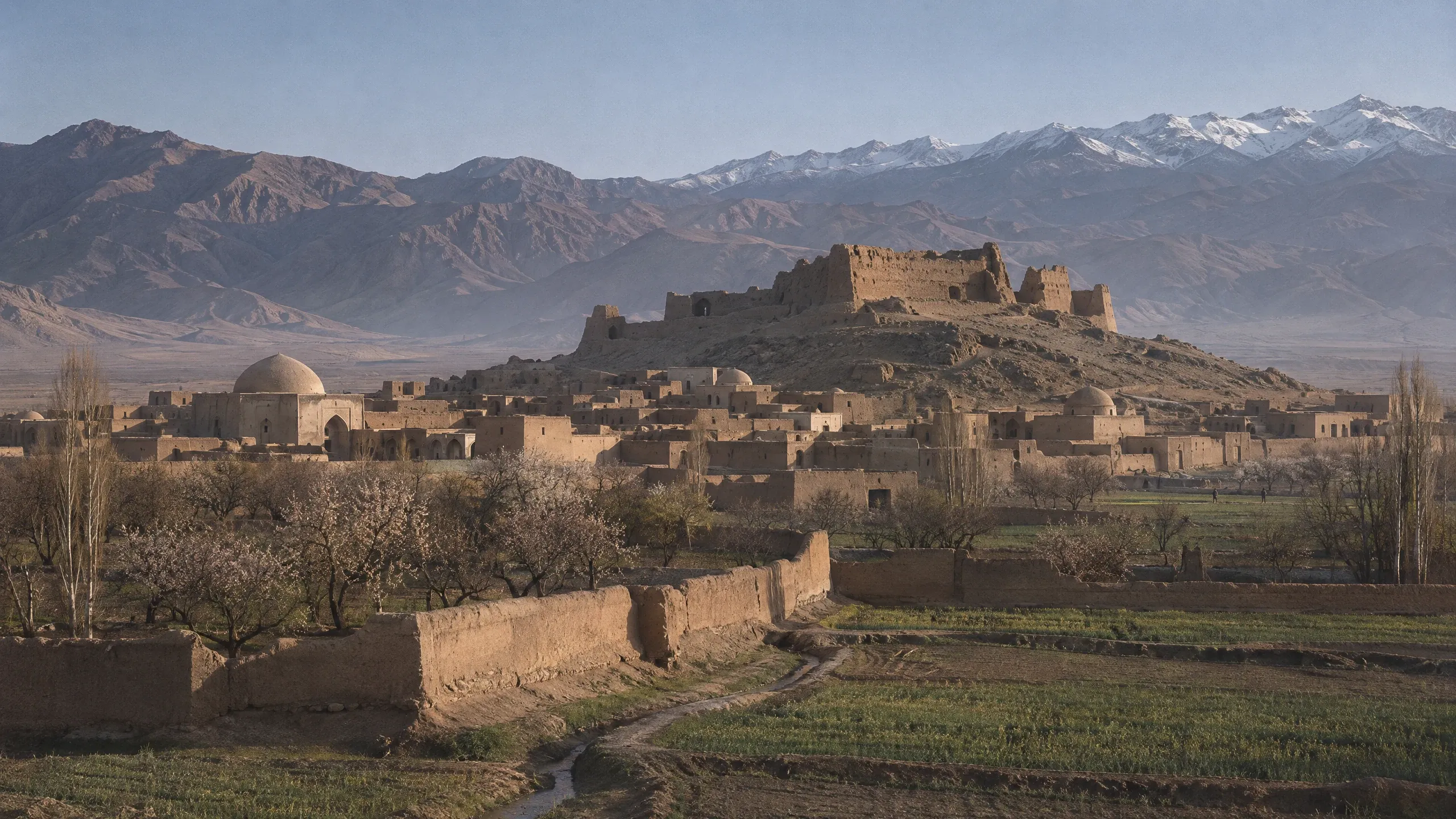
Location
Shahr-i Babak is a town in the province of Kerman in south-eastern Iran, about 180 kilometres south-west of the city of Kerman, between Rafsanjan and Sirjan. For about half a century from the 1740s it was the principal residence and stronghold of the Nizari Imams, and it remained one of their ancestral properties into the nineteenth century. A small Nizari community still lives in the town and its surrounding villages.1
A tradition about the Anjudan Imams
Nizari oral tradition holds that Mustansir bi’llah II and several of his successors lived at Shahr-i Babak. Daftary regards this as an error: the mausoleums of Mustansir bi’llah II and of his grandson Gharib Mirza stand at Anjudan in central Persia, and the Imams’ connection with Kerman began only in the eighteenth century.2
The move from Kahak
The Imams moved there for the sake of their Indian followers. After the fall of the Safavids, Khoja caravans travelling to the Anjudan and Mahallat areas were plundered and their pilgrims killed by Bakhtiyari tribesmen between Na’in and Yazd, and the flow of tithes to the Imam was choked. Towards the end of Nadir Shah’s reign (1148–1160/1736–1747) Hasan Ali, the forty-second Imam, moved his seat from Kahak to Shahr-i Babak, closer to the overland routes from India and to the port of Bandar Abbas, which many Indian pilgrims used.3
Some Nizaris already lived in the town, and with the Imam’s arrival it became an important Nizari centre. With the improved flow of tithes from the Khojas, Hasan Ali soon acquired extensive properties there and established a winter residence in Kerman city. Daftary calls him the first Imam of his line to emerge from concealment and obscurity; he became involved in the affairs of the province and was treated with respect by the Afsharid Shahrukh, who ruled Kerman from 1160/1747 until 1172/1758–1759. Hasan Ali’s daughter married Shahrukh’s son Lutf Ali Khan.4
The Imam’s stronghold
Under Hasan Ali’s grandson Abu’l-Hasan Ali, governor of Kerman from around 1170/1756, Shahr-i Babak was the family’s fortified base. When the Afghan and Baluchi forces of Azam Khan of Qandahar ravaged the province as far as the gates of Kerman while the Imam was on one of his visits to Shahr-i Babak, he led his forces out from there and defeated them outside the city.5
In Safar 1205/October 1790 the Zand prince Lutf Ali Khan marched to Sirjan, aiming to take Shahr-i Babak. Daftary describes it as Abu’l-Hasan’s main stronghold in the province, where he had many adherents among its Khurasani and Ata Allahi inhabitants, with a fortified and well-provisioned fortress guarded by a large number of armed Nizaris under the Imam’s cousin Mirza Sadiq. Informed at Sirjan how hard it would be to take, Lutf Ali Khan turned instead against Kerman city. In 1206/1792 the Imam was again away from Kerman, restoring order around Shahr-i Babak and Sirjan where Qashqai and Arab tribesmen were threatening the people, when the Sufi Mushtaq Ali Shah was killed in the city.6
After the Qajar conquest
When Agha Muhammad Khan Qajar took Kerman from Lutf Ali Khan in 1209/1794 and massacred many of its people, the local Nizaris were spared. The Nizari sayyids, relatives of the Imam who lived in Shahr-i Babak, were allowed to move with their families to Kahak, where Agha Muhammad Khan gave them new lands in compensation for what they had left in Kerman. A few hundred Ata Allahi families of the same locality were settled outside the city of Kerman. The fortress at Shahr-i Babak nevertheless remained one of the family’s ancestral properties.7
Aga Khan I’s base, 1840
Half a century later the town was again the Imam’s base. In 1256/1840 Aga Khan I, having left Mahallat ostensibly for Mecca and fought the governor of Yazd, made for Shahr-i Babak, which he intended to use as his base for seizing Kerman. It was, Daftary writes, a stronghold of the Ata Allahi and Khurasani tribesmen who recognised him as their Imam. In the ’Ibrat-afza he calls the fortress “my inherited home and property”.8
He found its citadel held by Afghan chiefs from Qandahar, Kuhandil Khan and his associates, who had taken refuge in Persia after the British invasion of Afghanistan and made themselves unpopular. His arrival coincided with an attempt by a former local governor, Hajji Muhammad Ali, to dislodge them. Joined by many Ata Allahis and Khurasanis, the Aga Khan took part in the siege and forced the Afghans to surrender. He then sent his brother Muhammad Baqir Khan to Sirjan for provisions and withdrew to Rumani, a nearby village, before the campaign that ended in his defeat at Rigan in 1841. He met some of the same Afghan chiefs again at Qandahar the following year.9
Ismailis today
Daftary reports that Nizaris in Iran today live mainly in Khurasan and the central province, especially Tehran and some nine villages around Mahallat, with smaller numbers in the province of Kerman, mainly in the towns of Kerman, Sirjan and Shahr-i Babak and their surrounding villages, as well as in Yazd.10
Footnotes
-
Farhad Daftary, The Isma’ilis: Their History and Doctrines, 2nd ed. (Cambridge University Press, 2007), pp. 459, 504. ↩
-
Daftary, The Isma’ilis, 2nd ed. (Cambridge University Press, 2007), p. 423; Daniel Beben and Daryoush Mohammad Poor, The First Aga Khan: Memoirs of the 46th Ismaili Imam (I.B. Tauris / Institute of Ismaili Studies, 2018), Introduction, pp. 24–25. ↩
-
Daftary, The Isma’ilis, 2nd ed. (Cambridge University Press, 2007), pp. 459–460; Beben and Mohammad Poor, The First Aga Khan (2018), Introduction, p. 27. ↩
-
Daftary, The Isma’ilis, 2nd ed. (Cambridge University Press, 2007), pp. 459–460; Beben and Mohammad Poor, The First Aga Khan (2018), Introduction, p. 27. ↩
-
Daftary, The Isma’ilis, 2nd ed. (Cambridge University Press, 2007), p. 460. ↩
-
Daftary, The Isma’ilis, 2nd ed. (Cambridge University Press, 2007), pp. 461–462. ↩
-
Daftary, The Isma’ilis, 2nd ed. (Cambridge University Press, 2007), p. 462; Beben and Mohammad Poor, The First Aga Khan (2018), Introduction, p. 42. ↩
-
Daftary, The Isma’ilis, 2nd ed. (Cambridge University Press, 2007), p. 468; Beben and Mohammad Poor, The First Aga Khan (2018), Introduction, p. 42, and translation of the ’Ibrat-afza, p. 97. ↩
-
Daftary, The Isma’ilis, 2nd ed. (Cambridge University Press, 2007), pp. 468–469; Beben and Mohammad Poor, The First Aga Khan (2018), translation of the ’Ibrat-afza, p. 97 and nn. 85–87, 140–141. ↩
-
Daftary, The Isma’ilis, 2nd ed. (Cambridge University Press, 2007), p. 504. ↩