The first Imam out of concealment
Sayyid Hasan Ali, also known as Sayyid Hasan Beg, was the forty-second Imam of the Qasim-Shahi line and the son of Sayyid Ali. Daftary calls him the first Imam of his line to emerge from concealment and obscurity. For nearly five centuries after the fall of Alamut the Imams had lived under Sufi and then Twelver Shi’i disguise; Hasan Ali became a soldier, landowner and provincial notable whose identity as Imam was known to his contemporaries. He is also the first Imam of the line about whom outside Persian chronicles report in some detail.1
His dates are uncertain. His father’s tombstone at Kahak records Sayyid Ali’s death in 1167/1754, yet both Daftary and Beben and Mohammad Poor describe Hasan Ali acting as Imam under Nadir Shah, who died in 1747. The date of his own death is not recorded in the sources used here.2
In the service of Nadir Shah
After the Afghans took Isfahan in 1134/1722, the Safavid commander Nadir Quli Beg drove them out and in 1736 had himself crowned shah, founding the short-lived Afsharid dynasty. Nadir abandoned the Safavids’ official patronage of Twelver Shi’ism and tried to have Shi’ism recognised as a fifth, Ja’fari, school of law. Beben and Mohammad Poor argue that, having set himself against the Twelver ulama, Nadir saw a convenient ally in the Nizari Imamate.3
Nadir developed a close relationship with Hasan Ali and employed him as a commander in his army, in which a number of Nizaris also served. The earliest account is by Nadir’s chronicler Muhammad Kazim Marvi, who reports that the Imam served in the royal camp but was later accused of treason and blinded. An early nineteenth-century Ismaili text from Central Asia, the Silk-i guhar-riz, records that its author’s grandfather, the pir Khwaja Muhammad Salih, visited the Imam at Mashhad and spent six months in his service, and that the Imam had taken part in the capture of Isfahan. Later sources add that he accompanied Nadir’s invasion of India, was rewarded with a governorship near his ancestral Mahallat, and, after being blinded on charges of heresy, was pardoned and reinstated. The Nizari historian Fida’i Khurasani says the Imam and his followers went with Nadir as far as Kabul and Peshawar.4
Why Kerman
Towards the end of Nadir Shah’s reign (1148–1160/1736–1747), Hasan Ali moved to Shahr-i Babak in Kerman, about 180 kilometres south-west of the city of Kerman, between Rafsanjan and Sirjan. The seat of the Imamate had been in the Qumm region since at least the fifteenth century. The main source for the move is Ahmad Ali Khan Vaziri (d. 1295/1878), author of a history and a historical geography of his native province.5
Vaziri relates that in the chaos after the fall of the Safavids the Khojas who regularly travelled to the Anjudan and Mahallat area to visit their Imam and remit their dues were often plundered and killed between Nain and Yazd by Bakhtiyari tribesmen, and were extorted by officials along the way. Shahr-i Babak was closer to the overland routes from India and to the Persian Gulf, including the port of Bandar Abbas used by many Indian pilgrims. Some Nizaris already lived there, among them the Ata Allahi tribesmen whom Hasan Ali’s grandfather Shah Nizar II had settled around Sirjan.6
The wealth of the Khojas
The move worked. With the improved flow of the Khojas’ tithes, Hasan Ali soon acquired extensive properties at Shahr-i Babak and established a winter residence in the city of Kerman. Marvi reports that the Imam received many pilgrims and notable sums from his followers in India, centred on Ahmadabad in Gujarat. Beben and Mohammad Poor link this wealth to a wider change: in the late seventeenth and eighteenth centuries the Khojas were moving towards the coasts of Sind and Gujarat, and many, as merchants, profited from the growing Indian Ocean trade, even as the decline of overland trade weakened the Safavid state.7
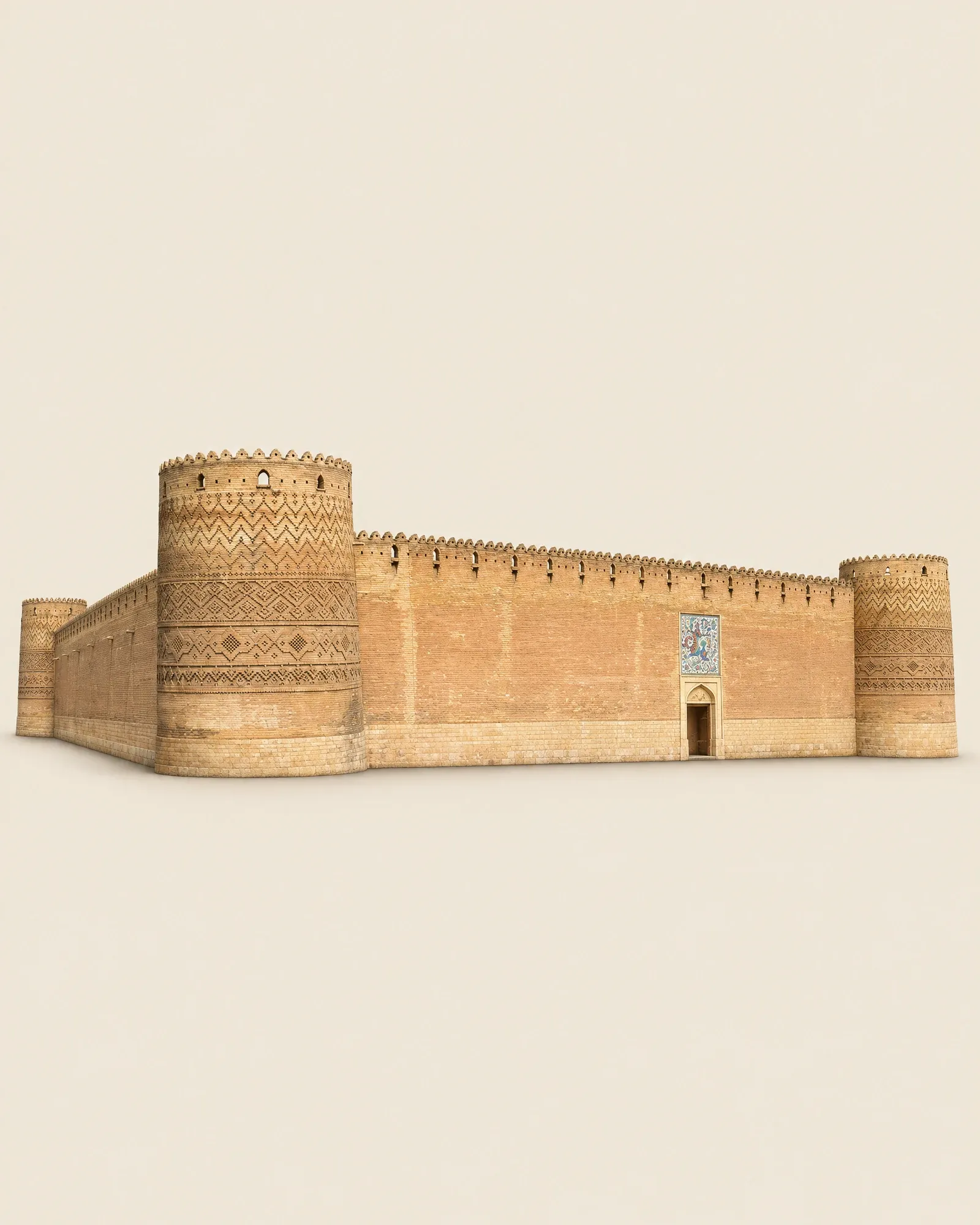
Shahr-i Babak became an important Nizari centre, and members of the Imam’s family, the Nizari sayyids, settled there. They remained until 1209/1794, when, after the Qajar conquest of Kerman, Agha Muhammad Khan allowed them to move to Kahak and gave them new lands in compensation for what they left behind. The fortress remained in the family: a century after Hasan Ali, Aga Khan I called it his “inherited home and property”. During his revolt of 1840–1841 he made for Shahr-i Babak, a stronghold of the Ata Allahi and Khurasani Nizaris, only to find the fortress occupied by Afghan chiefs from Qandahar, whom he besieged before moving on towards Kerman.8
Afsharid Kerman
Hasan Ali became actively involved in the affairs of Kerman. After Nadir Shah’s murder in 1160/1747 the province was ruled by the Afsharid Shahrukh, Nadir’s grandson, until he was killed in 1172/1758–1759 and Kerman passed to Karim Khan Zand. Shahrukh treated the Imam with respect, and their association culminated in the marriage of Hasan Ali’s daughter to Shahrukh’s son, Lutf Ali Khan. It was the first recorded of a series of marriage alliances between the Imams and Persia’s ruling houses in the eighteenth and nineteenth centuries.9
Succession
Hasan Ali was succeeded by his son Qasim Ali, also known as Sayyid Ja’far, whose Imamate was evidently brief and about whom the surviving sources give no particular details at all. Qasim Ali’s son Abu’l-Hasan Ali became governor of Kerman.10
Footnotes
-
Farhad Daftary, The Isma’ilis: Their History and Doctrines, 2nd ed. (Cambridge University Press, 2007), p. 459; Daniel Beben and Daryoush Mohammad Poor, The First Aga Khan: Memoirs of the 46th Ismaili Imam (I.B. Tauris / Institute of Ismaili Studies, 2018), Introduction, pp. 21–23. ↩
-
Daftary, The Isma’ilis, 2nd ed. (Cambridge University Press, 2007), pp. 458–459; Beben and Mohammad Poor, The First Aga Khan (2018), Introduction, pp. 22–23, 27. ↩
-
Daftary, The Isma’ilis, 2nd ed. (Cambridge University Press, 2007), p. 459; Beben and Mohammad Poor, The First Aga Khan (2018), Introduction, pp. 21–23. ↩
-
Beben and Mohammad Poor, The First Aga Khan (2018), Introduction, pp. 22–23 and n. 62, citing Muhammad Kazim Marvi, Alamara-yi Nadiri, vol. 3, p. 1182; Silk-i guhar-riz, pp. 108–110; Athar-i Muhammadi, IIS MS 919, pp. 15–16; Fida’i Khurasani, Hidayat al-mu’minin al-talibin, pp. 142–143. ↩
-
Daftary, The Isma’ilis, 2nd ed. (Cambridge University Press, 2007), p. 459; Beben and Mohammad Poor, The First Aga Khan (2018), Introduction, p. 24. ↩
-
Daftary, The Isma’ilis, 2nd ed. (Cambridge University Press, 2007), pp. 457, 459; Beben and Mohammad Poor, The First Aga Khan (2018), Introduction, pp. 24–27, citing Ahmad Ali Khan Vaziri, Tarikh-i Kirman, pp. 698–699. ↩
-
Daftary, The Isma’ilis, 2nd ed. (Cambridge University Press, 2007), p. 459; Beben and Mohammad Poor, The First Aga Khan (2018), Introduction, pp. 25–27 and nn. 69–70, citing Muhammad Kazim Marvi, ’Alamara-yi Nadiri, ed. M. A. Riyahi (Tehran, 1985), vol. 3, p. 1182. ↩
-
Daftary, The Isma’ilis, 2nd ed. (Cambridge University Press, 2007), pp. 459, 462, 468; Beben and Mohammad Poor, The First Aga Khan (2018), Introduction, and the ’Ibrat-afza, account of the Kerman campaign, with n. 84. ↩
-
Daftary, The Isma’ilis, 2nd ed. (Cambridge University Press, 2007), pp. 459, 463; Beben and Mohammad Poor, The First Aga Khan (2018), Introduction, p. 27. ↩
-
Daftary, The Isma’ilis, 2nd ed. (Cambridge University Press, 2007), p. 459; Beben and Mohammad Poor, The First Aga Khan (2018), Introduction, p. 27. ↩