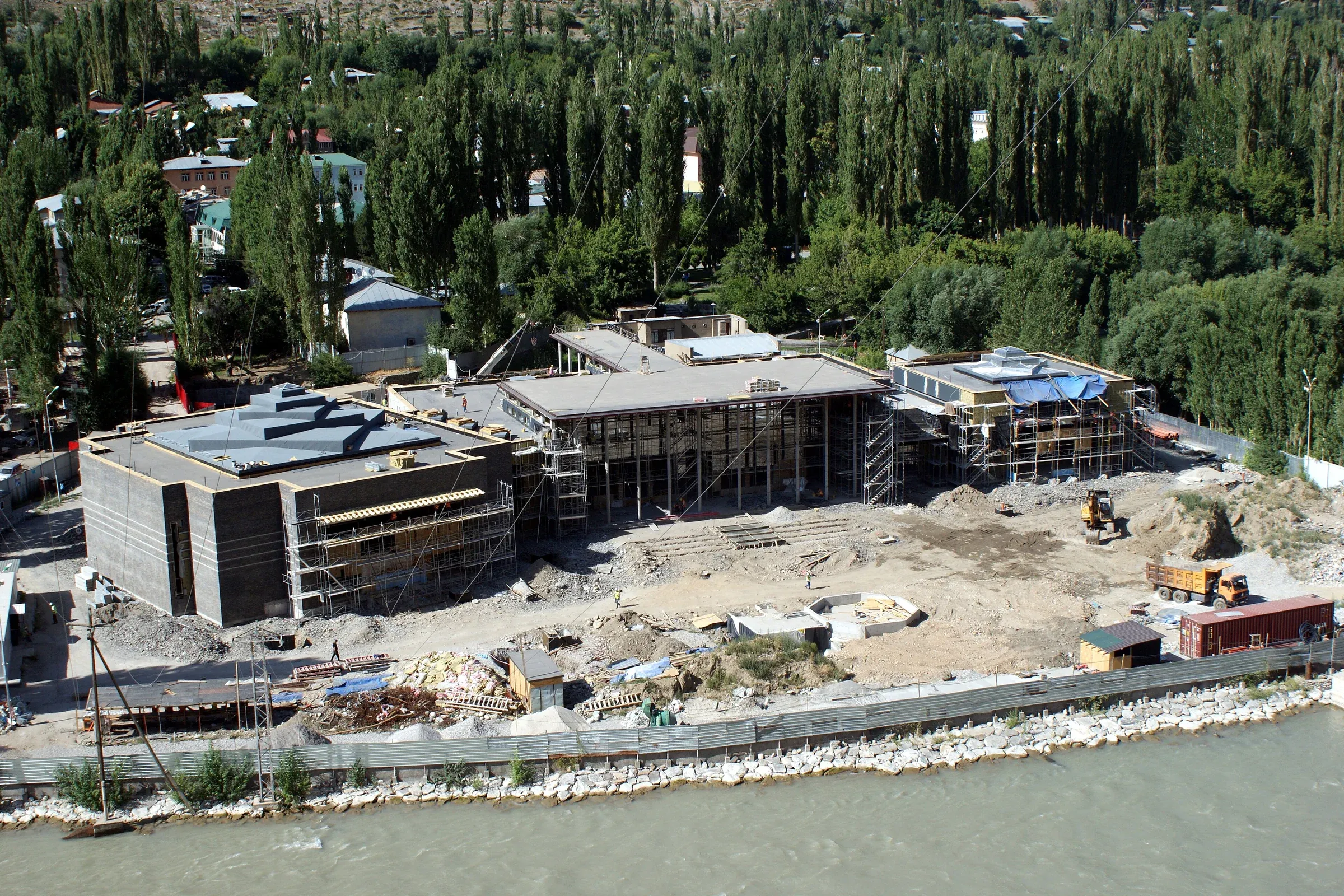
Khorog is the capital of the Gorno-Badakhshan Autonomous Region of Tajikistan. It stands where the Gunt river joins the Panj, the upper Oxus, which here forms the border with Afghan Badakhshan. Most of the region’s population are Nizari Ismailis, and Khorog is the largest town of the Pamiri Ismailis. It is the terminus of the Pamir Highway from Osh in Kyrgyzstan and, since 2000, the seat of the University of Central Asia. The history of the wider region is given in The Ismailis of Central Asia.1
Setting
The Encyclopaedia Iranica places Khorog in the territory of the Shughni people. The Shughnis of the Gunt basin and Khorog, the Rushanis of the Rushan district on the Oxus, and the Bartangis of the Bartang valley speak closely related East Iranian dialects. Together they make up perhaps three-quarters of the Pamiri peoples on the Soviet side of the border, known to Russians as “Mountain Tajiks” or “Pamir Tajiks” and to their Tajik neighbours as Ghalcha. The Wakhis of the Wakhan and the Ishkashimis to the south speak other Pamiri languages.2
The region is high, narrow and short of arable land. Iranica, writing in the Soviet period, describes the economy of Soviet Badakhshan as almost wholly agricultural and pastoral, apart from small food-processing and building-material industries at Khorog. It was the only significant town on the Soviet side of the border. Faydabad played the corresponding role in Afghan Badakhshan.3
Border town
Khorog’s position is a product of the Anglo-Russian settlement of the Pamirs. Daftary records that the agreement of 1895 fixed the Panj as the boundary between the Russian and Afghan spheres, dividing the Ismailis of Shughnan, Rushan and Wakhan between two states. David Straub’s study of the upper Amu Darya describes how the new line cut through communities that had shared religious leaders, marriage ties and trade. Khorog lies on the Russian, later Soviet, bank; the Ismaili villages of Afghan Shughnan face it across the river.4
Soviet capital
In 1925 the Soviet authorities created the Gorno-Badakhshan Autonomous Region within Tajikistan, and Khorog became its capital. Daftary notes that Soviet rule cut the Ismailis of the region off from their Imam for most of the twentieth century. Religious practice was restricted, and the last direct contact with Aga Khan III was the mission of Pir Sabz Ali in 1923, before the region was closed.5
Soviet integration of the region depended on the road. Mostowlansky dates the Pamir Highway between Osh and Khorog to the early 1930s, when the Soviets aimed to bind the border region into the Union under Stalin. Regular automobile traffic began in 1935. Iranica describes the “East Pamir highway” from Khorog through Murghab to Osh as a strategic route, joined by a frontier road up the Oxus and Pamir rivers. The highway made Khorog the hub through which goods, officials and Soviet modernity reached the Pamirs.6
Civil war and relief
After Tajikistan became independent in 1991, civil war broke out in 1992. Daftary credits the relief programme that followed with saving the region from “certain economic catastrophe”. In 1993 the Aga Khan Foundation set up the Pamir Relief and Development Programme, and in 1997 it was reorganised as the Mountain Societies Development Support Programme. Daftary, who was present, records that some 200,000 Nizaris of Tajikistan saw their Imam for the first time in 1995, when Aga Khan IV visited Badakhshan.7
University of Central Asia
In 2000 Aga Khan IV founded the University of Central Asia, with its first campus at Khorog and others planned elsewhere in Central Asia. Daftary describes its purpose as fostering economic and social development in the mountain regions of Central Asia while helping their peoples preserve their cultural heritage. Its location in Khorog, the main town of a mainly Ismaili region, reflected the place of Badakhshan in the work of the Aga Khan Development Network.8
Khorog today
Mostowlansky describes Khorog in the 2000s and 2010s as both a refuge and a place many young people leave for Dushanbe or abroad. The journey from Dushanbe could take an hour by small plane in good weather or several days by road. In 2012 fighting between government forces and local militias broke out in Khorog and lasted for several days. Mostowlansky’s fieldwork along the Osh-Khorog road shows how the town remained the link between the Ismaili villages of western Badakhshan and the Kyrgyz and Pamiri settlements of the eastern Pamirs around Murghab, a district whose mixed Kyrgyz and Pamiri population lives mostly along the highway. Murghab borders Afghanistan, Kyrgyzstan and China, and for the people Mostowlansky interviewed, Khorog and Osh were the two directions in which life could turn.9
Khorog connects the medieval history of Badakhshan, associated with Nasir Khusraw, with the modern Imamat. Its Ismailis share a religious heritage with the communities of Afghan Badakhshan, Hunza and Xinjiang. See Hunza.10
Footnotes
-
Farhad Daftary, The Isma’ilis: Their History and Doctrines, 2nd ed. (Cambridge University Press, 2007), pp. 494-495, 502-503, https://archive.org/details/bk692; Till Mostowlansky, Azan on the Moon: Entangling Modernity along Tajikistan’s Pamir Highway (University of Pittsburgh Press, 2017), prologue. ↩
-
“Badakhshan i. Geography and Ethnography”, Encyclopaedia Iranica, section on ethnography, https://www.iranicaonline.org/articles/badaksan/bada%E1%B8%B5san-i-geography-and-ethnography/. ↩
-
“Badakhshan i. Geography and Ethnography”, Encyclopaedia Iranica, section on economy. ↩
-
Daftary, The Isma’ilis, p. 494; David Straub, “The Ismailis and Kirghiz of the Upper Amu Darya and Pamirs in Afghanistan” (MA thesis, Indiana University, 2013), introduction and ch. 1. ↩
-
Daftary, The Isma’ilis, pp. 494-495. ↩
-
Mostowlansky, Azan on the Moon, prologue; “Badakhshan i. Geography and Ethnography”, Encyclopaedia Iranica, section on economy. ↩
-
Daftary, The Isma’ilis, pp. 502-503; Mostowlansky, Azan on the Moon, ch. 4. ↩
-
Daftary, The Isma’ilis, p. 503. ↩
-
Mostowlansky, Azan on the Moon, prologue and introduction. ↩
-
Daftary, The Isma’ilis, pp. 494-496. ↩