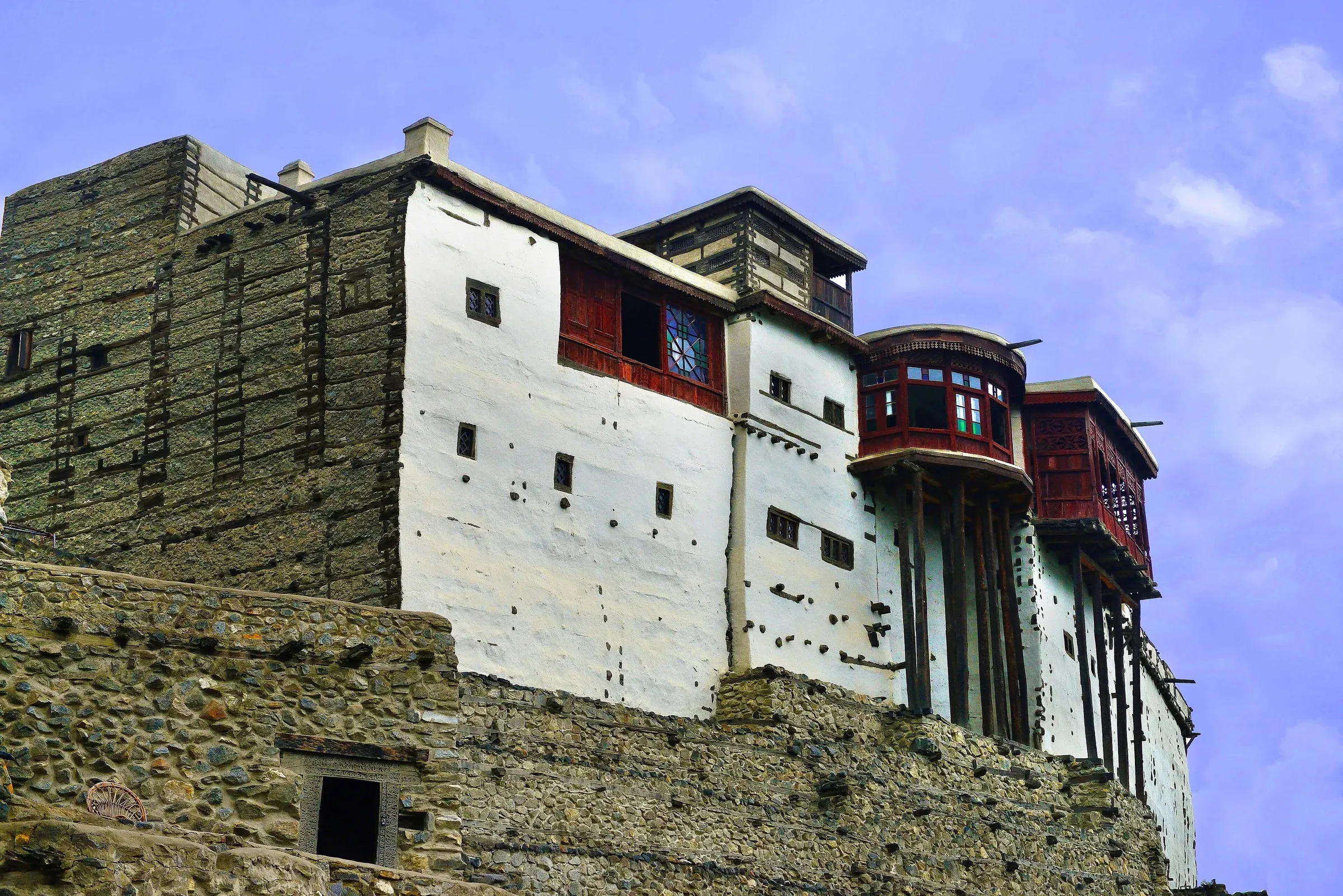
Hunza is a high valley of the Karakoram in the Gilgit-Baltistan region of northern Pakistan, on the river of the same name below the passes to Xinjiang and the Wakhan corridor. It was long a small principality ruled by hereditary Mirs from the fort at Baltit. Its population became Nizari Ismaili in the first half of the nineteenth century, and from the 1890s its rulers kept close relations with Aga Khan III. Hunza is the best documented of the mountain Ismaili communities of the old frontier between British India, Afghanistan, China and Russian Central Asia.1
Land and language
The people of Hunza call themselves Burusho and speak Burushaski. The Encyclopaedia Iranica describes two main varieties: the closely related dialects of Hunza and neighbouring Nagar, perhaps spoken by as many as 80,000 people, and that of Yasin northwest of Gilgit, spoken by about 10,000. The grammar of Burushaski has been compared with the Caucasian languages and with Basque, but no genetic relationship with any other language has been proved. The name of the Burusho may appear in a Khotanese travel report of probably the tenth century. The language has absorbed loanwords from Shina, Khowar, Turkic, Tibetan and, through Urdu, Persian.2
Conversion
Daftary dates the Ismaili conversion of Hunza to the early nineteenth century. Mir Salim Khan (d. 1239 AH/1823 CE) was the first ruler to adopt Nizari Ismailism. Under his son and successor Mir Ghazanfar, the whole population was converted by da’is from Badakhshan, who also trained local khalifas to teach the new converts. The Ismailis of Hunza called themselves Mawla’is, as followers of the Imam addressed as Mawla. Mir Nazim Khan’s autobiography gives the dynasty’s own account: the people were first idolaters, became Shi’is through marriages with the ruling family of Baltistan, and became Mawla’i in the reign of his great-grandfather Shah Salim Khan.3
The religious life of Hunza remained tied to Badakhshan. Daftary notes that the Nizaris of Hunza keep a selection of the Ismaili texts preserved by their co-religionists in Badakhshan, and observe similar rituals. Religious leadership lay with the khalifas, while the Mir held political authority. See The Ismailis of Central Asia.4
The British conquest of 1891
In the nineteenth century the Mirs balanced between Kashmir, China and the British. Nazim Khan recalls a pony taken by his father in a raid on Ladakh. His brother Safdar Ali told the British that he held a jagir in Yarkand, that Hunza had long exchanged annual presents with the Chinese, and that the two shared rights in the Raskam valley. In 1885-86 Colonel William Lockhart sought passage through Hunza towards the Wakhjir pass, and the young Nazim Khan went to Gilgit as a guarantor of the party’s safety. Nazim Khan describes the rise of Russian interest in the Pamirs and a Russian officer’s warning that Hunza would become Russian territory if a Russian post were established before the British arrived. In 1891 his eldest brother, Mir Safdar Ali, refused to let a letter from the British agent Colonel Algernon Durand pass through Hunza to Kashgar. Durand then mounted an expedition against Hunza and Nagar. Daftary records that Hunza, with Nagar, Chitral and neighbouring districts, was annexed to British India in 1891.5
After the campaign the British installed Nazim Khan as Mir. His autobiography describes the ceremony: a British officer, Major Robertson, read the sanad, placed him on the throne and invested him with a robe while guns were fired. Chinese envoys who attended were not permitted to give him presents. He ruled as a feudatory under the British Gilgit Agency, and his autobiography records his reforms of marriage custom: unions between close relatives were forbidden and child marriage discouraged.6
Hunza and the Aga Khans
Daftary records that Aga Khan III established close relations with the Mirs of Hunza. Nazim Khan’s autobiography describes meeting the Aga Khan at a durbar in Delhi, where the Imam asked to see him the following day. On another occasion he went with the ruler of Nagar and a Mawla’i pir to the Aga Khan’s camp in Delhi to present the tribute collected from Hunza, Yasin and Punial. The Imam’s emissary Pir Sabz Ali visited Hunza and set up jamatkhanas there in 1923, during the mission that also reached Badakhshan.7
In his memoirs Aga Khan III listed the Ismailis of the Indian frontier among his followers and set out the principle that their spiritual allegiance to the Imam did not affect their temporal allegiance to the states in which they lived. Hunza illustrates the point. Its ruler was a vassal of Kashmir and the British Crown; in 1935 Nazim Khan received a medal at the celebration of George V’s Silver Jubilee in Gilgit.8
Hunza and Badakhshan
The autobiography shows how closely Hunza’s affairs were tied to those of Badakhshan across the passes. Nazim Khan describes the overthrow of Sultan Murad of Badakhshan with the help of Abd al-Rahman and Kabuli forces, and the tyranny of Mir Alam, whom Abd al-Rahman then installed, which drove Badakhshani princes to take refuge in Gilgit by way of Yasin. Such refugees, traders and falconers moved between the valleys. The Hunza Ismailis also received their religious teachers from Badakhshan. For the later history of the region under Aga Khan IV see The Aga Khan Development Network.9
Hunza therefore connects several histories told on this site: the Persian-language Ismailism of Badakhshan and Khorog, the frontier politics of the British Raj, and the Imamat’s relations with the mountain communities described in The Ismailis of Central Asia.10
Footnotes
-
Farhad Daftary, The Isma’ilis: Their History and Doctrines, 2nd ed. (Cambridge University Press, 2007), pp. 495-496, https://archive.org/details/bk692. ↩
-
Georg Buddruss, “Burushaski”, Encyclopaedia Iranica, https://www.iranicaonline.org/articles/burushaski-language-spoken-in-hunza-karakorum-north-pakistan; Daftary, The Isma’ilis, p. 495. ↩
-
Daftary, The Isma’ilis, p. 495; Mohammad Nazim Khan, The Autobiography of Sir Mohomed Nazim Khan, Mir of Hunza, chapter “Some legends and some facts about my country”. ↩
-
Daftary, The Isma’ilis, pp. 495-496. ↩
-
Nazim Khan, Autobiography, chapters II-III and the chapter on the 1891 campaign; Daftary, The Isma’ilis, p. 495. ↩
-
Nazim Khan, Autobiography, chapter on his installation as Mir and chapter “Some legends and some facts about my country”. ↩
-
Daftary, The Isma’ilis, pp. 495-496; Nazim Khan, Autobiography, chapter on the Delhi durbar. ↩
-
Aga Khan III, The Memoirs of Aga Khan: World Enough and Time (London: Cassell, 1954), pp. 32-33, https://archive.org/details/memoirsofagakhan00agak; Nazim Khan, Autobiography, entry for 1935. ↩
-
Nazim Khan, Autobiography, chapter I; Daftary, The Isma’ilis, p. 495. ↩
-
Daftary, The Isma’ilis, pp. 495-496, 503. ↩