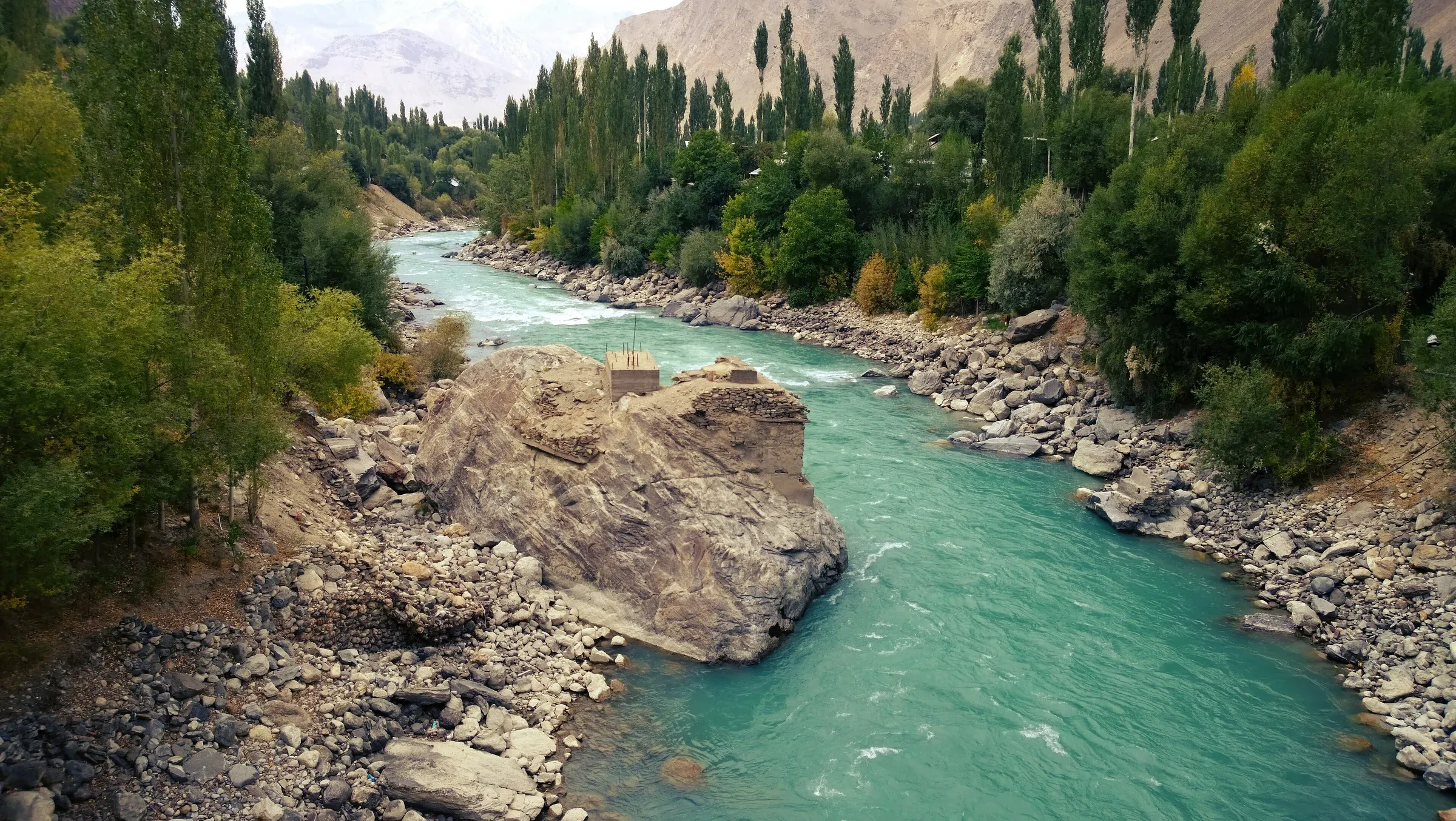
The Nizari Ismailis of Central Asia live mainly in Badakhshan, the mountain region of the upper Amu Darya (Oxus). Since 1895 the Panj river has divided it between Tajikistan to the north and east and Afghanistan to the south and west. Smaller communities live in the northern areas of Pakistan, including Hunza, and in the Tashkurgan region of Xinjiang in China. Isolated by geography and, after 1925, by Soviet rule, these communities developed their own religious literature, rituals and leadership. In Soviet Tajikistan they were cut off from their Imam for almost seventy years, until the Soviet Union dissolved in 1991.1
Peoples and languages
Iranica’s geographical survey describes the Pamir peoples, called Ghalcha by their Tajik neighbours, as speakers of several East Iranian languages. Speakers of Shughni in the Gunt valley and around Khorog, of Rushani on the Panj, and of Bartangi make up about three-quarters of the Pamir population on the former Soviet side. The Wakhi of the Wakhan valley account for about a fifth, roughly half of them in Afghanistan. Smaller groups speak Yazghulami, Ishkashimi, Sanglechi and Munji. None of these languages had an established written form, and the language of learning and religion was Persian, written as Tajik in Cyrillic script in the Soviet period.2
Most Pamir peoples follow Nizari Ismaili Shi’ism. Iranica records the local tradition that their ancestors were converted by the poet and da’i Nasir Khusraw (1004-c.1072). It also notes that the Wanji and Yazghulami peoples became Sunni at the end of the nineteenth century, and that a small part of the Bartang population is Sunni. Daftary adds that the Ismailis of Badakhshan make up most of the Ismailis of Afghanistan and Central Asia.3
Nasir Khusraw and the local tradition
Nasir Khusraw spent the last fifteen years or more of his life in exile at Yumgan, a valley of the Kokcha, a tributary of the Amu Darya. There he wrote most of his poetry and prose, including the Jami’ al-hikmatayn, completed in 1070 (462 AH) for his protector, the local amir Ali ibn al-Asad. The Ismailis of Badakhshan call him Pir or Shah Sayyid Nasir and regard him as the founder of their community. The Ismailis of Hunza and the other communities that grew from Badakhshan share this tradition.4
Out of regular contact with their Imams for long periods, the Central Asian Ismailis were led by their own khalifas, learned members of the community who also performed religious ceremonies. Daftary describes a literary tradition centred on the writings attributed to Nasir Khusraw. It is marked by local rites such as the Chiragh-i rawshan, the lighting of a lamp for the dead, and by madahs, devotional poems in praise of Ali ibn Abi Talib. The community kept its manuscripts secretly in private hands.5
Pirs, dues and the Imam in Bombay
In the nineteenth century, contact with the Imam in Bombay was maintained through hereditary pirs. Straub’s study of the Afghan Pamirs records that these pirs represented the Aga Khan in the region and collected annual dues on his behalf. He cites British reports that the people of Wakhan, Shughnan, Rushan, Chitral, Munjan and Sanglich sent a tenth of their produce each year. The British Historical and Political Gazetteer of Afghanistan counted the inhabitants of Ishkashim, Munjan and Kuran among the Aga Khan’s followers. Straub argues that these networks of representatives maintained communal cohesion across the borders later imposed on the region.6
Aga Khan III included these communities among his followers. In his memoirs he lists “Chinese Turkestan” and “Russian Central Asia”, along with Afghanistan, Persia and Syria, as places where his followers lived. He drew a distinction between their spiritual loyalty to the Imam and their political allegiance to the states they lived in.7
The 1895 border
During the nineteenth century the northern part of Badakhshan was absorbed into Central Asian khanates, and the region became a meeting point between Russian and British imperial interests. Straub traces the dispute to the Granville-Gorchakov agreement of 1873, which set the Amu Darya as the line between Russian and Afghan territory but left the status of its upper tributaries unclear. In 1883 the Afghan emir overthrew the ruling houses of Shughnan, Wakhan and Zebak, and in the following decade their elites were destroyed in a series of conflicts with Kabul.8
In 1895 an Anglo-Russian boundary commission assigned the right bank of the Panj to the Khanate of Bukhara, then a Russian protectorate, and the left bank to Afghanistan, with Faydabad as its chief town. The emir of Afghanistan reluctantly accepted the Wakhan corridor, a strip of territory reaching to the Qing border. Ismaili communities that had shared rulers and ties of marriage on both banks of the river were now under two states.9
Russian scholars and the manuscripts
The 1895 border opened the Russian side to travellers and scholars. Count Alexis Bobrinskoy visited Wakhan and Ishkashim in 1898 and published an account of their Ismailis in 1902. In the same year A. Polovtsev, an official in Turkistan, acquired a copy of the Umm al-kitab and deposited it in the Asiatic Museum in St Petersburg. Aleksandr Semenov first visited the Shughni Ismailis in 1901. Ivan Zarubin collected manuscripts in Shughnan and Rushan in 1914. Daftary notes that the Zarubin and Semenov collections, with fewer than twenty genuine items between them, were then the largest holding of Ismaili manuscripts in any Western library.10
Soviet rule, 1925-1991
Daftary writes that Aga Khan III found it difficult to stay in direct contact with Badakhshan, and that the difficulty grew sharply after Central Asia was incorporated into the Soviet Union. His last contact was probably in 1923, through his emissary Pir Sabz Ali (d. 1938), a Khoja dignitary. Mostowlansky records that Pir Sabz Ali travelled from Bombay through territories now in Afghanistan, China, Pakistan and Tajikistan. Many Pamiris still remember his message from the Imam not to resist the Russians but to engage productively with Soviet rule.11
In 1925 the Soviet government created the Autonomous Region of Gorno-Badakhshan, with its capital at Khorog, as part of Tajikistan. Iranica comments that the region was intended to recognise the ethnic and religious distinctiveness of the Pamir peoples. In the early 1930s a strategic road, the Pamir Highway, was built to connect Khorog with Osh in the Ferghana valley. From the 1960s the region received subsidised supplies, which local people called “Moscow provisioning”. Until 1991, however, the Ismailis of Tajikistan were entirely cut off from their Imam and could not practise their faith openly under Soviet anti-religious policy.12
Some of the hidden tradition nonetheless survived and became known. Daftary records that hundreds of manuscripts held privately by Ismailis in Tajik Badakhshan were recovered between 1959 and 1963. In the 1990s many more were identified in Shughnan and other districts through the work of the Institute of Ismaili Studies, founded in London in 1977. The Institute now holds the largest collection of Ismaili manuscripts in the West.13
Independence and civil war
Tajikistan became independent in 1991 and fell into civil war from 1992 to 1997. Mostowlansky describes how regional identities became politicised in the last Soviet years, and how the La’li Badakhshan (“Ruby of Badakhshan”) movement proposed an autonomous future for the region. In the 1991 presidential election, opponents attacked Davlat Khudonazarov, a Pamiri Ismaili candidate, as a Badakhshani “infidel”. During the war, people were killed because of their regional origin and their faith.14
Because most of the population of Gorno-Badakhshan was Ismaili, the region’s suffering became an immediate priority for the Aga Khan Development Network. In 1993 the Aga Khan Foundation set up the Pamir Relief and Development Programme. In 1997 it became the Mountain Societies Development Support Programme, as its work extended to the Rasht valley and Khatlon. Mostowlansky reports that Pamiris and Kyrgyz along the highway both regarded the food and heating fuel supplied from 1993 as having secured their survival. The aid was also distributed to non-Ismailis.15
Contact with the Imam restored
Daftary, who was present, records that around 200,000 Nizaris in Tajikistan saw their Imam for the first time in 1995, when Aga Khan IV visited Badakhshan. By then, in his assessment, the Pamir relief programme had saved the region from “certain economic catastrophe”. He describes how Ismailis who had been “severely repressed under the Soviet regime” gathered in tens of thousands to renew their allegiance.16
The council system set out in the 1986 constitution was not at first extended to Tajikistan. Daftary records that since the early 1990s the community there has been administered through special committees. In 2000 Aga Khan IV founded the University of Central Asia in Khorog, with campuses in other Central Asian republics, to support the mountain societies of the region and their cultural heritage.17
Afghanistan, China and Pakistan
The Ismailis on the Afghan side of the Panj, in Shughnan, Wakhan and Ishkashim, shared the language and religious tradition of their neighbours in Tajikistan. Straub notes that they lived on the edge of the Afghan state and had more in common with communities across the border than with other Afghans. Afghanistan closed its borders with the Soviet Union and China in the 1940s, isolating these communities. Straub also counts the Ismailis of Sarikol in Xinjiang and of Hunza among the followers of the Aga Khan in the region. In Hunza, Nizari Ismailism was reintroduced from Badakhshan in the early nineteenth century. Their twentieth-century history under Chinese and British, later Pakistani, rule is treated in the page on Hunza.18
Footnotes
-
Farhad Daftary, The Isma’ilis: Their History and Doctrines, 2nd ed. (Cambridge University Press, 2007), pp. 494-495, https://archive.org/details/bk692. ↩
-
“Badakhshan i. Geography and Ethnography”, Encyclopaedia Iranica, III/4, section on ethnography, https://www.iranicaonline.org/articles/badaksan/bada%E1%B8%B5san-i-geography-and-ethnography/. ↩
-
“Badakhshan i. Geography and Ethnography”, Encyclopaedia Iranica, section on ethnography; Daftary, The Isma’ilis, p. 495. ↩
-
Daftary, The Isma’ilis, pp. 206-208. ↩
-
Daftary, The Isma’ilis, pp. 494-495. ↩
-
David Straub, “The Ismailis and Kirghiz of the Upper Amu Darya and Pamirs in Afghanistan: A Micro-History of Delineating International Borders” (MA thesis, Indiana University, 2013), introduction and ch. 1, section on confessional ties. ↩
-
Aga Khan III, The Memoirs of Aga Khan: World Enough and Time (London: Cassell, 1954), pp. 32-33, https://archive.org/details/memoirsofagakhan00agak. ↩
-
Daftary, The Isma’ilis, p. 495; Straub, “The Ismailis and Kirghiz”, introduction. ↩
-
Daftary, The Isma’ilis, pp. 28, 495; Straub, “The Ismailis and Kirghiz”, abstract and introduction. ↩
-
Daftary, The Isma’ilis, pp. 28-29. ↩
-
Daftary, The Isma’ilis, p. 495; Till Mostowlansky, Azan on the Moon: Entangling Modernity along Tajikistan’s Pamir Highway (University of Pittsburgh Press, 2017), pp. 110-111. ↩
-
Daftary, The Isma’ilis, p. 495; “Badakhshan i. Geography and Ethnography”, Encyclopaedia Iranica, introduction and section on modern economy; Mostowlansky, Azan on the Moon, prologue and ch. 2. ↩
-
Daftary, The Isma’ilis, pp. 29-30. ↩
-
Mostowlansky, Azan on the Moon, p. 109. ↩
-
Mostowlansky, Azan on the Moon, pp. 109-110. ↩
-
Daftary, The Isma’ilis, p. 502. ↩
-
Daftary, The Isma’ilis, pp. 502-503. ↩
-
Straub, “The Ismailis and Kirghiz”, abstract and introduction, ch. 1; Daftary, The Isma’ilis, pp. 494-495. ↩