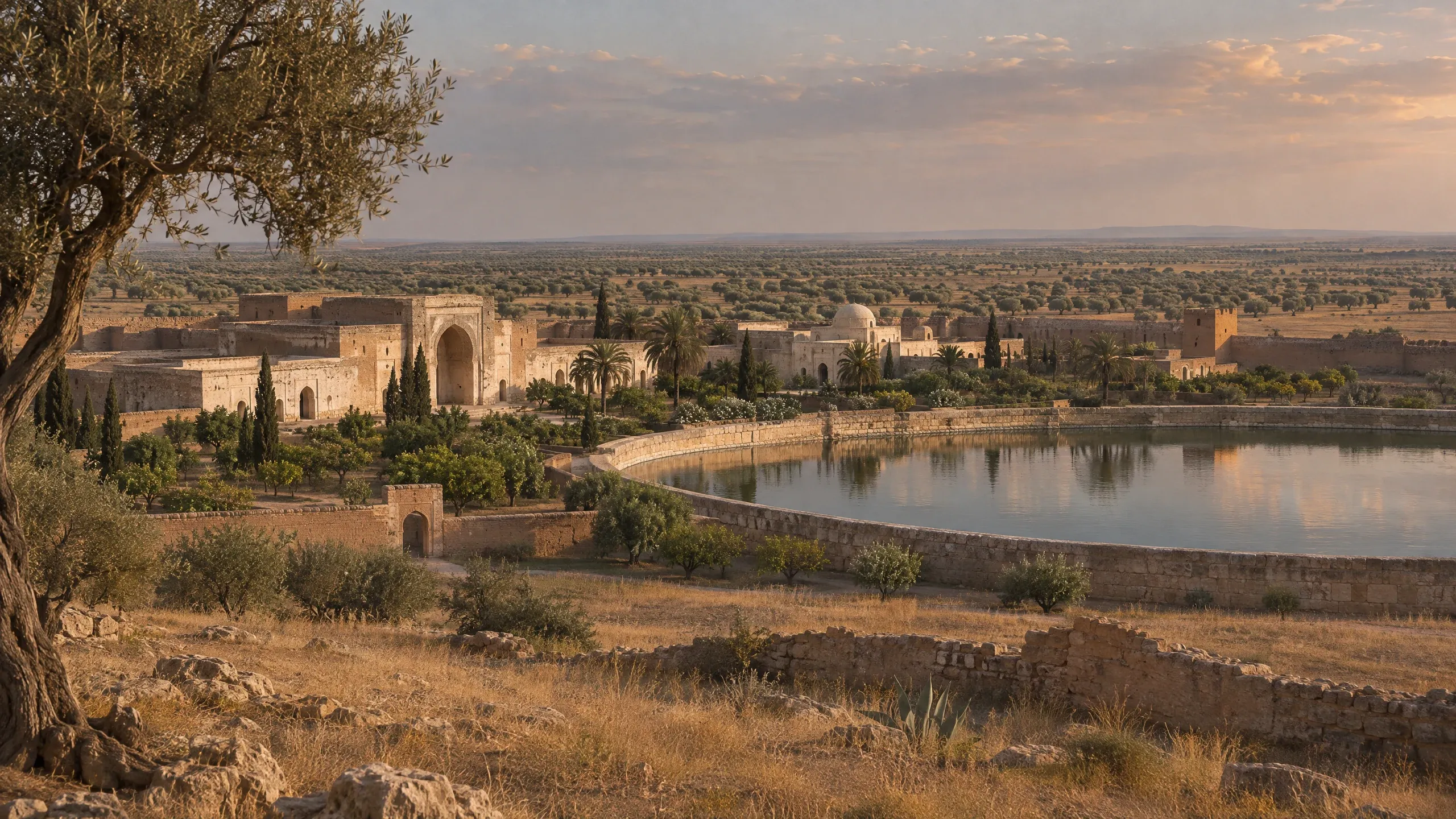
Raqqada was a palace city built by the Aghlabid amirs a few kilometres south of Qayrawan, the old capital of Ifriqiya. In March 909 the Kutama army of the da’i Abu Abd Allah al-Shi’i occupied it when the last Aghlabid fled, and on 4 January 910 Abd Allah al-Mahdi entered it as caliph. It was the first seat of the Fatimid state until the court moved to Mahdiya in 921.123
The Aghlabid palace city
The Aghlabids, who governed Ifriqiya for the Abbasids, built residences away from Qayrawan. Ibrahim I founded al-Abbasiyya in 800, about four miles south of the city; Raqqada followed in 876, built on land used as a country retreat, with many palaces and several water basins.4 Fenwick lists Raqqada among at least nine Muslim capitals built and later abandoned in North Africa between 700 and 1050.5
Medieval texts describe at least five royal palaces with gardens, a congregational mosque, baths, markets, caravanserais and barracks for the 10,000 enslaved Sudanese soldiers with whom Ibrahim II is said to have surrounded himself. Fenwick compares this layout of scattered palaces, gardens and barracks to the Abbasid palace city of Samarra in Iraq, and notes that it was later mirrored at Fatimid Mansuriyya and at the Hammadid Qal’a.6
Archaeology
Excavations in the 1960s by Mahmud Chabbi uncovered only a small part of the site: a square fortified complex of about 109 rooms with courtyards and annexes, interpreted as a palace and probably the Qasr al-Sahn, together with a large reservoir and a brick kiln. The complex was built of rammed earth in three phases and resembles the Umayyad desert castles of Syria and Iraq.6 Raqqada also gave its name to a distinctive ware: the mustard-yellow lead-glazed ceramics known as jaune de Raqqada, made at the palace site from the late ninth century, at the same time as glazed wares appeared in Sicily and al-Andalus.7
The Fatimid conquest
By 296/909 the Kutama had taken the towns of the western and southern frontier of the Aghlabid state, including Qafsa, Qastiliya and al-Urbus. The amir Ziyadat Allah III abandoned Raqqada and fled to Egypt.1 On 1 Rajab 296/25 March 909 Abu Abd Allah entered Raqqada.18 He governed in the name of the still-absent Imam: the Shi’i call to prayer was introduced and coins were struck naming the hujjat Allah, the “proof of God”, without giving his name.1
Abu Abd Allah then marched west to free al-Mahdi from detention at Sijilmasa, where the Imam was acclaimed caliph in August 909.28
The proclamation of the caliphate
Al-Mahdi entered Raqqada on 20 Rabi’ II 297/4 January 910. The next day, Friday 21 Rabi’ II/5 January, the khutba in all the mosques of Qayrawan was read in the name of Abu Muhammad Abd Allah, al-imam al-mahdi bi’llah, amir al-mu’minin, and a manifesto announced that the caliphate had returned to the family of the Prophet.2 Raqqada thus became the setting for the first proclamation of a caliphate by an Imam of the ahl al-bayt.2
First measures of the new state
The policies announced from Raqqada set the pattern of Fatimid rule in Ifriqiya. Jurists were instructed to follow the teachings of Ja’far al-Sadiq, and the Shi’i phrase “Come to the best of works” (hayya ’ala khayr al-’amal) was added to the call to prayer. Brett stresses that Ismailism became the creed of the state and of its servants, but that there was no attempt at mass conversion of the Sunni population.29
Tension with Qayrawan
The new rulers at first benefited from a certain passivity on the part of the people of Qayrawan, but hostility soon followed. Mahfoudh notes that some pious Sunnis abandoned the frontier fortresses on the coast to oppose the new regime, and that the large number of Kutama Berbers in the city angered its inhabitants, especially the shopkeepers. In 912 fighting between the two groups killed about a thousand people, mostly Berbers.4 The same years saw the execution of Abu Abd Allah and his brother in 298/911 and a Kutama revolt in support of a rival Mahdi.10
Abandonment for Mahdiya
Mahfoudh attributes the decision to leave the Qayrawan area to the sense of insecurity in a hostile Sunni environment.11 Al-Mahdi began building Mahdiya on the coast in 300/912 and moved his capital there in 308/921.3 Raqqada remained in use; al-Mansur was born there in 301/914.12
A park beside Mansuriyya
When al-Mansur built Sabra al-Mansuriyya south-east of Qayrawan after defeating Abu Yazid, the seat of government moved there from Mahdiya. Brett records that the new palace city replaced Raqqada, a kilometre or two away, which became a park and a parade ground.13 Like the other short-lived palace cities of early medieval North Africa, Raqqada was eventually abandoned; Fenwick notes that all of these sites have since been excavated to some degree.5
Footnotes
-
Farhad Daftary, The Isma’ilis: Their History and Doctrines, 2nd ed. (Cambridge University Press, 2007), p. 127. ↩ ↩2 ↩3 ↩4
-
Farhad Daftary, The Isma’ilis: Their History and Doctrines, 2nd ed. (Cambridge University Press, 2007), p. 128. ↩ ↩2 ↩3 ↩4 ↩5
-
Farhad Daftary, The Isma’ilis: Their History and Doctrines, 2nd ed. (Cambridge University Press, 2007), p. 142. ↩ ↩2
-
F. Mahfoudh, “Kairouan”, Encyclopédie berbère, vol. 27 (Édisud, 2005), pp. 4095–4102, https://journals.openedition.org/encyclopedieberbere/1302, §§ 24–25. ↩ ↩2
-
Corisande Fenwick, “Ifriqiya and the Central Maghreb”, in The Oxford Handbook of Islamic Archaeology (Oxford University Press, 2020), author manuscript p. 9, https://discovery.ucl.ac.uk/10067414/. ↩ ↩2
-
Corisande Fenwick, “Ifriqiya and the Central Maghreb”, in The Oxford Handbook of Islamic Archaeology (Oxford University Press, 2020), author manuscript p. 10, https://discovery.ucl.ac.uk/10067414/. ↩ ↩2
-
Corisande Fenwick, “Ifriqiya and the Central Maghreb”, in The Oxford Handbook of Islamic Archaeology (Oxford University Press, 2020), author manuscript p. 16, https://discovery.ucl.ac.uk/10067414/. ↩
-
A. M. Di Tolla, “Midrār (Banū) ou Midrārides”, Encyclopédie berbère, vol. 32 (Peeters, 2010), section “Les Midrārides et le Mahdī ʿUbayd Allāh”, https://journals.openedition.org/encyclopedieberbere/599. ↩ ↩2
-
Michael Brett, “The Fatimid revolution (861–973) and its aftermath in North Africa”, in J. D. Fage (ed.), The Cambridge History of Africa, vol. 2 (Cambridge University Press, 1978), p. 603. ↩
-
Farhad Daftary, The Isma’ilis: Their History and Doctrines, 2nd ed. (Cambridge University Press, 2007), p. 141. ↩
-
F. Mahfoudh, “Kairouan”, Encyclopédie berbère, vol. 27 (Édisud, 2005), pp. 4095–4102, https://journals.openedition.org/encyclopedieberbere/1302, § 26. ↩
-
Farhad Daftary, Historical Dictionary of the Ismailis (Scarecrow Press, 2012), s.v. “al-Mansur”. ↩
-
Michael Brett, “The Fatimid revolution (861–973) and its aftermath in North Africa”, in J. D. Fage (ed.), The Cambridge History of Africa, vol. 2 (Cambridge University Press, 1978), p. 610. ↩