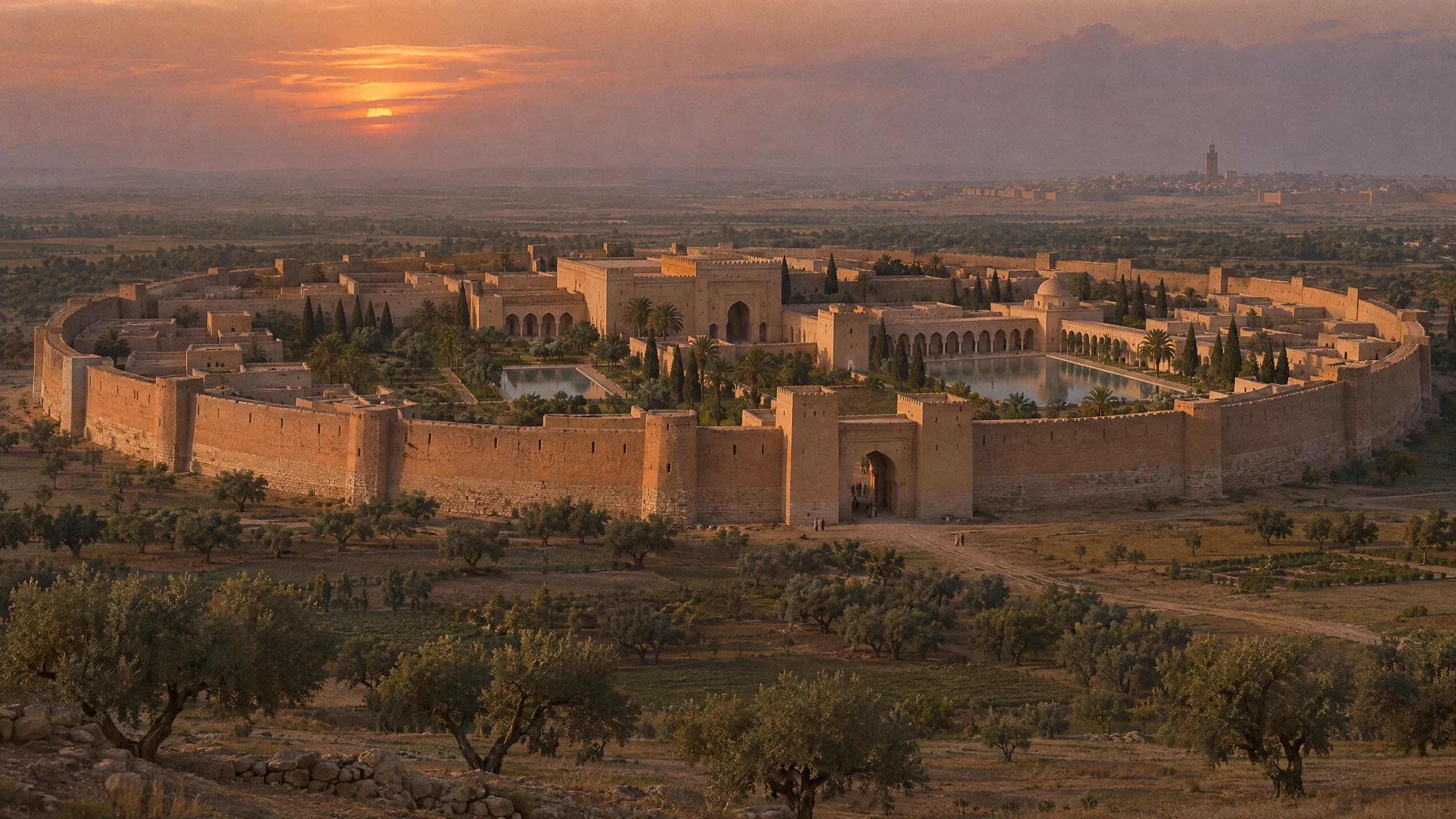
Sabra al-Mansuriyya was the second Fatimid capital in Ifriqiya, a palace city founded by the caliph al-Mansur just outside Qayrawan after his victory over the Khariji rebel Abu Yazid. It was the seat of the dynasty from 337/948 until al-Mu’izz left for Egypt, and of the Zirid rulers of Ifriqiya until 1057. Its plan, palaces and mosque served as a model for Cairo.12
Foundation
After the defeat of Abu Yazid in 336/947, al-Mansur decided to return to the region of Qayrawan and build a new princely city.31 Brett places it south-south-east of Qayrawan and records that it was called Sabra, “fortitude”, as well as al-Mansuriyya, “the city of al-Mansur”, and that it replaced Raqqada as the seat of government, transferred there from Mahdiya.4 Al-Mansur settled there in 337/948.1
Cressier and Rammah interpret the return to Qayrawan both as a gesture of conciliation towards the city’s Sunni elite and as a way of keeping the old metropolis of Ifriqiya under close control.2 Al-Mansur probably built only the walls, the central palace and the main axes of the street plan before his death in 341/953.2
Plan
The city lay a little over a kilometre south-east of Qayrawan.5 Its mud-brick wall enclosed an ellipse whose axes measured 1,350 and 1,050 metres; the line of the wall has been reconstructed largely by remote sensing and confirmed by excavation on two stretches.5 Fenwick gives the enclosed area as 111 hectares and describes the shape as an imitation of the round city of Baghdad.6 Daftary notes that excavations confirm the circular plan, and that its palaces, gates and mosque, called al-Azhar, served as a model for those of Cairo, founded in 358/969.17
The inner zone contained at least two palaces and elaborate basins with pavements in opus sectile, mosaics, stone sculpture and one of the most important collections of painted stucco with animal and human figures from the Maghrib before the eleventh century. The outer zone held houses and workshops producing glass, fine ceramics including lustreware, and jewellery.6 A kiln with lustreware wasters has been found, and glass was used for window panes in the palaces. Fenwick lists Sabra among the known glass-making centres of tenth- and eleventh-century North Africa.89
The city of al-Mu’izz
Cressier and Rammah regard al-Mu’izz as the main author of the city’s grandeur. He restored an Aghlabid aqueduct that drew water from about thirty kilometres away and diverted it to serve Sabra before Qayrawan, and he ordered the markets of Qayrawan transferred to the new city.2 Mahfoudh adds that the two cities were linked by a walled road watched by tax collectors, and that the growth of Sabra pulled the commercial centre of Qayrawan westward, leaving the Great Mosque at the eastern edge of the medina.10
From Mansuriyya al-Mu’izz directed the campaigns of Jawhar to the Atlantic in 958–960 and the preparations for the conquest of Egypt.11 Al-Qadi al-Nu’man served as judge of Mansuriyya before becoming chief judge of the state.12 The Midrarid ruler of Sijilmasa, captured by Jawhar, was brought there as a prisoner.13
After 973
Al-Mu’izz left Ifriqiya in Shawwal 361/August 972 and entered Cairo in 362/973, leaving Buluggin ibn Ziri as governor.14 Sabra was not abandoned. It remained the capital of the Zirid governors and then sultans. The Zirid al-Mu’izz ibn Badis later joined Qayrawan to Sabra with two long parallel walls in order to control all trade passing between the two cities.2 Relations with Qayrawan stayed tense: in 1016 the inhabitants of Qayrawan massacred many Shi’is, and troops from al-Mansuriyya sacked the city in reprisal.1516
Brett traces the city’s place in Zirid politics. Buluggin’s son al-Mansur moved his residence in 991 from Ashir in the central Maghrib to Sabra and Qayrawan, an attempt, in Brett’s words, “to seat the monarchy more firmly”.17 In 1015 Badis forced the shopkeepers of Qayrawan to move to the market of Sabra, where rents were high; Brett suggests that this economic grievance contributed to the anti-Ismaili riots that followed.18 When al-Mu’izz ibn Badis broke with Cairo, the only consolation of the Fatimid vizier al-Yazuri, according to Brett, was the flight of the qadi of Sabra to Egypt.19
After the defeat of the Zirid army by the Arab tribes at Haydaran, al-Mu’izz ibn Badis retreated to Sabra and concentrated the remnant of his army there while walls were hastily built around Qayrawan.20
After the Zirid al-Mu’izz ibn Badis returned to Sunnism and broke with Cairo, the Banu Hilal invaded Ifriqiya. Qayrawan fell in 1054, and in 1057 al-Mu’izz ibn Badis fled from al-Mansuriyya to Mahdiya. Mahfoudh treats this as the end of Sabra; Cressier and Rammah date its abandonment and destruction to the second half of the eleventh century, after the Hilali invasions.2122232
Excavation
Much of the site has been lost to the expansion of modern Qayrawan; Cressier and Rammah estimated in 2004 that more than half of the enclosed area was covered by modern buildings. A Franco-Tunisian programme of excavations began in 2003 under their direction.5246
Footnotes
-
Farhad Daftary, The Isma’ilis: Their History and Doctrines, 2nd ed. (Cambridge University Press, 2007), p. 147. ↩ ↩2 ↩3 ↩4
-
Patrice Cressier and Mourad Rammah, “Première campagne de fouilles à Ṣabra al-Manṣūriya (Kairouan, Tunisie)”, Mélanges de la Casa de Velázquez 34-1 (2004), pp. 401–409, https://journals.openedition.org/mcv/1241, § 5. ↩ ↩2 ↩3 ↩4 ↩5 ↩6
-
F. Mahfoudh, “Kairouan”, Encyclopédie berbère, vol. 27 (Édisud, 2005), pp. 4095–4102, https://journals.openedition.org/encyclopedieberbere/1302, § 26. ↩
-
Michael Brett, “The Fatimid revolution (861–973) and its aftermath in North Africa”, in J. D. Fage (ed.), The Cambridge History of Africa, vol. 2 (Cambridge University Press, 1978), p. 610. ↩
-
Patrice Cressier and Mourad Rammah, “Première campagne de fouilles à Ṣabra al-Manṣūriya (Kairouan, Tunisie)”, Mélanges de la Casa de Velázquez 34-1 (2004), pp. 401–409, https://journals.openedition.org/mcv/1241, § 6. ↩ ↩2 ↩3
-
Corisande Fenwick, “Ifriqiya and the Central Maghreb”, in The Oxford Handbook of Islamic Archaeology (Oxford University Press, 2020), author manuscript p. 11, https://discovery.ucl.ac.uk/10067414/. ↩ ↩2 ↩3
-
Farhad Daftary, The Isma’ilis: Their History and Doctrines, 2nd ed. (Cambridge University Press, 2007), p. 159. ↩
-
Corisande Fenwick, “Ifriqiya and the Central Maghreb”, in The Oxford Handbook of Islamic Archaeology (Oxford University Press, 2020), author manuscript p. 16, https://discovery.ucl.ac.uk/10067414/. ↩
-
Corisande Fenwick, “Ifriqiya and the Central Maghreb”, in The Oxford Handbook of Islamic Archaeology (Oxford University Press, 2020), author manuscript pp. 17–18, https://discovery.ucl.ac.uk/10067414/. ↩
-
F. Mahfoudh, “Kairouan”, Encyclopédie berbère, vol. 27 (Édisud, 2005), pp. 4095–4102, https://journals.openedition.org/encyclopedieberbere/1302, § 27. ↩
-
Farhad Daftary, The Isma’ilis: Their History and Doctrines, 2nd ed. (Cambridge University Press, 2007), p. 156. ↩
-
Farhad Daftary, The Isma’ilis: Their History and Doctrines, 2nd ed. (Cambridge University Press, 2007), p. 169. ↩
-
A. M. Di Tolla, “Midrār (Banū) ou Midrārides”, Encyclopédie berbère, vol. 32 (Peeters, 2010), section “Al-Šākir-li-llāh et l’apogée de Sijilmāsa”, https://journals.openedition.org/encyclopedieberbere/599. ↩
-
Farhad Daftary, The Isma’ilis: Their History and Doctrines, 2nd ed. (Cambridge University Press, 2007), p. 162. ↩
-
F. Mahfoudh, “Kairouan”, Encyclopédie berbère, vol. 27 (Édisud, 2005), pp. 4095–4102, https://journals.openedition.org/encyclopedieberbere/1302, § 28. ↩
-
Farhad Daftary, The Isma’ilis: Their History and Doctrines, 2nd ed. (Cambridge University Press, 2007), p. 183. ↩
-
Michael Brett, “The Fatimid revolution (861–973) and its aftermath in North Africa”, in J. D. Fage (ed.), The Cambridge History of Africa, vol. 2 (Cambridge University Press, 1978), p. 625. ↩
-
Michael Brett, “The Fatimid revolution (861–973) and its aftermath in North Africa”, in J. D. Fage (ed.), The Cambridge History of Africa, vol. 2 (Cambridge University Press, 1978), p. 630. ↩
-
Michael Brett, “The Fatimid revolution (861–973) and its aftermath in North Africa”, in J. D. Fage (ed.), The Cambridge History of Africa, vol. 2 (Cambridge University Press, 1978), p. 633. ↩
-
Michael Brett, “The Fatimid revolution (861–973) and its aftermath in North Africa”, in J. D. Fage (ed.), The Cambridge History of Africa, vol. 2 (Cambridge University Press, 1978), p. 634. ↩
-
F. Mahfoudh, “Kairouan”, Encyclopédie berbère, vol. 27 (Édisud, 2005), pp. 4095–4102, https://journals.openedition.org/encyclopedieberbere/1302, § 29. ↩
-
F. Mahfoudh, “Kairouan”, Encyclopédie berbère, vol. 27 (Édisud, 2005), pp. 4095–4102, https://journals.openedition.org/encyclopedieberbere/1302, § 30. ↩
-
Farhad Daftary, The Isma’ilis: Their History and Doctrines, 2nd ed. (Cambridge University Press, 2007), p. 202. ↩
-
Patrice Cressier and Mourad Rammah, “Première campagne de fouilles à Ṣabra al-Manṣūriya (Kairouan, Tunisie)”, Mélanges de la Casa de Velázquez 34-1 (2004), pp. 401–409, https://journals.openedition.org/mcv/1241, §§ 1–4. ↩