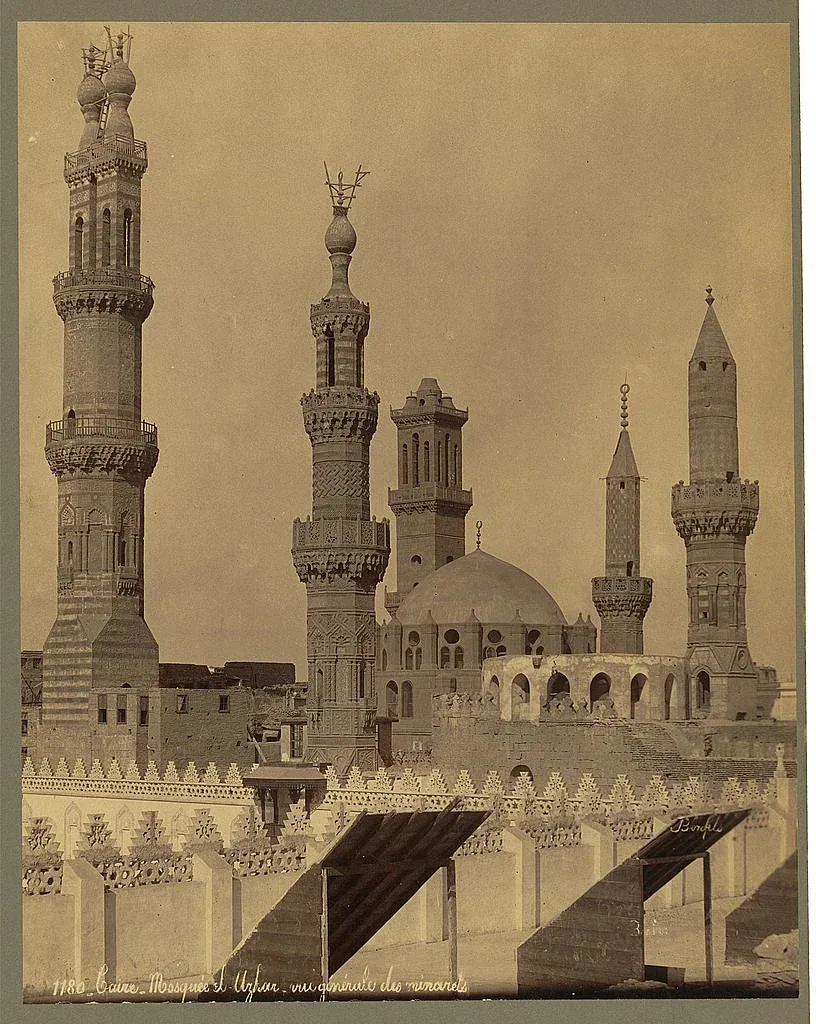
Al-Azhar, founded by Jawhar in 359/970 as the congregational mosque of the new Fatimid city of Cairo, is often described as the oldest continuously operating university in the world.12 This page traces what the Fatimid sources say about the mosque as a place of teaching between 970 and 1171; the building itself is described under al-Azhar Mosque.
Two scholarly readings frame the subject. Daftary records that al-Azhar became a university in 378/988–989 and that Ismaili scholars, jurists and students took part constantly in its seminars throughout the Fatimid period.1 Walker, re-examining the chronicles, argues that al-Azhar was an important congregational mosque but never a university in the Fatimid period, and was a teaching institution for law only during a relatively short period.34
The congregational mosque
Al-Azhar was completed two years after its foundation and was in use before al-Mu’izz entered Cairo in 362/973.1 Britannica dates the opening of its doors to 972.5 It was the chief mosque of the royal city, where the Friday khutba was pronounced in the name of the Imam-caliph.1
The Friday sessions on law
The Fatimids taught Ismaili law publicly. Al-Qadi al-Nu’man began Friday sessions on law after the midday prayer in Ifriqiya, reading from his Da’a’im al-Islam, and after his death the sessions continued in the great mosques of Cairo, including al-Azhar, Amr and al-Hakim.6 In 365/975 his son Ali ibn al-Nu’man lectured at al-Azhar to large audiences from a text composed by his father.6
Walker notes that in the reigns of al-Aziz and al-Hakim the judiciary worked mainly from Fustat and the old mosque of Amr, so the da’i had to travel some hours to Cairo for the weekly Ismaili sessions. These were normally held on Thursdays and Fridays in the palace and at al-Azhar, with separate assemblies for men and women.7 Many chief qadis were also chief da’is, and five descendants of al-Nu’man held both offices.7
Ibn Killis’s college of 378/988
The basis for the claim that al-Azhar became a university is a report in al-Maqrizi’s Khitat. In 378/988 the vizier Ya’qub ibn Killis asked al-Aziz for funds to pay stipends to a group of jurists (fuqaha’). They were to acquire and renovate a house near al-Azhar, gather at the mosque on Fridays and hold a study circle (halqa) from the noon prayer until the afternoon prayer, and receive an annual grant from the vizier’s funds. There were thirty-five of them.89
Al-Qalqashandi, citing the contemporary historian al-Musabbihi, confirms the report, adds that they discussed fiqh, and names their head as Abu Ya’qub, qadi of al-Khandaq.9 Walker accepts the report and calls it a residential college for law associated with al-Azhar, but notes that the sources say nothing about which fiqh was taught and record no endowment to perpetuate it.9
Ibn Killis was himself a jurist. Daftary notes that he was an expert in Ismaili law and wrote a treatise based on the pronouncements of al-Mu’izz and al-Aziz.10 Walker records that the treatise, al-Risala al-waziriyya, and a summary of it formed, with the Da’a’im, the essentials of Fatimid fiqh, and that under al-Zahir there was a brief attempt to require everyone to memorise both.11 Ibn Killis also held sessions for jurists in his own house and kept many scholars on his payroll; Walker suggests that his private patronage and public office were easily confused.912
After Ibn Killis
Ibn Killis died in 380/991, two years after creating the college. References to his jurists in ceremonies at al-Azhar continue for three years and then stop; Walker presumes that the funding, largely his own, ran out.13 New congregational mosques, which often received greater caliphal attention, further reduced al-Azhar’s role.13
When al-Hakim endowed favoured institutions in 400/1010, the beneficiaries were al-Azhar, the mosques of Rashida and al-Maqs, and the new Dar al-’Ilm. The terms for al-Azhar, preserved by al-Maqrizi, make no provision for legal scholars, and Walker finds no further evidence of its use as a law college.13
Sessions for women
Al-Azhar did keep one distinctive teaching role. Daftary records that by al-Hakim’s time the majalis al-hikma, the instructional sessions of the da’wa, were organised for different audiences: initiates, courtiers and palace staff. A separate session for women was held at al-Azhar, while royal and noble women were taught in the palace.14 Walker likewise notes that in the list of venues for these sessions al-Azhar was the place of the public sessions for women.13
The esoteric majalis al-hikma themselves were held in a special hall of the palace for initiates, with lectures approved in advance by the Imam.14 Walker stresses that these sessions had no fixed location: as many as five might be held in one week in different places for different audiences, and they were repeated in other cities and mosques.15
Crowds and sessions under al-Hakim
Walker describes the first decades of Fatimid rule in Egypt as the high point of these sessions. Under the chief da’i and qadi al-Fariqi in the first half of al-Hakim’s reign, as many as five sessions were held each week, each for a different audience: commoners, women of the palace, the elite, outsiders and others.7 A historian reports that in 385/995 the crowds at one session were so large that eleven men were crushed to death, and a similar report from 395/1004–1005 again mentions deaths in the throng.7
In this period the major books of al-Nu’man, especially the Da’a’im al-Islam or an abridgement of it, were read in these sessions, and together with Ibn Killis’s legal treatise they formed something like a course in Fatimid law.711 Walker thinks it more likely, however, that each chief da’i used a mixture of materials and wrote some of his own lectures. Druze records cite numbered lectures by Abd al-Aziz ibn Muhammad ibn al-Nu’man and al-Fariqi, chief qadis and da’is from 394 to 398 and from 398 to 405 respectively.11
The lectures were written out and submitted to the Imam for inspection and signature. When the copy was read to the faithful, the written text itself was treated with reverence, and touching it or being touched with it formed part of the ceremony.16
Written majalis
The word majlis referred both to the session and to the lecture read at it.16 Three major collections survive: the eight hundred majalis of al-Mu’ayyad al-Shirazi, chief da’i from 450/1058 to 470/1078; the al-Majalis al-Mustansiriyya of the same period, which S. M. Stern attributed to the qadi al-Maliji; and a collection by Abu’l-Barakat, chief da’i under al-Amir.15 Walker notes that al-Mu’ayyad also wrote lectures for others, including the vizier al-Yazuri when he held the office of chief da’i.15
Other mosques of Cairo
Al-Azhar was not the only Fatimid congregational mosque. The Friday law sessions were also held at the old mosque of Amr in Fustat and at the mosque of al-Hakim, and al-Hakim’s endowment of 400/1010 also benefited the mosques of Rashida and al-Maqs.613 Sanders notes that the Fatimid Imam was described as an emanation of divine light, and that new mosques in Cairo received names evoking that light: al-Anwar, “the most luminous”, the second name of the mosque of al-Hakim, and al-Aqmar, “the moonlit”, built in 519/1125.17
The end of Fatimid teaching
Because of its role in spreading Ismaili doctrine, al-Azhar met the hostility of the Ayyubids after the fall of the dynasty.1 Walker cites al-Maqrizi’s statement that only when Saladin abolished the Shi’i legal school and replaced it with the Shafi’i “did the majlis al-da’wa in the Azhar mosque and the others cease”.8 Britannica records that Saladin suspended the Friday prayer and teaching at al-Azhar for nearly a century, until the Mamluks revived it as a centre of Sunni scholarship.5
The “university” debate
Walker’s essay opens with a criticism of what he calls a kind of boosterism that has made al-Azhar under the Fatimids a mythic prototype of the madrasa, or even of the modern university.2 He argues that the legend obscures the real evidence for Fatimid educational policy, and notes that, with few exceptions, Ismaili scholars are not known to have had any connection with al-Azhar as an institution of learning.2
He identifies a recurring confusion in both medieval and modern accounts, which merge al-Azhar, the Dar al-’Ilm, the majalis al-hikma and the palace libraries into one institution, although each had its own origin, function and history.4 In his view the myth rests on a single report, the college of Ibn Killis, which may not have outlasted its founder.4
Britannica also notes that in its early history the institution had no entrance requirements, formal curriculum or degrees.5 Daftary’s account, by contrast, emphasises continuity: from 378/988 al-Azhar was a seat of Ismaili learning whose seminars engaged Ismaili scholars throughout the Fatimid period.1 The difference reflects how “university” is defined and how much weight the single report of 378 can bear.
Later history
The Mamluks made al-Azhar one of the most revered centres of Sunni learning, and under the Ottomans it became the pre-eminent institution of Islamic education, with the office of the shaykh of al-Azhar.5 Britannica describes it today as the foremost institution of Sunni scholarship.5 The Fatimid mosque survives at its core in the historic centre of Cairo.5
Footnotes
-
Farhad Daftary, The Isma’ilis: Their History and Doctrines, 2nd ed. (Cambridge University Press, 2007), p. 159. ↩ ↩2 ↩3 ↩4 ↩5 ↩6
-
Paul E. Walker, “Fatimid Institutions of Learning”, in Fatimid History and Ismaili Doctrine (Ashgate Variorum, 2008), essay I; first published in Journal of the American Research Center in Egypt 34 (1997), p. 1. ↩ ↩2 ↩3
-
Paul E. Walker, “Fatimid Institutions of Learning”, in Fatimid History and Ismaili Doctrine (Ashgate Variorum, 2008), essay I; first published in Journal of the American Research Center in Egypt 34 (1997), p. 2. ↩
-
Paul E. Walker, “Fatimid Institutions of Learning”, in Fatimid History and Ismaili Doctrine (Ashgate Variorum, 2008), essay I; first published in Journal of the American Research Center in Egypt 34 (1997), p. 40. ↩ ↩2 ↩3
-
“Al-Azhar University”, Encyclopaedia Britannica, https://www.britannica.com/topic/al-Azhar-University. ↩ ↩2 ↩3 ↩4 ↩5 ↩6
-
Farhad Daftary, The Isma’ilis: Their History and Doctrines, 2nd ed. (Cambridge University Press, 2007), p. 214. ↩ ↩2 ↩3
-
Paul E. Walker, “Fatimid Institutions of Learning”, in Fatimid History and Ismaili Doctrine (Ashgate Variorum, 2008), essay I; first published in Journal of the American Research Center in Egypt 34 (1997), p. 11. ↩ ↩2 ↩3 ↩4 ↩5
-
Paul E. Walker, “Fatimid Institutions of Learning”, in Fatimid History and Ismaili Doctrine (Ashgate Variorum, 2008), essay I; first published in Journal of the American Research Center in Egypt 34 (1997), p. 15. ↩ ↩2
-
Paul E. Walker, “Fatimid Institutions of Learning”, in Fatimid History and Ismaili Doctrine (Ashgate Variorum, 2008), essay I; first published in Journal of the American Research Center in Egypt 34 (1997), p. 16. ↩ ↩2 ↩3 ↩4
-
Farhad Daftary, The Isma’ilis: Their History and Doctrines, 2nd ed. (Cambridge University Press, 2007), p. 177. ↩
-
Paul E. Walker, “Fatimid Institutions of Learning”, in Fatimid History and Ismaili Doctrine (Ashgate Variorum, 2008), essay I; first published in Journal of the American Research Center in Egypt 34 (1997), p. 12. ↩ ↩2 ↩3
-
Paul E. Walker, “Fatimid Institutions of Learning”, in Fatimid History and Ismaili Doctrine (Ashgate Variorum, 2008), essay I; first published in Journal of the American Research Center in Egypt 34 (1997), p. 17. ↩
-
Paul E. Walker, “Fatimid Institutions of Learning”, in Fatimid History and Ismaili Doctrine (Ashgate Variorum, 2008), essay I; first published in Journal of the American Research Center in Egypt 34 (1997), p. 18. ↩ ↩2 ↩3 ↩4 ↩5
-
Farhad Daftary, The Isma’ilis: Their History and Doctrines, 2nd ed. (Cambridge University Press, 2007), p. 215. ↩ ↩2
-
Paul E. Walker, “Fatimid Institutions of Learning”, in Fatimid History and Ismaili Doctrine (Ashgate Variorum, 2008), essay I; first published in Journal of the American Research Center in Egypt 34 (1997), p. 14. ↩ ↩2 ↩3
-
Paul E. Walker, “Fatimid Institutions of Learning”, in Fatimid History and Ismaili Doctrine (Ashgate Variorum, 2008), essay I; first published in Journal of the American Research Center in Egypt 34 (1997), p. 13. ↩ ↩2
-
Paula A. Sanders, “The Fatimid state, 969–1171”, in Carl F. Petry (ed.), The Cambridge History of Egypt, vol. 1 (Cambridge University Press, 1998), pp. 172–173. ↩