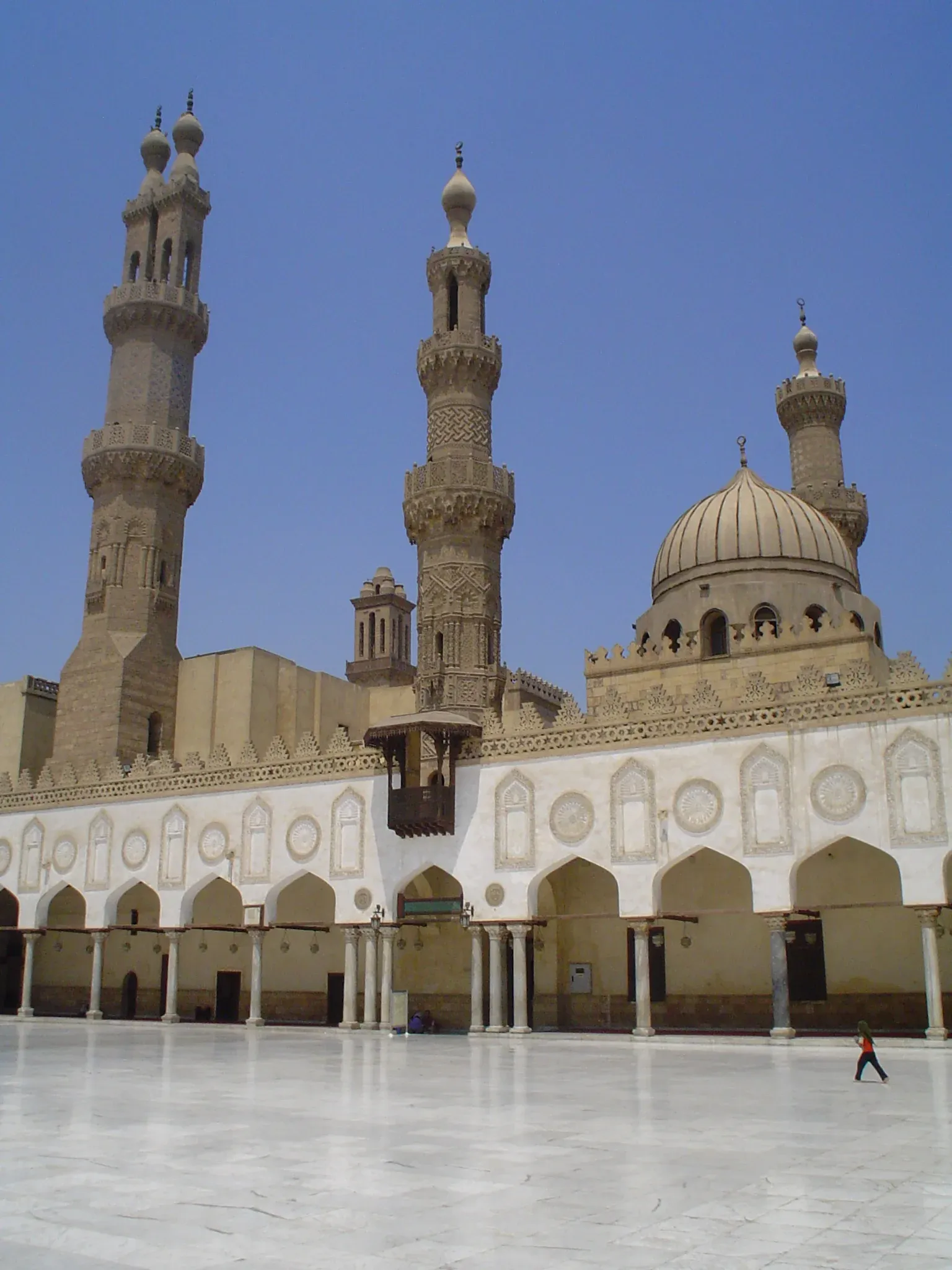
Jawhar ibn Abd Allah, known as al-Siqilli (“the Sicilian”), was the chief general of the Fatimid Imam-caliph al-Mu’izz. He brought the far Maghrib under Fatimid rule in 958–960, conquered Egypt in 969, laid out Cairo and the mosque of al-Azhar, and governed Egypt for four years until the Imam arrived in 973. Daftary calls him the ablest of all the Fatimid generals.123
Origins
Jawhar was a freedman of the Fatimids, possibly of Slav origin. He carried several epithets: al-Saqlabi (“the Slav”), al-Siqilli (“the Sicilian”) and al-Rumi (“the Greek”).1 O’Leary, writing from the chronicles, calls him Abu’l-Hasan Jawhar ibn Abd Allah, “Jawhar the Greek scribe”, a liberated slave trained as a secretary whose father had been a subject of the Byzantine Empire.4 Al-Imad holds that he was born a Christian, possibly Byzantine Orthodox, around 300/912, and converted to Islam.5
He rose to become secretary (katib) to the caliphs al-Mansur and al-Mu’izz, and then al-Mu’izz’s chief general (al-qa’id).1 Al-Imad dates his appointment as commander-in-chief to 351/962, a date difficult to reconcile with Daftary’s account of the campaign he led in 347/958.51
The western campaign
In 347/958 Jawhar led the Fatimid army west and defeated, near Tahart, a large Zanata Berber force under Ya’la ibn Muhammad, chief of the Sunni Banu Ifran and an ally of the Umayyads of Spain, who was killed in the battle.1 He then invaded the principality of Sijilmasa, still ruled by the Banu Midrar, and killed its amir, Muhammad ibn al-Fath.1
After a year in that region he marched on Fes, the Umayyad stronghold in the far Maghrib, and in 349/960 took it after a siege of a few weeks, largely through the bravery of Ziri ibn Manad, chief of the Sanhaja, and captured its Umayyad governor.1 For a brief period Fatimid authority reached the Atlantic, with the exception of Ceuta, and even the last Idrisid ruler of the Rif, al-Hasan ibn Jannun, pledged allegiance.1
The conquest of Egypt
When Kafur, the effective ruler of Ikhshidid Egypt, died in 357/968, the country fell into disorder. Al-Mu’izz chose Jawhar to lead the long-prepared expedition.2 In Rabi’ I 358/February 969 the army set out from Qayrawan after a ceremonial farewell. Al-Mu’izz gave Jawhar his own garments and ordered all governors on the route to dismount when greeting him; O’Leary’s sources add that the caliph’s sons and the great officers dismounted before Jawhar at the farewell.67
Jawhar entered Fustat in Sha’ban 358/July 969.6 He proclaimed a general amnesty and guaranteed the lives and property of the population, dropped the Abbasid caliph al-Muti’ from the Friday sermon, tolerated religious freedom and introduced Shi’i forms of prayer only gradually, aware that Shafi’i Sunnis and Coptic Christians formed the majority.6
Founding Cairo
Jawhar camped north of Fustat and immediately began a new royal city, first called al-Mansuriyya and later al-Qahira al-Mu’izziyya. He marked out two palaces, for the caliph and his heir, according to plans drawn up by al-Mu’izz, together with government and army buildings.6 Walker notes that the plan, with its northern gate al-Futuh, southern gate Zuwayla and central mosque al-Azhar, had been brought by Jawhar from Ifriqiya.8 In Jumada I 359/April 970 he laid the foundations of al-Azhar.6 Al-Imad emphasises that the separate site kept the Maghribi officials and troops apart from the population of Fustat and so reduced friction.9
Governor of Egypt
Jawhar governed Egypt for four years, until the arrival of al-Mu’izz in 362/973. He gave priority to relieving famine, improving the finances and reforming the administration, preferring Kutama and other Maghribis for the most important posts.3 Al-Imad describes him as the only Fatimid general of the early period to exercise the powers of a vizier without the title, acting in effect as an interim military governor, and credits him with laying, with Ibn Killis, the foundations of the Fatimid administration.10
According to al-Imad, he had the government maintain the irrigation canals, introduced Ismaili formulas into the daily prayers, employed Sunnis and Copts in government at the outset, doubled the land tax and used the revenue to build roads and bridges, and divided Cairo into quarters (haras) by ethnic group.119
He also sought to extend Fatimid rule over the former Ikhshidid lands. In 359/969–970 Mecca and Medina submitted to al-Mu’izz, beginning a Fatimid suzerainty over the Hijaz that lasted, with interruptions, until the reign of al-Mustansir; the Hijaz was permanently lost to the Fatimids by 473/1081.312 His lieutenant Ja’far ibn Falah took southern Syria in 359/970 but was killed when the Qarmatis seized Damascus in 360/971.13
Later career
In 365/976, immediately after his accession, al-Aziz sent the veteran Jawhar to retake Damascus from the Turkish commander Alptakin, who was allied with the Qarmatis.14 When fresh Qarmati forces under al-Hasan al-A’sam arrived, Jawhar retreated to Ramla and then to Ascalon, where he was besieged for almost seventeen months. In 367/977–978 he was allowed to return to Egypt on humiliating terms.14
He lived quietly in Egypt until his death in 381/992.14 His family remained close to the dynasty: Abd al-Aziz ibn Muhammad ibn al-Nu’man, grandson of al-Qadi al-Nu’man and chief judge until 401/1011, was Jawhar’s son-in-law.15
Footnotes
-
Farhad Daftary, The Isma’ilis: Their History and Doctrines, 2nd ed. (Cambridge University Press, 2007), p. 156. ↩ ↩2 ↩3 ↩4 ↩5 ↩6 ↩7 ↩8
-
Farhad Daftary, The Isma’ilis: Their History and Doctrines, 2nd ed. (Cambridge University Press, 2007), p. 158. ↩ ↩2
-
Farhad Daftary, The Isma’ilis: Their History and Doctrines, 2nd ed. (Cambridge University Press, 2007), p. 161. ↩ ↩2 ↩3
-
De Lacy O’Leary, A Short History of the Fatimid Khalifate (Kegan Paul, Trench, Trubner, 1923), https://archive.org/details/shorthistoryoffa00oleauoft, pp. 98–99. ↩
-
Leila S. al-Imad, The Fatimid Vizierate, 969–1172 (Klaus Schwarz Verlag, 1990), https://archive.org/details/TheFatimidVizierate9691172, p. 10 and nn. 11–12. ↩ ↩2
-
Farhad Daftary, The Isma’ilis: Their History and Doctrines, 2nd ed. (Cambridge University Press, 2007), p. 159. ↩ ↩2 ↩3 ↩4 ↩5
-
De Lacy O’Leary, A Short History of the Fatimid Khalifate (Kegan Paul, Trench, Trubner, 1923), https://archive.org/details/shorthistoryoffa00oleauoft, pp. 99–100. ↩
-
Paul E. Walker, “The Isma’ili Da’wa and the Fatimid Caliphate”, in Carl F. Petry (ed.), The Cambridge History of Egypt, vol. 1 (Cambridge University Press, 1998), p. 139. ↩
-
Leila S. al-Imad, The Fatimid Vizierate, 969–1172 (Klaus Schwarz Verlag, 1990), https://archive.org/details/TheFatimidVizierate9691172, pp. 13–15. ↩ ↩2
-
Leila S. al-Imad, The Fatimid Vizierate, 969–1172 (Klaus Schwarz Verlag, 1990), https://archive.org/details/TheFatimidVizierate9691172, p. 1 and n. 1. ↩
-
Leila S. al-Imad, The Fatimid Vizierate, 969–1172 (Klaus Schwarz Verlag, 1990), https://archive.org/details/TheFatimidVizierate9691172, pp. 11–13. ↩
-
Farhad Daftary, The Isma’ilis: Their History and Doctrines, 2nd ed. (Cambridge University Press, 2007), p. 198. ↩
-
Farhad Daftary, The Isma’ilis: Their History and Doctrines, 2nd ed. (Cambridge University Press, 2007), p. 162. ↩
-
Farhad Daftary, The Isma’ilis: Their History and Doctrines, 2nd ed. (Cambridge University Press, 2007), p. 173. ↩ ↩2 ↩3
-
Farhad Daftary, The Isma’ilis: Their History and Doctrines, 2nd ed. (Cambridge University Press, 2007), p. 172. ↩