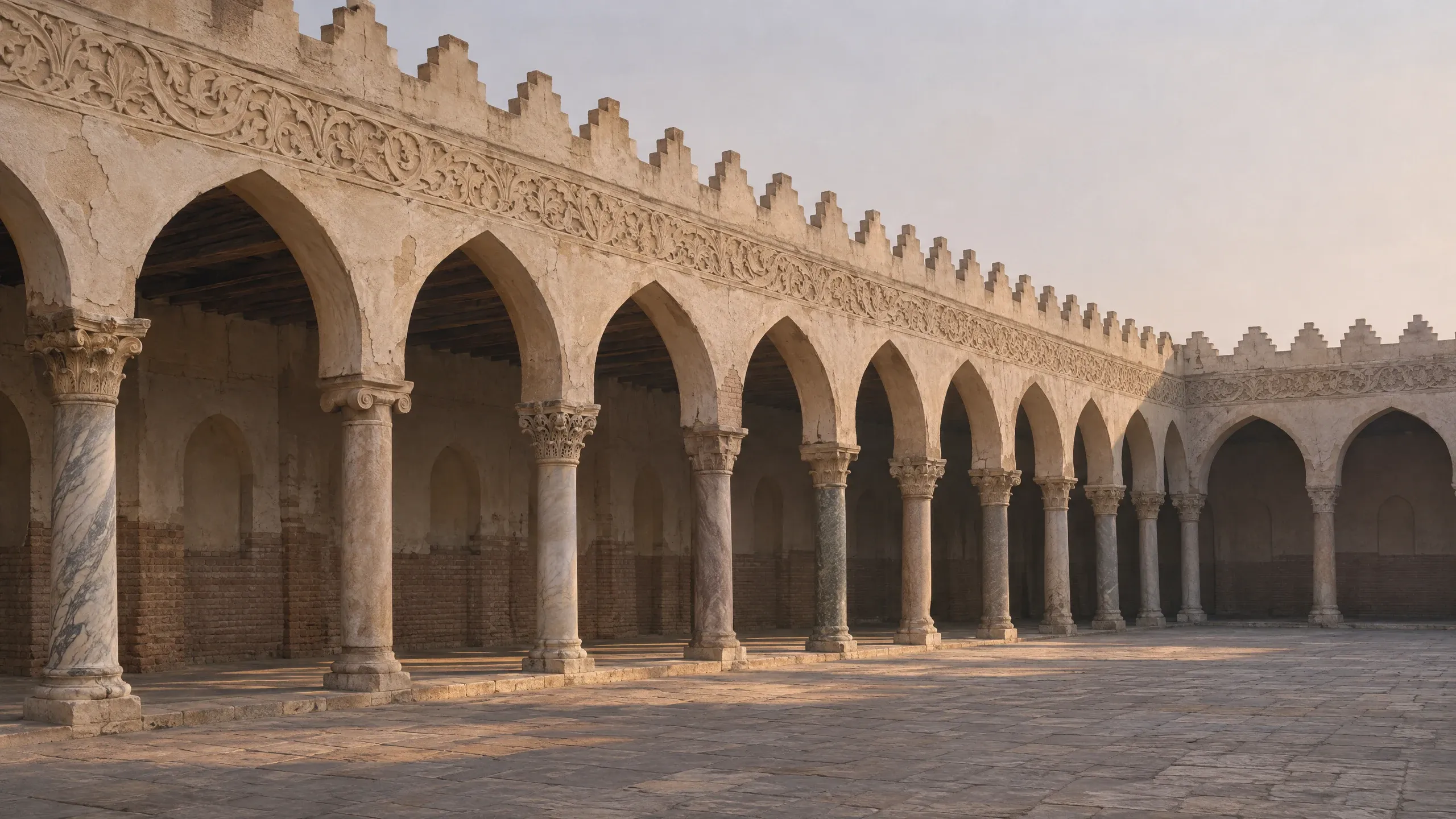
The mosque of al-Azhar was the first congregational mosque of Fatimid Cairo. Jawhar laid its foundations in Jumada I 359/April 970, less than a year after the conquest of Egypt, and the building was completed two years later. Under the Fatimids it was the setting for Friday sermons in the name of the Imam-caliph, for public lectures on Ismaili law, and from 988 for a salaried body of scholars. This page treats the building and its Fatimid setting; the history of the institution is told in al-Azhar.12
Foundation
The mosque belonged to the plan of the new city that Jawhar brought from Ifriqiya. Walker notes that, like its namesake Sabra al-Mansuriyya, the new city was given a northern gate called al-Futuh, a southern gate called Zuwayla and a central congregational mosque called al-Azhar.3 Daftary likewise records that the mosque of Sabra al-Mansuriyya was called al-Azhar, so the name, the plan and the gates of Cairo all prefigured in the Maghrib.4
Daftary dates the foundation to Jumada I 359/April 970 and the completion of the original structure to two years later.1 Britannica notes some dispute over the exact year, but gives 970 for the start of construction and 972 for the opening of its doors to the public.2 The mosque was thus in use for the Friday prayer before al-Mu’izz entered the city in Ramadan 362/June 973.15
The name
The name al-Azhar means “the most radiant” or “the most resplendent”. Britannica suggests that it may allude to Fatima, the daughter of the Prophet, known as al-Zahra’, “the Luminous”, from whom the Fatimid dynasty took its name.2 Sanders places the name in a wider pattern: the Fatimid Imam was described as an emanation of divine light, and as new mosques were built in Cairo throughout the period they received names evoking that luminosity, such as al-Anwar, “the most luminous”, the second name of the mosque of al-Hakim, and al-Aqmar, built in 519/1125.6
Place in the city
Early Cairo consisted of two palaces and a congregational mosque, al-Azhar, all enclosed by a brick wall.7 Sanders notes that al-Azhar was not attached to the palace but stood nearby, to its south-east. From the early eleventh century the mosque of al-Hakim, outside the northern wall, assumed equal importance in the ceremonial life of the court.67 UNESCO lists al-Azhar first among the significant Fatimid mosques of the historic city, alongside al-Hakim, al-Aqmar and Salih Tala’i.8
Ismaili teaching
Al-Azhar became a centre for the public teaching of Ismaili law. The Friday sessions on law begun by al-Qadi al-Nu’man after the midday prayer, using his Da’a’im al-Islam, continued after his death at al-Azhar and the other great mosques of Cairo, such as Amr and al-Hakim.9 In 365/975 his son Ali ibn al-Nu’man lectured at al-Azhar to vast audiences from a text composed by his father.9
In 394/1004 Abd al-Aziz ibn Muhammad ibn al-Nu’man, after becoming chief qadi, lectured in the palace and at al-Azhar, drawing on one of his grandfather’s treatises. His uncle Muhammad ibn al-Nu’man had lectured to large numbers in 385/995 on the sciences of the ahl al-bayt, continuing a custom set by al-Qadi al-Nu’man in the Maghrib.10 By the time of al-Hakim a separate session was held for women at al-Azhar, while royal and noble women received instruction in the palace.10 The esoteric majalis al-hikma for initiates, however, were held in a special hall of the palace rather than in the mosque.10
The college of 988
Daftary records that al-Azhar became a university in 378/988–989, and assigns the credit for using it in this way to the vizier Ibn Killis under al-Aziz, himself an expert in Ismaili jurisprudence and author of a legal treatise based on the pronouncements of al-Mu’izz and al-Aziz.111 Britannica describes it as formally organised as an Ismaili centre of learning in 988, with no entrance requirements, formal curriculum or degrees in its early history.2 Daftary stresses that Ismaili scholars, jurists and students took part constantly in its seminars throughout the Fatimid period.1
After the Fatimids
Because of its role in spreading Ismaili doctrine, al-Azhar suffered the hostility of the Sunni Ayyubids after the fall of the Fatimid dynasty.1 Britannica records that Saladin suspended the Friday prayer and classes there for nearly a century; the Mamluks revived it and made it one of the most revered centres of Sunni scholarship. It was damaged by an earthquake in the early fourteenth century and repaired, and its buildings were altered and enlarged in the fourteenth and fifteenth centuries.2
Under Ottoman rule the institution became the pre-eminent centre of Islamic education, and the office of the shaykh of al-Azhar, later called the grand imam, was created.2 The mosque remains at the centre of the medieval city, close to the Khan al-Khalili bazaar and the main north–south street, Shari’ al-Mu’izz li-Din Allah, named after the caliph who founded the city.12 Britannica describes al-Azhar today as the foremost institution of Sunni scholarship.2
Footnotes
-
Farhad Daftary, The Isma’ilis: Their History and Doctrines, 2nd ed. (Cambridge University Press, 2007), p. 159. ↩ ↩2 ↩3 ↩4 ↩5 ↩6
-
“Al-Azhar University”, Encyclopaedia Britannica, https://www.britannica.com/topic/al-Azhar-University. ↩ ↩2 ↩3 ↩4 ↩5 ↩6 ↩7
-
Paul E. Walker, “The Isma’ili Da’wa and the Fatimid Caliphate”, in Carl F. Petry (ed.), The Cambridge History of Egypt, vol. 1 (Cambridge University Press, 1998), p. 139. ↩
-
Farhad Daftary, The Isma’ilis: Their History and Doctrines, 2nd ed. (Cambridge University Press, 2007), p. 147. ↩
-
Farhad Daftary, The Isma’ilis: Their History and Doctrines, 2nd ed. (Cambridge University Press, 2007), p. 162. ↩
-
Paula A. Sanders, “The Fatimid state, 969–1171”, in Carl F. Petry (ed.), The Cambridge History of Egypt, vol. 1 (Cambridge University Press, 1998), pp. 172–173. ↩ ↩2
-
Paula A. Sanders, “The Fatimid state, 969–1171”, in Carl F. Petry (ed.), The Cambridge History of Egypt, vol. 1 (Cambridge University Press, 1998), p. 166. ↩ ↩2
-
UNESCO World Heritage Centre, “Historic Cairo”, World Heritage List no. 89, https://whc.unesco.org/en/list/89/. ↩
-
Farhad Daftary, The Isma’ilis: Their History and Doctrines, 2nd ed. (Cambridge University Press, 2007), p. 214. ↩ ↩2
-
Farhad Daftary, The Isma’ilis: Their History and Doctrines, 2nd ed. (Cambridge University Press, 2007), p. 215. ↩ ↩2 ↩3
-
Farhad Daftary, The Isma’ilis: Their History and Doctrines, 2nd ed. (Cambridge University Press, 2007), p. 177. ↩
-
“Cairo: History”, Encyclopaedia Britannica, https://www.britannica.com/place/Cairo/History. ↩