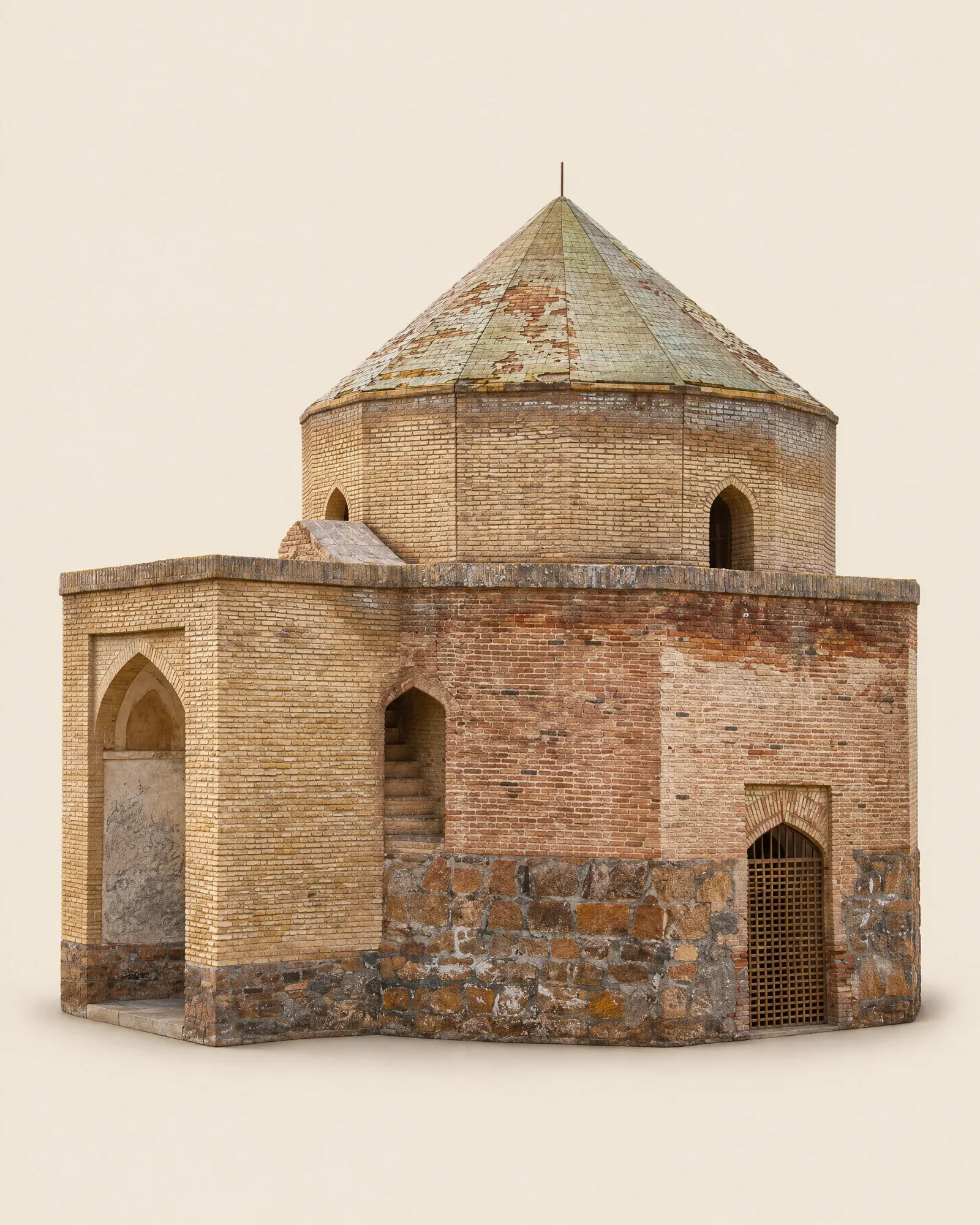
The first Imam of Anjudan
The Anjudan period of Nizari history, which lasted two centuries, begins with Ali Shah, the thirty-second Imam of the Qasim-Shahi line, better known by his throne-name Mustansir bi’llah II. Daftary describes him as the first Nizari Imam who is definitely connected with Anjudan, the village in central Persia that remained the seat of the Qasim-Shahi Imams until the end of the seventeenth century, a span that coincides with most of the Safavid period. He succeeded his father Muhammad ibn Islam Shah around 868/1463–1464.1
His throne-name was a statement. Al-Mustansir bi’llah had been the regnal title of the Fatimid caliph-Imam al-Mustansir, whose death in 487/1094 had produced the Nizari-Musta’li schism and from whose son Nizar all Nizari Imams descend. Daftary notes that the very titles adopted by this Imam and his grandson Gharib Mirza, who became Mustansir bi’llah III, show that the Imams now clearly strove to revive the old glories of the Ismailis.2
Shah Qalandar: a Sufi persona
The revival was conducted under cover. Persia was still predominantly Sunni, and the Nizaris were obliged to practise taqiyya and to disguise their beliefs mainly in the guise of Sufism. Mustansir bi’llah II’s Sufi name was Shah Qalandar, and his mausoleum is still called by that name in Anjudan. Daftary suggests he may have been the first Qasim-Shahi Imam to associate with the Ni’mat Allahi Sufi order, but adds that concrete evidence is lacking and that the formal association of the Imams with that order began more than two centuries later.3
To outsiders the Imams appeared as Sufi murshids, shaykhs, pirs or qutbs, and were probably regarded also as pious Husaynid sayyids, descendants of the Prophet through Fatima. Their followers posed as murids guided along the tariqa towards the haqiqa. With Alid loyalism spreading through many Sufi orders, the Nizaris’ veneration of Ali and the early Husaynid Imams caused no particular alarm. During the Anjudan period it became customary for the Imams to take Sufi names such as Shah Qalandar and Shah Gharib and to add Shah and Ali to their names, as Sufi masters did.4
Why Anjudan
Daftary infers that the Imams chose Anjudan after a careful search. The village had a central position but lay away from the seats of the main Sunni powers then ruling western and eastern Persia, the Aq Qoyunlu at Tabriz and the later Timurids at Herat. It was also close to Qumm and Kashan, traditional Shi’i centres known as dar al-mu’minin, “the abode of the faithful”. Anjudan lies at the foot of a low rocky range about thirty-seven kilometres east of Arak and roughly the same distance west of Mahallat, in the fertile plain of Farahan.5
Reasserting the Imam’s authority
The revival was above all a reorganisation of the da’wa. During the first post-Alamut centuries, when the Imams had little direct contact with their followers, Nizari communities in Persia, Central Asia and India had come under local leaders known by the Sufi term pir. In most communities the office had become hereditary, and some dynasties of pirs had become effectively independent of Imams whose whereabouts were unknown to most of their followers. They were most autonomous in the regions furthest from the Imam, Afghanistan, Badakhshan and Central Asia and the Indian subcontinent, and they often controlled the religious dues they collected.6
Mustansir bi’llah II began sending trusted da’is to localities in Khurasan, Afghanistan, Badakhshan and elsewhere. His successors continued the policy and seem also to have summoned regional da’is to Persia regularly for consultation and instruction. The aims were to win new converts in distant lands, to bring over Nizaris who followed the rival Muhammad-Shahi Imams, and to replace powerful hereditary pirs with the Imam’s own appointees.7
The Pandiyat-i javanmardi
Mustansir bi’llah II’s teaching survives in the Pandiyat-i javanmardi, “Admonitions on Spiritual Chivalry”, a collection of his sermons to the believers (mu’mins) and to those seeking high standards of ethical behaviour and spiritual chivalry (javanmardi). It was compiled and written down in Persian by an anonymous Nizari author during the Imamate of his son Abd al-Salam Shah. Its title pairs two ideas: pand, moral counsel, and javanmardi, the ethic of chivalrous generosity long cultivated in Persian Sufi and artisan circles.8
The book uses Sufi language throughout. The Nizaris are called ahl-i haqq and ahl-i haqiqat, “the people of the truth”, and the Imam is designated pir, murshid and qutb. The admonitions begin with the Sufi division of religion into shari’at, tariqat and haqiqat, presenting the haqiqat as the batin, the inner meaning, of the shari’at, reached through the spiritual path. In line with Nizari teaching rooted in the earlier doctrine of the qiyama, the haqiqat consists essentially in recognising the spiritual reality of the Imam of the time.9
Two practical duties run through the text: obedience to the present Imam, with the assurance that no sacrifice is too great for the didar, the journey to see him; and payment of religious dues, above all the dah-yik, a tithe of ten per cent of annual earnings. Daftary observes that the reorganisation of the da’wa required exactly these two things, adequate revenues and loyal da’is.10
The Pandiyat travelled widely. The Nizari Khojas preserved Sindhi (Khojki) and Gujarati versions and maintain that the book was sent to India by the Imam of the time for their guidance. Persian copies survive in the manuscript collections of Badakhshan, Hunza and other northern areas of Pakistan, and Chinese Turkistan.11
Death and the mausoleum of Shah Qalandar
Mustansir bi’llah II died in 885/1480, the date inscribed on the wooden box (sanduq) placed over his grave. Nizari tradition places his death in 880/1475–1476, close to the inscription. His octagonal mausoleum, built during the Imamate of his son Abd al-Salam Shah and still known locally as Shah Qalandar, is the oldest surviving Nizari monument at Anjudan. Nizari oral tradition holds that he and his next few successors lived at Shahr-i Babak in Kerman; Daftary calls this tradition erroneous.12
The monuments were rediscovered only in 1937, when Ivanow identified an old mosque and three mausoleums containing the tombs of several Imams and their relatives. The villagers, who are Twelver Shi’is, did not know who was buried there; when the Qajar Nasir al-Din Shah visited Anjudan in Dhu’l-Qa’da 1309/June 1892, he did not suspect the locality’s Ismaili past. By Daftary’s visit in 1976, some of the remains Ivanow had described had disappeared.13
Footnotes
-
Farhad Daftary, The Isma’ilis: Their History and Doctrines, 2nd ed. (Cambridge University Press, 2007), pp. 418, 422–423. ↩
-
Daftary, The Isma’ilis, 2nd ed. (Cambridge University Press, 2007), pp. 423, 431. ↩
-
Daftary, The Isma’ilis, 2nd ed. (Cambridge University Press, 2007), pp. 423, 431. ↩
-
Daftary, The Isma’ilis, 2nd ed. (Cambridge University Press, 2007), p. 431. ↩
-
Daftary, The Isma’ilis, 2nd ed. (Cambridge University Press, 2007), pp. 423, 431. ↩
-
Daftary, The Isma’ilis, 2nd ed. (Cambridge University Press, 2007), p. 432. ↩
-
Daftary, The Isma’ilis, 2nd ed. (Cambridge University Press, 2007), p. 432. ↩
-
Daftary, The Isma’ilis, 2nd ed. (Cambridge University Press, 2007), p. 432. ↩
-
Daftary, The Isma’ilis, 2nd ed. (Cambridge University Press, 2007), p. 433. ↩
-
Daftary, The Isma’ilis, 2nd ed. (Cambridge University Press, 2007), pp. 432–433. ↩
-
Daftary, The Isma’ilis, 2nd ed. (Cambridge University Press, 2007), pp. 432–433. ↩
-
Daftary, The Isma’ilis, 2nd ed. (Cambridge University Press, 2007), p. 423. ↩
-
Daftary, The Isma’ilis, 2nd ed. (Cambridge University Press, 2007), p. 423; see also The Anjudan revival. ↩