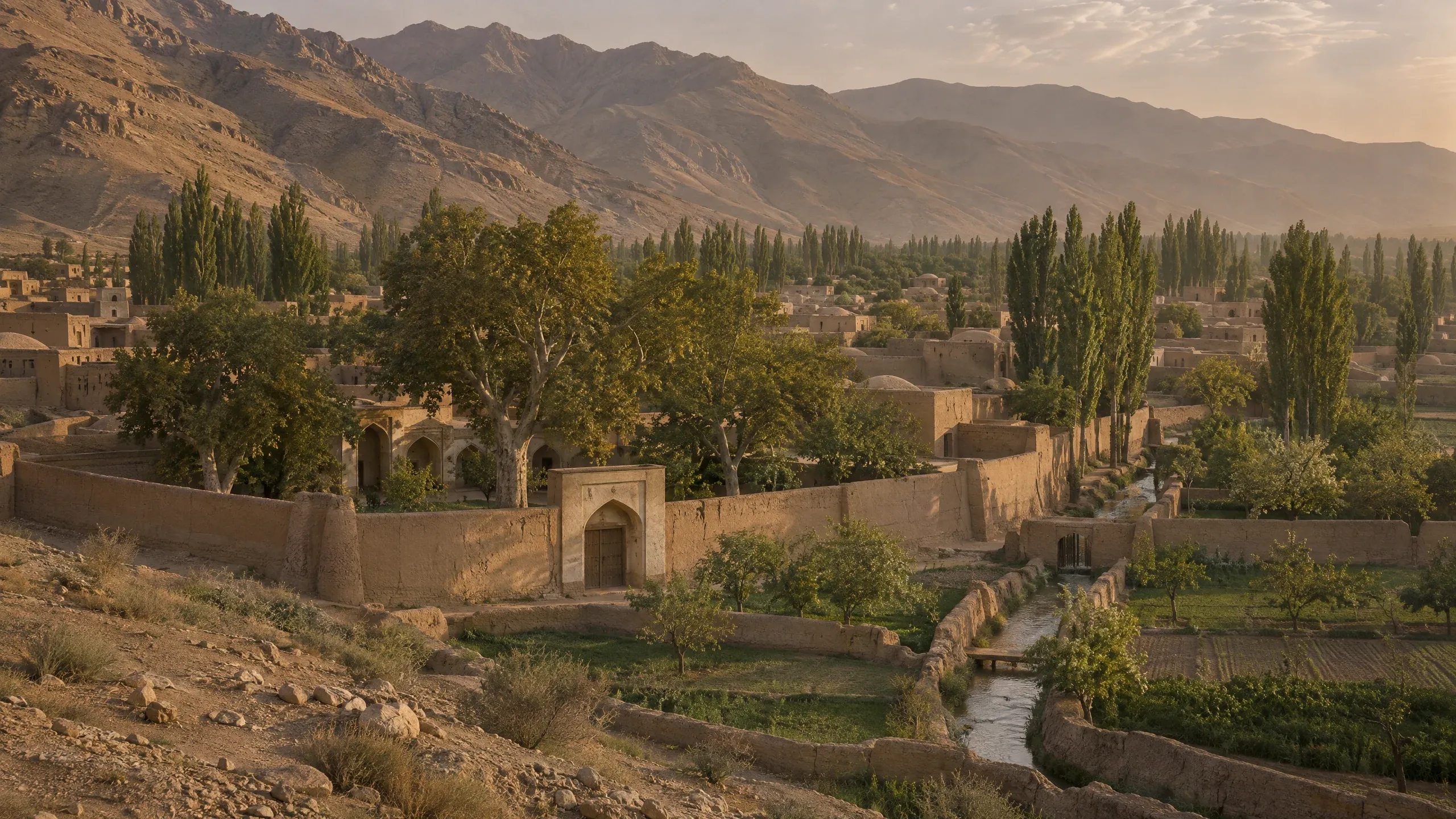
Location and setting
Mahallat is a town in central Iran, south-west of Qumm. Anjudan, seat of the Imams for some two centuries, lies about thirty-seven kilometres to its west, and Kahak, their later seat, to its north-west. For about four centuries the Qasim-Shahi Nizari Imams held lands and lived in this district, which Daftary describes as the area of the family’s “deep roots” in central Persia.1
The Imams arrive
The connection goes back to the fifteenth century. Islam Shah, who died around 829/1425–1426, moved the residence of the Qasim-Shahi Imams from Adharbayjan to localities around Qumm and Mahallat during the early decades of his long Imamate, and may have been the first of his line to settle at Anjudan. In the sixteenth century Khayrkhwah-i Harati, describing his journey to see the Imam, does not name Anjudan, but his mention of nearby places such as Mahallat shows where he went. By 1090/1680, Daftary writes, the Imams had developed deep roots in Mahallat and the other localities around Anjudan.2
The district remained the destination of Khoja pilgrims from India. The Kerman historian Vaziri (d. 1295/1878) relates that after the fall of the Safavids Khojas travelling to the Anjudan and Mahallat areas to visit their Imam and pay their dues were often plundered and killed by Bakhtiyari tribesmen between Na’in and Yazd, one reason the Imams later moved south-east to Shahr-i Babak.3
Nadir Shah and Hasan Ali
Later family sources link Hasan Ali, the forty-second Imam, with the government of the Mahallat district. According to accounts gathered by Beben and Mohammad Poor, he accompanied Nadir Shah on his invasion of India and was rewarded with the governorship of the region around his ancestral village of Mahallat; enemies at court then accused him of heresy, and Nadir Shah had him blinded before pardoning and reinstating him. A late nineteenth-century source, the Athar-i Muhammadi, says that Nadir Shah gave him the governorship of Kiyab, a town near Mahallat. These reports come from much later texts and are not confirmed by contemporary chronicles.4
Sufis of Mahallat
In the late eighteenth and early nineteenth centuries Mahallat was a centre of the Ni’mat Allahi Sufi order as well as of the Imam’s family. Muhammad Sadiq Mahallati, a Nizari sayyid who was perhaps a brother of Imam Abu’l-Hasan Ali, was a Ni’mat Allahi poet under the name Sidq Ali Shah; his daughter Bibi Sarkara married Shah Khalil Allah and bore Aga Khan I. Her brother Izzat Ali Shah, a prominent Ni’mat Allahi dervish, spent most of his life in Mahallat, where the Imam’s influence had by then extended, and died there around 1245/1829.5
The Qajar grant
After Shah Khalil Allah was killed at Yazd in 1232/1817, his widow pleaded for justice at the Qajar court. Fath Ali Shah added to the young Imam’s lands in the Mahallat area, gave him his daughter Sarv-i Jahan Khanum in marriage, made him governor of Qumm and gave him the title Aqa Khan. From then on Hasan Ali Shah was generally known as Aqa Khan Mahallati, because of the title and the family’s roots in the district. See The Aga Khan title.6
Aga Khan I at Mahallat
The Imam’s first son by the Qajar princess, Aqa Ali Shah, the future Aga Khan II, was born at Mahallat in 1246/1830 and spent his early years there. In the reign of Fath Ali Shah, Aga Khan I sheltered the Ni’mat Allahi master Mast Ali Shah in the village of Dawlatabad near Mahallat, when he fled the Twelver ulama of Fars; Mast Ali Shah later lived as his guest at Mahallat, as did Rahmat Ali Shah, afterwards qutb of one of the order’s branches.7
After the siege of Bam and his captivity in Kerman, Muhammad Shah pardoned the Aga Khan late in 1254/1838 on condition that he retire peacefully to his estates at Mahallat. After a short stay in Qumm he did so. There he had built a large fortified residential compound for his family and his many dependants and servants; a section of its encircling wall survives.8
Departure, 1840
The residence lasted just under two years. In the ’Ibrat-afza the Aga Khan blames his renewed troubles on the intrigues of Hajji Abd al-Muhammad Mahallati, a man who had risen in the service of the chief minister Hajji Mirza Aqasi. When the government sent troops to nearby Dalijan to investigate rumours about him, the Aga Khan, fearing renewed hostilities, asked leave to go on pilgrimage to Mecca and to send his household to the shrine cities of Iraq. Permission was granted, and on 1 September 1840 he left Mahallat. He never returned.9
The family estates after 1840
The Imam’s younger brother Abu’l-Hasan Khan, the Sardar, was pardoned by Nasir al-Din Shah after his campaigns in Baluchistan, married a Qajar princess and managed the family’s lands at Mahallat until his death in 1297/1880. His son Mirza Isma’il Khan I’tibar al-Saltana (d. 1346/1928) managed the Aga Khans’ properties at Mahallat and Kerman. The Sardar’s descendants still living in Tehran and Mahallat follow Twelver Shi’ism.10
Footnotes
-
Farhad Daftary, The Isma’ilis: Their History and Doctrines, 2nd ed. (Cambridge University Press, 2007), pp. 423, 456, 464. ↩
-
Daftary, The Isma’ilis, 2nd ed. (Cambridge University Press, 2007), pp. 418, 434, 456. ↩
-
Daftary, The Isma’ilis, 2nd ed. (Cambridge University Press, 2007), p. 460. ↩
-
Daniel Beben and Daryoush Mohammad Poor, The First Aga Khan: Memoirs of the 46th Ismaili Imam (I.B. Tauris / Institute of Ismaili Studies, 2018), Introduction, citing the Athar-i Muhammadi (IIS MS 919, pp. 15–16). ↩
-
Daftary, The Isma’ilis, 2nd ed. (Cambridge University Press, 2007), p. 463. ↩
-
Daftary, The Isma’ilis, 2nd ed. (Cambridge University Press, 2007), pp. 463–464; Farhad Daftary, ed., A Modern History of the Ismailis (I.B. Tauris / Institute of Ismaili Studies, 2011), Introduction, https://archive.org/details/bk861. ↩
-
Daftary, The Isma’ilis, 2nd ed. (Cambridge University Press, 2007), pp. 465–468, 477. ↩
-
Daftary, The Isma’ilis, 2nd ed. (Cambridge University Press, 2007), pp. 465–466 and fig. 18; Beben and Mohammad Poor, The First Aga Khan (2018), Introduction, p. 41 and fig. 5. ↩
-
Beben and Mohammad Poor, The First Aga Khan (2018), Introduction, pp. 40–42; Daftary, The Isma’ilis, 2nd ed. (Cambridge University Press, 2007), pp. 467–468. ↩
-
Daftary, The Isma’ilis, 2nd ed. (Cambridge University Press, 2007), pp. 471–472. ↩