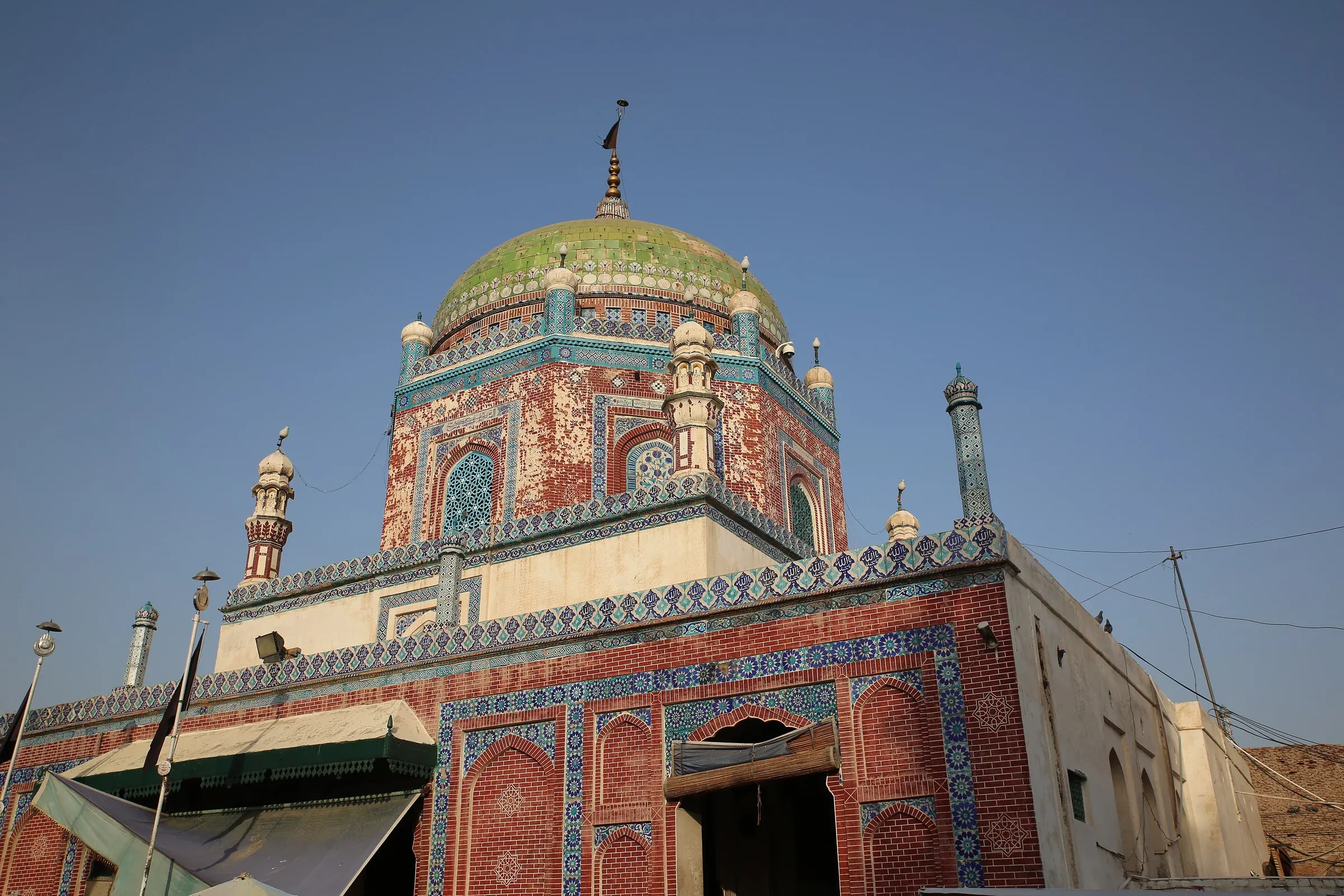
Pir Shams, in full Shams al-Din, is the pir whom Nizari tradition credits with starting the Nizari da’wa in Sindh and Punjab. His shrine stands in Multan, where he is known as Shah Shams al-Din Sabzawari. He is the reputed author of a large body of ginans, including garbi dance-songs and the mystical poem Brahma Prakasha. He is also one of the hardest figures in Ismaili history to pin down. Daftary calls him “an obscure figure surrounded by all sorts of legends”, and the dates assigned to his activity span two centuries.12
Three men in one name
Kassam’s study, the fullest of his ginans, shows that the remembered Pir Shams combines three historical personalities. The first is an Ismaili pir active around Multan. The second is Shams-i Tabriz, the wandering mystic who met Jalal al-Din Rumi in Konya around 1244 and vanished about three years later. The third is the Nizari Imam Shams al-Din Muhammad, who survived the Mongol destruction of Alamut and died around 1310.34
The identification with Shams-i Tabriz comes from local oral tradition around the Multan shrine. Pilgrims there still call the shrine “Shah Shams” and say it holds Rumi’s mentor. Sindhi folklore tells that Shams ordered the sun to come down and cook a fish for him, which is why Multan is so hot. An official plaque at the tomb names the Ismaili saint Pir Shams. Another plaque records his death in 1356, a date repeated in Ali Chunara’s community history Nur-i Mubin. Ivanow doubted the plaque, since the shrine had been rebuilt many times, and Nanji likewise distrusted any inscription on it.5
Kassam doubts both larger identifications. Shams-i Tabriz disappeared from Konya about three years after meeting Rumi and died before Rumi (d. 1273); a tomb attributed to him at Konya would also rule out burial at Multan. Imam Shams al-Din Muhammad, whose birth is placed between 1235 and 1252, would have been only about seven to twelve when Shams-i Tabriz died. Kassam suggests the identification with the Imam may have been fostered later to strengthen the claims of Nur Muhammad Shah. Kassam attributes the confusion partly to the Imam’s time in Tabriz. A 1930s article by Ahmad Akhtar had already argued against the claim that Shams-i Tabriz was an Ismaili Imam.6
Dates
Daftary sets out the range. Some ginans name Qasim Shah as the Imam of Pir Shams’s time, which points to the mid-fourteenth century. Other ginans place him in the twelfth century. Daftary’s own view is that Nizari influence took hold among the Hindus of Sindh mainly after the fall of Alamut in 1256, and that the first Nizari da’is arrived towards the end of the Alamut period.78
Kassam argues for an earlier setting. The ginans give dates of 1118, 1143 and 1150 CE, which conflict with one another. The genealogy kept by his shrine’s custodians gives 1165–1276. She takes the shrine genealogy seriously. A birth in 1165 would follow the declaration of the qiyama at Alamut in 1164. The narrative ginans also describe forts, battles, alliances with Hindu chiefs and a promise of victory near Multan and the Chenab. To Kassam these fit the time of the Ghurid campaigns against the Ismailis of Multan, which culminated in 1175. She concludes that Pir Shams most likely came from Sabzawar as a young man and was active from the mid-twelfth into the thirteenth century, while the Alamut state still offered hope of support.9
Mission and converts
The ginans centre his mission on Multan and on Uch (Uchchh). They tell of contests with Hindu ascetics and with the Suhrawardi Sufi Baha al-Din Zakariyya of Multan, and of converts such as the “two youths” Surabhan and Chandrabhan. Kassam reads the legendary rivalry with Zakariyya as a memory of real pressure from state-backed Sufi orders on the Satpanth da’wa.10
A community of goldsmiths in Multan and Punjab, the Shamsis, claim to have been converted by Pir Shams. In modern times they have acknowledged the Aga Khan. Daftary also records that his son Nasir al-Din and grandson Shihab al-Din (Sahib al-Din) succeeded him and carried on the da’wa in secret. They stand as the twenty-first and twenty-second names in the traditional lists of pirs. After them the office passed to Pir Sadr al-Din.11
The ginans of Pir Shams
The ginans attributed to Pir Shams fall into distinct groups. Narrative ginans place him around Multan. The garbis are songs sung while dancing in a circle, from which Kassam’s dissertation takes its title. Kassam argues that the garbis belong to a later phase: they name people who lived between the fourteenth and eighteenth centuries, are set in Analwad (perhaps Anhilwad in Gujarat), and treat salvation in purely religious terms. Some versions of the Dasa Avatara, which identifies the Imam with the tenth avatar of Vishnu, are also attributed to him.1213
Asani and Virani read these ginans as theological texts rather than historical chronicles. Their verses on the soul’s longing, the guide and the vision of the light belong to a tradition that saw the pir’s words as gnosis passed down from the Imam.1415
Footnotes
-
Farhad Daftary, The Isma’ilis: Their History and Doctrines, 2nd ed. (Cambridge: Cambridge University Press, 2007), p. 385. ↩
-
Tazim R. Kassam, Songs of Wisdom and Circles of Dance: An Anthology of Hymns by the Satpanth Isma’ili Saint, Pir Shams (PhD dissertation, McGill University, 1992), abstract and ch. 1, https://archive.org/details/bk038. ↩
-
Kassam, Songs of Wisdom and Circles of Dance, ch. 5, “Pir Shams: Problems of Historical Identity.” ↩
-
Daftary, The Isma’ilis, pp. 385–386. ↩
-
Kassam, Songs of Wisdom and Circles of Dance, ch. 5, pp. 147–148, citing W. Ivanow and Azim Nanji. ↩
-
Kassam, Songs of Wisdom and Circles of Dance, ch. 5, section on Shams-i Tabriz. ↩
-
Daftary, The Isma’ilis, p. 386. ↩
-
Daftary, The Isma’ilis, pp. 442–443. ↩
-
Kassam, Songs of Wisdom and Circles of Dance, ch. 5, conclusion. ↩
-
Kassam, Songs of Wisdom and Circles of Dance, ch. 5, conclusion. ↩
-
Daftary, The Isma’ilis, pp. 442–443. ↩
-
Kassam, Songs of Wisdom and Circles of Dance, ch. 1 and ch. 5, conclusion. ↩
-
Daftary, The Isma’ilis, p. 450. ↩
-
Ali S. Asani, “Isma’ilism xiv. Isma’ilism in Ginan Literature,” Encyclopaedia Iranica, vol. XIV, fasc. 2 (2007), pp. 204–205, https://iranicaonline.org/articles/ismailism-xiv-ismailism-in-ginan-literature/. ↩
-
Shafique N. Virani, “Symphony of Gnosis: A Self-Definition of the Ismaili Ginan Tradition,” in Todd Lawson (ed.), Reason and Inspiration in Islam (London: I.B. Tauris, 2005), pp. 503–509. ↩