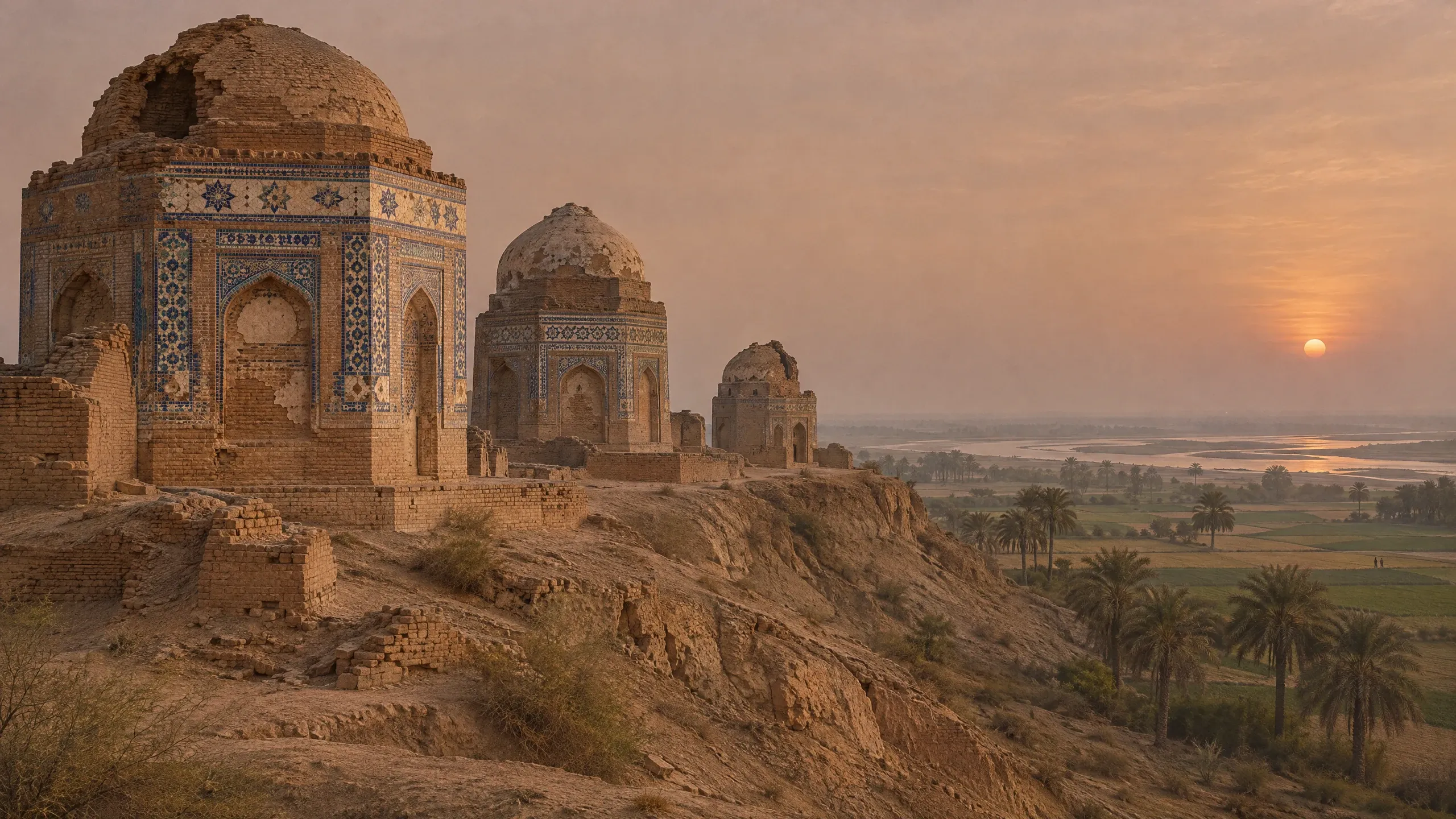
Uch, also written Uchchh and known today as Uch Sharif, is a town in southern Punjab, Pakistan, south of Multan. From the twelfth to the sixteenth century it was one of two poles of Ismaili activity in the region, the other being Multan. Under Pir Sadr al-Din and his son Pir Hasan Kabir al-Din it was the seat of the Satpanth da’wa in India. It was also, at the same time, a headquarters of the Suhrawardi and Qadiri Sufi orders. That shared setting shaped the devotional language of the ginans.12
Ismailis and Ghurids
The earliest Ismaili history of Uch is tied to Multan, where a Fatimid-aligned Ismaili state lasted until the Ghaznavid conquest of the early eleventh century. Kassam collects the evidence for later Ismaili activity in the region in the twelfth century. Persian chronicles record that the Ghurid sultan Mu’izz al-Din Muhammad (Shihab al-Din) captured Multan “from the Karamitah”, a hostile name for Ismailis, in 1175. He then went on to take Uch. Juzjani’s Tabaqat-i Nasiri, in Raverty’s translation, and Ferishta’s later account describe the siege of a fort held by a raja of the Bhati tribe. Kassam reads these sources as evidence that Uch was “the other major centre of Nizari activity” in Upper Sindh. She argues that the Nizari da’wa there was linked with the Sumra rulers of Lower Sindh, who were centred in the Thatta district.34
Kassam uses this setting to date Pir Shams. The ginans attributed to him are full of battles, fortresses and the promise that the Shah will come from the West to seize Multan. In her reading, they remember the conflict of the twelfth century, when the Ismailis of Multan and Uch faced the Ghurids. In the ginans, Uch is mainly where the pir and his disciples make converts. The Suhrawardi saint Baha al-Din Zakariyya appears as Pir Shams’s chief rival, whom the pir curses with a pair of horns.5
Seat of the pirs
Daftary writes that Sadr al-Din, while founding jamatkhanas in Sindh, Punjab and Kashmir and extending the da’wa to Gujarat, “remained in Uchchh, from where he conducted the da’wa”. His shrine stands near Jetpur, close to Uch and south of Multan. It is now in the care of Twelver Shi’i custodians, who call him Hajji Sadr Shah. Hasan Kabir al-Din is said to have travelled widely before settling in Uch, “which served as the seat of the Satpanth da’wa in India”. His shrine outside the town is known locally as Hasan Darya. Daftary considers about 875/1470 the most likely date of his death.67
The period as seat of the da’wa ended in the generation after Hasan Kabir al-Din. The quarrel among his sons over the appointment of Pir Taj al-Din was followed by the departure of Imam Shah for Gujarat and by the Imams’ choice to send the Pandiyat-i javanmardi instead of a new pir. After that, the Satpanth centres that mattered most moved south: Kotri and Tando Muhammad Khan in Sindh, Pirana near Ahmadabad, and the Khoja settlements of Kutch and Kathiawar.89
A Sufi town
Uch’s other identity is Sufi. Daftary notes that the Suhrawardiyya was the most important Sufi order in Sindh in the thirteenth and fourteenth centuries, and that the Qadiriyya rose to prominence from the fifteenth. Both had their headquarters in Multan and Uch. Hasan Kabir al-Din himself appears in a list of the Suhrawardi shaykhs. Sufi terms such as murshid and murid became part of Khoja devotional vocabulary, and the ginans share many poetic forms with Sufi poetry in Punjabi and Sindhi.10
The monuments of Uch reflect this Sufi past. Pakistan has submitted a group of five monuments at the south-west corner of Uch Sharif for UNESCO’s Tentative List. The oldest are the fourteenth-century tomb and mosque of the Central Asian Sufi Jalal al-Din Bukhari. The tomb is a brick building with carved wooden pillars, glazed floral and geometric tiles and a lacquer-painted ceiling. A series of three-tiered domed tombs, faced with cut and moulded brick and blue-and-white faience mosaic, includes one said to have been built for Baha al-Halim by his pupil, the Suhrawardi saint Jahaniyan Jahangasht (1307–1383). Another was built around 1494 for Jahangasht’s great-granddaughter, Bibi Jawindi.11
The Ismaili shrines near Uch, those of Sadr al-Din and Hasan Kabir al-Din, are not part of that nomination. Both are now kept by custodians outside the Nizari community. This is common for the early Satpanth shrines, whose later custodians came from other branches of Islam.12
Uch in Khoja memory
For the Nizari Khojas, Uch is linked to the great pirs, not to any surviving community. The traditional lists of pirs, the ginans set in “Ucch” and the genealogies of the Kadiwala sayyids, who descend from Hasan Kabir al-Din through his son Rahmat Allah, all go back to the town. Sindhi and Punjabi, the languages of Uch and Multan, form the oldest layer of ginan vocabulary. Kassam notes that ginans exist in six languages: Punjabi, Sindhi, Multani or Saraiki (a mixture of Sindhi and Punjabi), Hindi, Kutchi and Gujarati. Most of those attributed to Pir Shams survive in Gujarati forms, with only a few in Punjabi, Sindhi and Hindi.1314
Footnotes
-
Farhad Daftary, The Isma’ilis: Their History and Doctrines, 2nd ed. (Cambridge: Cambridge University Press, 2007), pp. 442–443. ↩
-
Daftary, The Isma’ilis, p. 444. ↩
-
Tazim R. Kassam, Songs of Wisdom and Circles of Dance: An Anthology of Hymns by the Satpanth Isma’ili Saint, Pir Shams (PhD dissertation, McGill University, 1992), ch. 4, section on the Ghurids, citing Juzjani, Tabaqat-i Nasiri (tr. Raverty) and Ferishta, https://archive.org/details/bk038. ↩
-
Kassam, Songs of Wisdom and Circles of Dance, ch. 4, section on the Ghurids. ↩
-
Kassam, Songs of Wisdom and Circles of Dance, ch. 5, conclusion. ↩
-
Daftary, The Isma’ilis, p. 443. ↩
-
Daftary, The Isma’ilis, pp. 443–444. ↩
-
Daftary, The Isma’ilis, pp. 445–446. ↩
-
Daftary, The Isma’ilis, pp. 447–448. ↩
-
Daftary, The Isma’ilis, p. 444. ↩
-
UNESCO World Heritage Centre, Tentative List, “Tomb of Bibi Jawindi, Baha’al-Halim and Ustead and the Tomb and Mosque of Jalaluddin Bukhari” (submitted by Pakistan, 2004), https://whc.unesco.org/en/tentativelists/1883/. ↩
-
Daftary, The Isma’ilis, pp. 443–444. ↩
-
Daftary, The Isma’ilis, p. 447. ↩
-
Kassam, Songs of Wisdom and Circles of Dance, ch. 6, discussion of the languages of the ginans. ↩