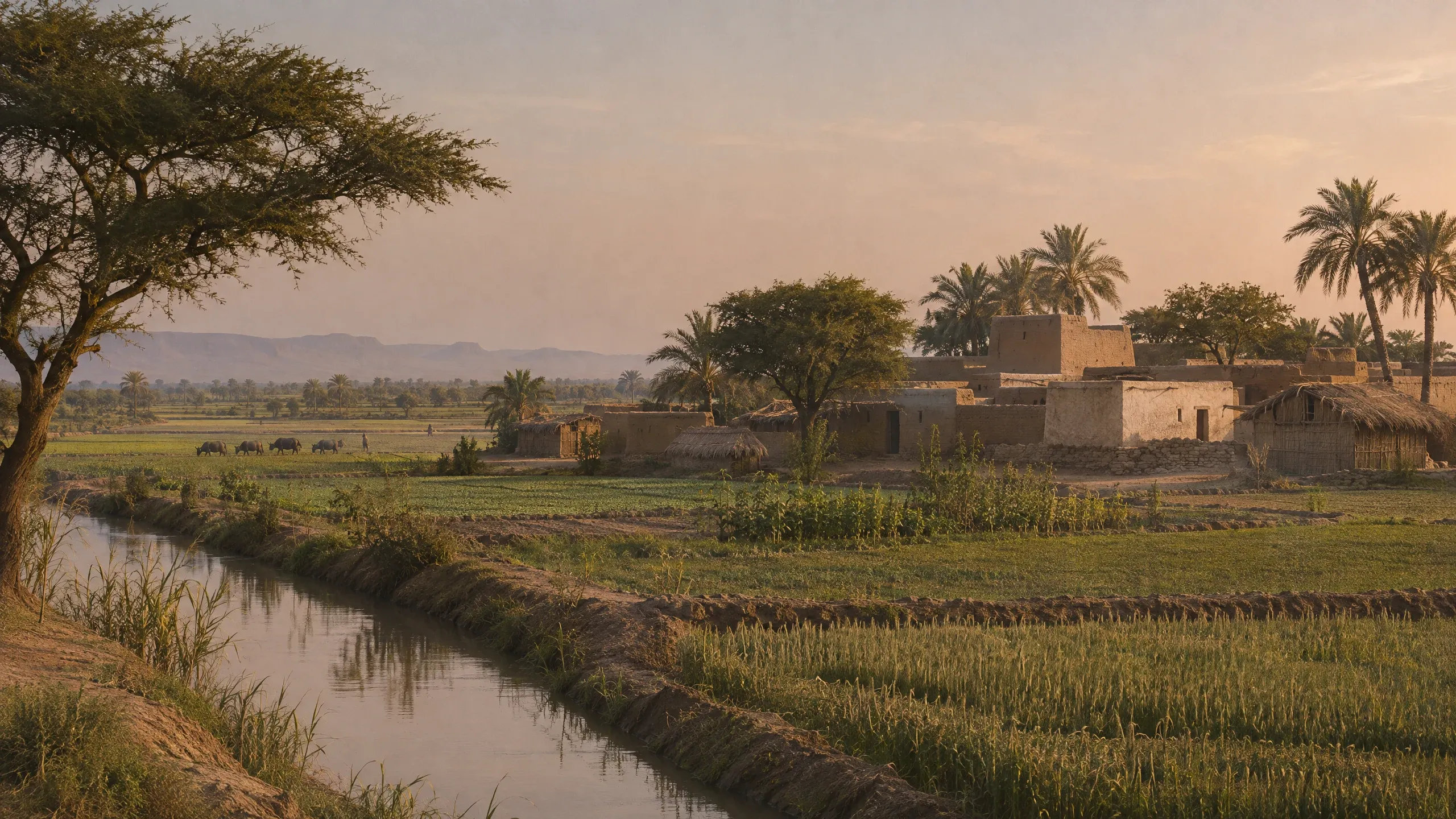
Sindh is the lower Indus region of what is now south-eastern Pakistan. It is bordered by Balochistan to the west and north, Punjab to the north-east, the Indian states of Rajasthan and Gujarat to the east, and the Arabian Sea to the south. The name comes from the river, called Sindhu. Sindh has a longer Ismaili history than any other part of South Asia. Ismaili rulers held Multan and Mansura in the Fatimid period, and the Sumra dynasty of Thatta adopted Ismailism. Satpanth tradition remembers the region as the field of Pir Shams and Pir Sadr al-Din, and as the home of the first jamatkhana. In the nineteenth century, Sindh was where Aga Khan I first settled on his arrival in India.12
Arab, Fatimid and Ghaznavid Sindh
The Arab conquest of 711 brought Islam to the subcontinent. From 712 to about 900 Sindh was the Umayyad and then Abbasid province of al-Sind, with its capital at al-Mansura, about 72 km north of modern Hyderabad. As caliphal power weakened, local Arab dynasties took control.3
Daftary describes how the Ismaili da’wa took root in this setting. An Ismaili state was set up in Multan in the Fatimid period. Around 401 AH a ruler of the Habbarid dynasty of Mansura also converted to Fatimid Ismailism and apparently made it the state religion. Mahmud of Ghazna destroyed both: Multan first, then Mansura in 416/1025. Fatimid Ismailism nevertheless survived in Sindh and became the creed of the Sumras, who rose against the Ghaznavids in 443/1051 and ruled from Thatta for almost three centuries.4
The Nizari da’wa
Nizari activity in South Asia, Daftary argues, was first concentrated in Sindh rather than in Gujarat, “where different forms of Isma’ilism had persisted in Multan and elsewhere despite periodical persecution”. Tradition credits Pir Shams with starting it. An earlier pir, Salah al-Din, is also said to have been sent from Alamut. Kassam places Pir Shams’s activity in the later twelfth century, in the conflicts between the Ismailis of Multan and Uch and the Ghurid sultan Mu’izz al-Din. She points to the Sumras of Lower Sindh as possible allies of the da’wa.56
The Satpanth took its lasting shape under Pir Sadr al-Din. Tradition says he converted Lohanas, gave them the title khwaja, from which the name Khoja comes, and built the first jamatkhana at Kotri, along with others in Punjab and Kashmir. Sindh’s politics were changing at the same time. Around 752/1351 the Sunni Sammas replaced the Sumras. The da’wa now depended on caste networks and hereditary pirs rather than on a sympathetic ruler. Daftary adds that the Nizari Khojas, with their Hindu-inflected Satpanth and their Sufi vocabulary, could present themselves as one more mystically oriented community of Sindh. That drew less attention from Sunni rulers.78
After the pirs
After Pir Taj al-Din, who died in the late fifteenth century and is buried at Jhun in Sindh, the line of pirs ended. Daftary records one later appointment, Pir Dadu. He was sent to Sindh in the second half of the sixteenth century to stop Khojas from returning to Hinduism or turning to Sunnism. Around 992/1584 Dadu was forced to leave Sindh with a group of followers for Navanagar (Jamnagar) in Gujarat. He died at Bhuj in Kutch in 1001/1593. The Imams of the Anjudan period were afterwards represented by wakils and bawas. Sayyid families descended from Pir Hasan Kabir al-Din kept their influence. The Kadiwala sayyids moved from Kadi in Kutch to Sindh and settled around 1194/1780 at Tando Muhammad Khan, where they are still active.910
Sindh also had a direct link with Persia. Daftary describes tombstones inscribed in Khojki Sindhi characters in the cemetery of Shah Nizar at Kahak. They record Khojas who made the long and dangerous journey to see the Imam in Persia.11
Mughal, Talpur and British Sindh
Britannica records that the Mughals ruled Sindh from 1591 to 1700. Several local Sindhi dynasties followed, the last of them the Talpurs, who lost the region to the British in 1843. Most of Sindh was then joined to the Bombay Presidency. It became a separate province in 1937, was merged into West Pakistan from 1955 to 1970, and was then restored as a province, with its capital at Karachi.12
Aga Khan I’s role in these events tied the modern Imamate to Sindh. He arrived in the autumn of 1842 and stayed at Jerruck, where his house still stands. He put his cavalry at the service of the British. He also passed on the battle plans of the Talpur amir Nasir Khan to Major James Outram, which saved the British camp from a night attack. After the battle of Miyani in February 1843 and the annexation of Sindh, General Sir Charles Napier granted him an annual pension of £2,000. In October 1844 he left Sindh by way of Karachi, travelling through Kutch and Kathiawar to Bombay.1314
Modern Sindh
Under Aga Khan II, Karachi became a second home of the Imamate. As heir, he visited the Khoja jamats of Sindh and Gujarat, organising their jamatkhanas. He lived for a time in Karachi, where Aga Khan III was born in 1877. After Partition in 1947, Asani describes Karachi as a city with a large Ismaili population, and records that Sunni revivalist groups there built mosques next to Ismaili jamatkhanas to draw Ismailis away. He also notes that Sindhi remains one of the languages into which the Imam’s farmans are translated for the jamat.1516
Footnotes
-
“Sindh,” Encyclopaedia Britannica, https://www.britannica.com/place/Sindh-province-Pakistan. ↩
-
Farhad Daftary, The Isma’ilis: Their History and Doctrines, 2nd ed. (Cambridge: Cambridge University Press, 2007), pp. 442–443, 470–472. ↩
-
“Sindh,” Encyclopaedia Britannica, history section. ↩
-
Daftary, The Isma’ilis, pp. 166–167. ↩
-
Daftary, The Isma’ilis, pp. 385–386. ↩
-
Tazim R. Kassam, Songs of Wisdom and Circles of Dance: An Anthology of Hymns by the Satpanth Isma’ili Saint, Pir Shams (PhD dissertation, McGill University, 1992), ch. 4 and ch. 5, conclusion, https://archive.org/details/bk038. ↩
-
Daftary, The Isma’ilis, p. 443. ↩
-
Daftary, The Isma’ilis, p. 444. ↩
-
Daftary, The Isma’ilis, p. 445. ↩
-
Daftary, The Isma’ilis, pp. 446–448. ↩
-
Daftary, The Isma’ilis, p. 457. ↩
-
“Sindh,” Encyclopaedia Britannica, history section. ↩
-
Daftary, The Isma’ilis, pp. 470–471. ↩
-
Daftary, The Isma’ilis, p. 472. ↩
-
Daftary, The Isma’ilis, p. 477. ↩
-
Ali S. Asani, “From Satpanthi to Ismaili Muslim: The Articulation of Ismaili Khoja Identity in South Asia,” in Farhad Daftary (ed.), A Modern History of the Ismailis (London: I.B. Tauris, 2011), sections on Ismaili Khojas after 1947 and on transnational identity. ↩