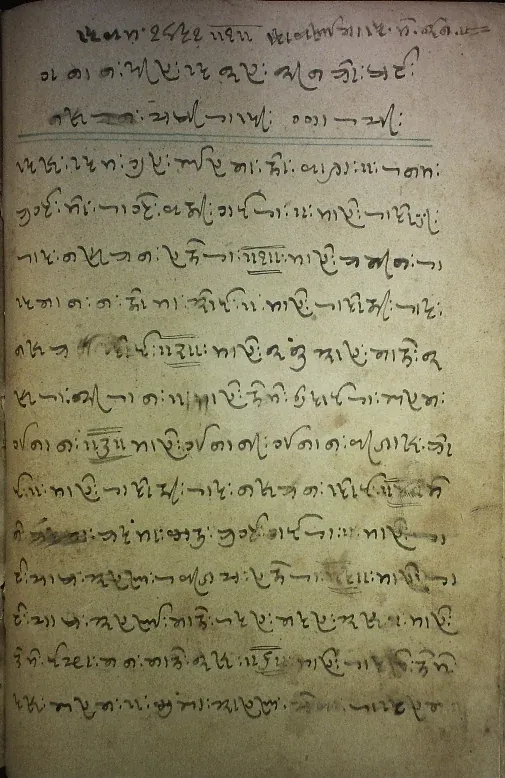
Ginans are the devotional hymns of the Nizari Ismailis of the Indian subcontinent. They are composed in north-western Indic vernaculars, chiefly Gujarati, Sindhi, Punjabi and forms of Hindi, and are sung to Indian melodic modes (ragas). For roughly seven centuries they formed the core of the liturgy and devotional life of the Satpanth communities later known as Khojas, and they are still recited in jamatkhanas today.1
The surviving corpus numbers some 1,000 compositions, in verse and prose. A ginan may be three verses long or run to hundreds of pages. The subjects include divine love, cosmology, meditation, ritual practice, eschatology and ethical conduct.2
The word
The term is usually derived from Sanskrit jnana, “knowledge”, in the sense of knowledge gained through meditation or esoteric wisdom. Asani renders the genre as “hymns of esoteric wisdom”.3 Wladimir Ivanow, the founder of modern Ismaili studies, compared the Indian usage to the Arabic Ismaili term haqa’iq, the true inner realities of religion. In the ginans themselves the word has two meanings at once: gnosis, and the body of texts that carries it. Virani’s study of nearly the whole corpus shows that this double sense is how the tradition defines itself.4
A fifteenth-century ginan cited by Virani places the origin of ginan before creation. In the darkness of pre-eternity (dhandhukar), the text says, the Incomprehensible One revealed his eternal gnosis (amar ginan) to the True Guide, who then called all souls to the “path of truth”, satpanth. The ginans thus present themselves not as human compositions but as the audible form of a knowledge held by the Guide from the beginning.5
Authorship and dating
Tradition attributes the ginans to the pirs, the chief representatives of the Ismaili Imams in South Asia, and to some of their family members and descendants. Most are credited to four figures placed between the twelfth and fifteenth centuries: Pir Satgur Nur, Pir Shams, Pir Sadr al-Din and Pir Hasan Kabir al-Din. A fifth, Imam Shah (d. c. 1513), is linked to the movement that broke away from the main community. Communities saw each pir as a “door” to the Imam.6
Almost everything known about these authors comes from hagiography, which is often anachronistic. Birth and death dates, especially for the earlier pirs, are uncertain. Daftary warns that the ginans are not reliable historical sources for the pirs’ careers, even though they are the main sources the communities kept.7 Kassam’s study of the ginans attributed to Pir Shams found dates inside the texts (1118, 1143 and 1150 CE) that do not match the genealogy kept by his shrine’s custodians, which covers 1165–1276. She concluded that attribution to a pir describes a tradition of composition and transmission. It does not prove single authorship by a historical individual.8
Attribution matters inside the tradition. In Satpanth understanding the pirs were not ordinary preachers. They were spiritually enlightened people whose authority came from the Imam in the “west”, Persia. Their verses carried that authority. Hagiographies say the pirs composed in local languages and idioms to cross the cultural and linguistic distance between themselves and their hearers.9
Composition did not end with the great pirs. Later sayyids descended from Hasan Kabir al-Din kept writing ginans. Among them were the Kadiwala sayyids, whose ancestor Sayyid Fadil Shah was active at Kadi in Kutch in the mid-seventeenth century before the family moved to Sindh. The last author whom the community recognises was a woman, Sayyida Imam Begum, who died in Karachi in 1866.1011
Doctrine in an Indic idiom
The central subject of the ginans is the Imam. Asani identifies four religious vocabularies that the authors used to express this doctrine. Which one appears depends on the date of composition, the theme and the audience.12
The first vocabulary is Vaishnava. Early ginans present Ali, and through him the line of Imams, as the long-awaited tenth avatar of Vishnu. This avatar, Kalki in Hindu sources, is renamed Nakalanki or Nikalank, “the stainless one”. The pir appears as the guide who knows where this avatar now lives: in Iran, as the Nizari Imam. The Qur’an is called the last of the Vedas. The best-known example is the Dasa Avatara (“Ten Incarnations”). Several versions exist, attributed to Pir Shams, Pir Sadr al-Din and Imam Shah.1314 Moir and Khan point out that Indic texts use nishkalanki only for the formless God. Its use as the title of an avatar was the Ismaili preachers’ equivalent of the Arabic ma’sum, “immaculate”, an attribute of the Imam.15
The second vocabulary is Sufi. The Suhrawardi and Qadiri orders were strong in Sindh and Punjab, where the pirs were most active. The ginans adopt Sufi terms: the Imam is the murshid (guide), the believer is the murid (disciple), the method is dhikr (remembrance), and the goal is didar, the vision of the divine. The long Hindi poem Bujh Niranjan describes stages of the mystical path in technical Sufi language. Khoja tradition attributes it to Pir Sadr al-Din. Asani has shown that it most likely came out of Qadiri circles and entered the ginan corpus later. Moir and Khan connect it with Muhammad Shahi Dula, a leader of the Sayyidkhani branch of the Imamshahis at Burhanpur who joined the Qadiri order.161718
The third vocabulary comes from the Sants, poet-saints whose anti-ritual, anti-caste teaching spread across north India in the same centuries. In this framework the ginans reject rote ritual and learning. They urge constant remembrance (sumiran) of the divine name (nam, shabd), which the Satguru, the “true guide”, bestows. In most ginans the Satguru is ambiguously the pir, the Imam (Shah) or both. The name Satpanth itself echoes Sant usage. Asani compares the later history of Satpanth to the way Guru Nanak’s Nanakpanth became Sikhism.19
The fourth vocabulary is that of bhakti, devotional love. The disciple is often a virahini, a woman separated from her beloved, who suffers viraha, the pain of longing. The beloved is the Imam. As a result, many ginans written by men speak in a woman’s voice. This convention is unusual in Arabic or Persian poetry, but it was common across sant, bhakti and Sikh poetry and in Sufi verse written in Indian languages.2021
The spiritual path
Across these vocabularies the ginans describe a consistent path. Attachment to the passing world, together with anger, greed and jealousy, keeps the soul in the cycle of rebirth. Release comes through allegiance to the Imam and his pir, who give the disciple a sacred word to meditate on. The goal is the vision (didar, darshan) of the divine light.22
Virani follows this teaching through the ginans’ own imagery. The soul has gnosis in the womb and makes a covenant (kol, Arabic qawl) with the Lord of the Resurrection (kayam, Arabic qa’im). This retells Qur’an 7:172, where the unborn descendants of Adam answer “Yes” to the question “Am I not your Lord?” Entering the world, the soul forgets its covenant, made drunk by the “wine of Satan” (sharab shaytani). A verse attributed to Pir Taj al-Din laments those who do not keep the promise: “Though we have composed in the diapason of sounds and musical modes, / The deaf will not listen!”23
Other ginans make the same points through dialogue and allegory. In one, Pir Hasan Kabir al-Din rebukes the yogi Kanipa for failing to recognise the Imam of the age, the “man of gnosis” (ginan purush). The pir uses the image of a lotus that grows from a swamp yet takes its water from the sky. Another ginan compares souls to birds caught in a hunter’s net. The ginans’ own conclusion is that knowledge is already within the heart, but only the True Guide can lead the soul back to it.24
Language, script and manuscripts
The ginans were written down in Khojki, a script used by Khoja merchants. Khojki was a refined form of Lohanaki, the script of the Lohana trading caste. Its letters were close to the commercial scripts of Sindh, and it was one of several mercantile scripts of the region. Manuscripts circulated in families and jamats. Many were later collected in London and elsewhere, where scholars have compared them with printed versions.2526
The ginans were not only an Ismaili Khoja inheritance. The Imamshahis of Pirana kept their own versions of many of the same texts in manuscript and print. Moir and Khan’s comparison of the two traditions shows that some passages giving special status to Imam Shah’s son Nur Muhammad Shah appear in printed Imamshahi versions but not in the manuscripts. Lines promising that the Imam would reappear among Imam Shah’s descendants appear to have been added in the late eighteenth century, for example to the ginan Cetamani.2728
Printing and the formation of a canon
According to community tradition, Aga Khan II and Aga Khan III asked Lalji Devraj and his associates to collect ginan manuscripts. The team recorded about 700 texts, edited to varying degrees. They published them through the Khoja press that Lalji Devraj founded in Bombay in 1903. The press was later called the Ismaili Printing Press, a change of name that reflects the shift in identity from Khoja to Ismaili. It printed Khojki with type cast in Germany. In 1922 ginan publication passed to the Recreation Club Institute, which Aga Khan III had founded in 1919. Private printing, such as the lithographs of the Ghulam-i Husayn press, was discouraged and had stopped by the early twentieth century.29
Lalji Devraj’s Tapsil buk of 1915, a catalogue of some 700 ginans, came to serve as the official list of the early printed texts. His editions were the basis for further revisions in the 1970s. His team is said to have buried nearly 3,500 of the manuscripts they used, which limited rival versions. Asani estimates that perhaps 300 texts were left out of the official corpus because their content no longer suited the direction in which Ismaili Khoja identity was moving.30
Changing use in the twentieth century
As the farmans (directives) of the living Imam were printed and became the main guide for faith and practice, the ginans’ role changed. They came to be read as commentary on the inner meaning (batin) of the Qur’an rather than as primary doctrine.31 Recitation of the Dasa Avatara, once the most important ginan in Khoja ceremonies, had stopped completely by the late 1950s. In the late 1970s other compositions that framed doctrine mainly in Indic terms were also dropped from use. Individual words were replaced: Hari became Ali, swami became maula, and Gur Brahma became Nabi Muhammad. Some members of the community objected, arguing that Indic words with no Hindu theological meaning had been removed as well.3233
The same texts took different paths in other communities. Among the Imamshahi Satpanthis of Gujarat, twentieth-century reformers read the ginans as part of a Hindu heritage. After a 1996 assembly of the sect’s religious leaders at Pirana, the syllable Om and images of Mahesh, Vishnu and Brahma were painted in the hall where the ghat-pat ceremony is held, opposite the qibla.3435 Asani concludes that the ginans are “portable” across modern religious boundaries. He also argues that calling them a literature of conversion, a view first set out publicly in the Aga Khan Case of 1866, is a later interpretation, not a description the texts give of themselves.36
Recitation
Ginans are sung by individuals and by congregations at the beginning and end of jamatkhana gatherings and at many other occasions. Each is tied to a traditional melody. Their opening verses are memorised and passed down by ear as well as in print. Kassam notes that the shorter ginans attributed to Pir Shams, including the garbi dance-songs, are among the best known and most used in the jamat. She also argues that the garbis belong to a later phase of the tradition than the narrative ginans set around Multan.37
Footnotes
-
Ali S. Asani, “Isma’ilism xiv. Isma’ilism in Ginan Literature,” Encyclopaedia Iranica, vol. XIV, fasc. 2 (New York: Encyclopaedia Iranica Foundation, 2007), pp. 204–205, https://iranicaonline.org/articles/ismailism-xiv-ismailism-in-ginan-literature/. ↩
-
Shafique N. Virani, “Symphony of Gnosis: A Self-Definition of the Ismaili Ginan Tradition,” in Todd Lawson (ed.), Reason and Inspiration in Islam (London: I.B. Tauris, in association with the Institute of Ismaili Studies, 2005), pp. 503–504. ↩
-
Asani, “Isma’ilism xiv,” p. 204; Ali S. Asani, “From Satpanthi to Ismaili Muslim: The Articulation of Ismaili Khoja Identity in South Asia,” in Farhad Daftary (ed.), A Modern History of the Ismailis (London: I.B. Tauris, in association with the Institute of Ismaili Studies, 2011), section “Locating Khoja Identity within Changing Contexts.” ↩
-
Virani, “Symphony of Gnosis,” pp. 504–505. ↩
-
Virani, “Symphony of Gnosis,” p. 503. ↩
-
Asani, “Isma’ilism xiv,” p. 204. ↩
-
Farhad Daftary, The Isma’ilis: Their History and Doctrines, 2nd ed. (Cambridge: Cambridge University Press, 2007), pp. 385–386, 442. ↩
-
Tazim R. Kassam, Songs of Wisdom and Circles of Dance: An Anthology of Hymns by the Satpanth Isma’ili Saint, Pir Shams (PhD dissertation, McGill University, 1992), ch. 5, “Pir Shams: Problems of Historical Identity,” https://archive.org/details/bk038. ↩
-
Asani, “Isma’ilism xiv,” p. 204. ↩
-
Daftary, The Isma’ilis, pp. 447–448. ↩
-
Asani, “From Satpanthi to Ismaili Muslim,” section on the standardisation of the ginans. ↩
-
Asani, “From Satpanthi to Ismaili Muslim,” section “Locating Khoja Identity within Changing Contexts.” ↩
-
Asani, “From Satpanthi to Ismaili Muslim,” section “Locating Khoja Identity within Changing Contexts”; Asani, “Isma’ilism xiv,” p. 205. ↩
-
Daftary, The Isma’ilis, p. 450. ↩
-
Zawahir Moir and Dominique-Sila Khan, “New Light on the Satpanthi Imamshahis of Pirana,” South Asia: Journal of South Asian Studies n.s. 33, no. 2 (2010), p. 214 and n. 12, https://doi.org/10.1080/00856401.2010.494824. ↩
-
Asani, “From Satpanthi to Ismaili Muslim,” section “Locating Khoja Identity within Changing Contexts.” ↩
-
Daftary, The Isma’ilis, p. 444. ↩
-
Moir and Khan, “New Light on the Satpanthi Imamshahis,” p. 221. ↩
-
Asani, “From Satpanthi to Ismaili Muslim,” section “Locating Khoja Identity within Changing Contexts.” ↩
-
Asani, “Isma’ilism xiv,” p. 205. ↩
-
Asani, “From Satpanthi to Ismaili Muslim,” section “Locating Khoja Identity within Changing Contexts.” ↩
-
Asani, “Isma’ilism xiv,” p. 205. ↩
-
Virani, “Symphony of Gnosis,” pp. 505–507. ↩
-
Virani, “Symphony of Gnosis,” pp. 507–509. ↩
-
Ali S. Asani, “Khoja,” Encyclopaedia Iranica, vol. XVI, fasc. 5 (2020), pp. 539–541, https://iranicaonline.org/articles/khoja/. ↩
-
Moir and Khan, “New Light on the Satpanthi Imamshahis,” pp. 212–213. ↩
-
Moir and Khan, “New Light on the Satpanthi Imamshahis,” p. 217 and n. 27. ↩
-
Moir and Khan, “New Light on the Satpanthi Imamshahis,” p. 224. ↩
-
Asani, “From Satpanthi to Ismaili Muslim,” section on the standardisation of the ginans. ↩
-
Asani, “From Satpanthi to Ismaili Muslim,” section on the standardisation of the ginans. ↩
-
Asani, “From Satpanthi to Ismaili Muslim,” sections “Reorienting understanding and practice of faith” and on the standardisation of the ginans. ↩
-
Asani, “From Satpanthi to Ismaili Muslim,” section on the standardisation of the ginans. ↩
-
Daftary, The Isma’ilis, p. 450. ↩
-
Asani, “From Satpanthi to Ismaili Muslim,” section on the standardisation of the ginans. ↩
-
Moir and Khan, “New Light on the Satpanthi Imamshahis,” pp. 231–232. ↩
-
Asani, “From Satpanthi to Ismaili Muslim,” section on the standardisation of the ginans. ↩
-
Kassam, Songs of Wisdom and Circles of Dance, ch. 1 and ch. 5. ↩