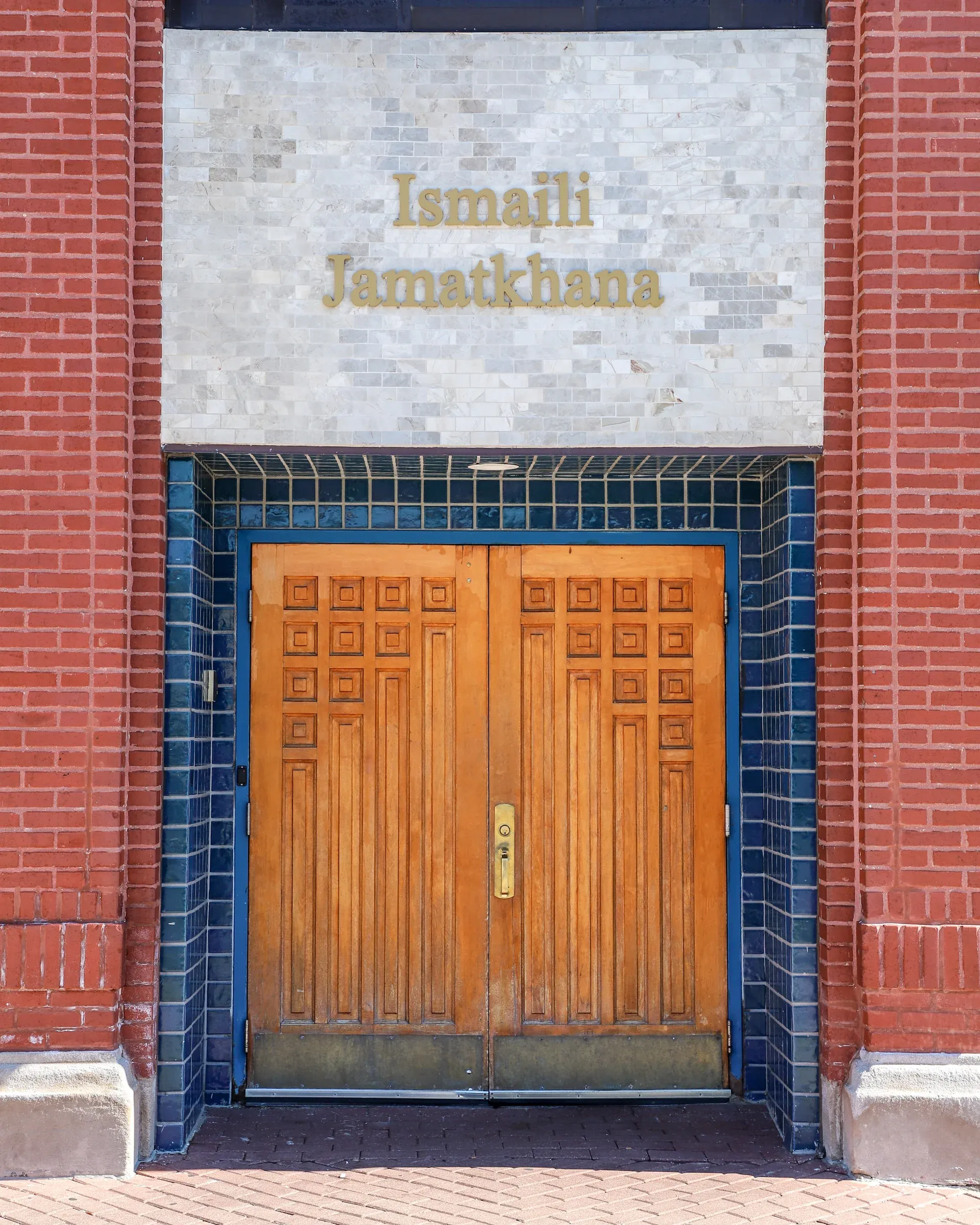
A jamatkhana is a house of congregation. The word combines Arabic jama’a, “community” or “assembly”, with Persian khana, “house”. Several Muslim communities in South Asia and Central Asia used it, Sufi orders among them. Among the Nizari Ismailis the jamatkhana became the main place of communal prayer and gathering. It began among the Satpanth communities of Sindh and Gujarat. From there it spread with the Khoja diaspora, and in the twentieth century it was adopted by Ismaili communities outside South Asia.12
The Ismaili institutional account describes it as one of a family of Muslim spaces, alongside the ribat, the zawiya and the khanaqa, that grew up next to the mosque. Each was used for the particular practices of a community or order. Ismaili institutions present the jamatkhana as reserved for members who have given the oath of allegiance (bay’a) to the Imam, and for practices specific to the Shia Ismaili tariqa. This page follows the institution’s history as historians have reconstructed it. It treats the community’s own view of the space as the community’s view.3
Origins under the pirs
Tradition credits Pir Sadr al-Din with founding the first jamatkhana, at Kotri (Kotdi) in Sindh. Daftary dates his death to between 770/1369 and 819/1416. He is said to have built two more centres, in Punjab and in Kashmir. Each was led by a mukhi, from Sanskrit mukhya, “chief”. The tradition is preserved in Khoja sources and repeated in modern Ismaili institutional writing. Aziz Esmail, for example, writes that Sadr al-Din “is credited with the setting up of the first jamatkhana (communal centre) at Kotdi”. No contemporary record confirms it.45
The tradition sets the jamatkhana within the organisation Sadr al-Din is said to have given the Indian da’wa. That organisation included the conversion of Lohana groups and the title khwaja for the converts. In this account, the jamatkhana was where converts met to recite ginans and the community prayer, and where the tithe (dasond) was collected for transmission to the Imam in Persia.67
The jamatkhana in Satpanth practice
The rites performed in early jamatkhanas can be reconstructed only partly, mostly from nineteenth-century descriptions. In the early nineteenth century, Khoja congregations recited ginans, among them the Dasa Avatara, and said a ritual prayer three times a day in Gujarati with Arabic and Persian phrases. Arabic namaz was kept for the two Ids. The ghat-pat ceremony, in which consecrated water mixed with Karbala clay was sipped, was a central rite.8
Asani adds that the old daily prayer, attributed to Pir Sadr al-Din, was in Sindhi and Gujarati with Arabic phrases. It called on the Imam as pir and murshid and as Nikalank, the stainless tenth avatar, and named a chain running from the ten avatars to the Imams down to Aga Khan III.9
Satpanth jamatkhanas outside the Khoja community took other forms. In Kutch, the Imamshahi Satpanthis traditionally met in khanas set up in ordinary houses. In the late twentieth century these were abandoned in favour of purpose-built “Nishkalanki Mandirs”. These had a canopy for the ghat-pat and images of three Hindu deities and the syllable Om painted on the wall. Moir and Khan describe the change as part of the redefinition of Imamshahi Satpanth as a Hindu sect.10 At the shrine of Pirana itself, the late eighteenth-century reforms of the Jalalshahi sayyid Bara Mian drew pilgrims in such numbers that guest houses (musafar khanas) had to be built for them. The shrine functioned as a regional pilgrimage centre rather than a congregational hall.11
Officers: the mukhi and the kamadia
Every Khoja congregation of any size had a mukhi and his assistant, the kamadia (pronounced kamriya), with clearly defined duties. They collected religious dues, especially the dasond. They presided over ceremonies in the jamatkhana. They acted as the social and religious heads of the local group. Asani describes the kamadia as a treasurer. Daftary notes that the titles were Sanskrit in origin and were later adopted by non-Khoja Nizari communities.1213
Before the Imam came to India, office-holders were usually elected, and the community ran its own affairs. In Bombay, communal property, the jamatkhanas included, was managed by a council of leading Khoja merchants. Together with the mukhi, the kamadia and a sayyid or vakil, they collected the dues sent to the Imams in Iran.14
Bombay: property, authority and violence
After Aga Khan I settled in Bombay in 1848, he attended the Bombay jamatkhana on major religious occasions and led the Khojas’ public prayers there. He also appointed the mukhis and kamadias of the larger congregations himself. This put the Imam at the centre of an institution that until then had been largely run by the caste.15
Control of the jamatkhana and its property became the centre of the nineteenth-century disputes. After their second expulsion in 1848, the dissident Barbhai party set up a separate jamatkhana in Bombay. At Mahim, the two parties shared one building: the Barbhai used the upper floor and the Aga Khan’s followers the lower. In 1850 four members of the Barbhai party were murdered in the Mahim jamatkhana. Nineteen Khojas were tried and four sentenced to death.16
The 1866 suit against the Aga Khan sought, among other things, to put communal property in trust and to make mukhis and kamadias elected again. Justice Arnould’s judgement placed the community property of the Nizari Khojas in the Aga Khan’s name and under his control. This included its jamatkhanas.1718
Aga Khan II and the provincial jamats
The Bombay settlement also changed provincial congregations. Aqa Ali Shah, later Aga Khan II, joined his father in Bombay in 1853. As heir apparent he regularly visited Nizari Khoja communities, especially in Sindh and Gujarat, and organised their jamatkhanas. For a time he lived in Karachi, where his son Sultan Muhammad Shah, the future Aga Khan III, was born in 1877. During his short imamate (1881–1885) he opened schools for Khoja children in Bombay and elsewhere. He also expanded contact with followers in Central Asia, Burma and East Africa, regions where Khoja migrants were already founding jamatkhanas of their own.19
Before these changes the jamatkhana had been mainly a caste institution of the Khojas: it held caste property, and caste members decided disputes and excommunications there. In the second half of the nineteenth century it became more and more an institution of the Imamate. Asani traces how sectarian affiliation replaced caste as the basis of Khoja identity. Once the jamatkhana was defined as the space of the Imam’s murids, those who rejected the Imam’s authority had to set up congregations of their own, as the Barbhai did with their separate Bombay jamatkhana in 1848, and as the Sunni and Ithna’ashari Khojas later did with their own communal institutions.202122
Constitution and reform
Under Aga Khan III the jamatkhana became the main channel for the Imam’s guidance. Constitutions from 1905 onward set up councils that ran communal affairs. Printed collections of farmans, the Imam’s directives, were read aloud in jamatkhanas as part of worship. Over the twentieth century the liturgy changed: the old dua was replaced in the 1950s by a new six-part prayer opening with Qur’anic verses, and ginans framed in strongly Indic terms were removed from use.23
After the Partition of 1947 the jamatkhanas of Pakistan faced new pressures. Asani reports that in Karachi, which has a large Ismaili population, Sunni revivalist groups such as the Jama’at-i Islami and the Tablighi Jama’at built mosques next to Ismaili jamatkhanas to draw Ismailis into Sunni practice.24
A global institution
With migration to East Africa from the nineteenth century, and later to Europe and North America, the jamatkhana became the common institution of a dispersed community. The Institute of Ismaili Studies has published Aliaa Remtilla’s account of East African jamatkhanas built in Kenya, Uganda and Tanzania under Aga Khan III and Aga Khan IV. Her account follows the migrations that followed the Ugandan expulsion of 1972.25
Asani describes how the offices of mukhi and kamadia, “a quintessentially Khoja institution representing the authority of the Imam in the jamaat-khana”, were extended to non-Khoja Ismaili communities. Practices also travelled the other way: Persian and Arabic qasidas from other Ismaili traditions are now recited in Khoja jamatkhanas. A farman given in Dushanbe may be read in a jamatkhana in Karachi, Mombasa, Toronto or Boston.26
Institutional statements describe the jamatkhana’s purpose in ethical as well as devotional terms. At the foundation ceremony of the Dhaka jamatkhana in 2008, Aga Khan IV called it “a place of peace and tranquillity, filled with a spirit of humility and prayer” and “a place for search and enlightenment”.27
In large cities, jamatkhanas have been built into Ismaili Centres, which also have public and secular spaces. At the opening of the Ismaili Centre in Toronto on 12 September 2014, Aga Khan IV said: “One of the ways in which Ismailis have expressed their identity wherever they have lived is through their places of prayer, known today as the Jamatkhana.” At the foundation of the jamatkhana in Khorog, Tajikistan, in 2008, he said it would be “reserved for traditions and practices specific to the Shia Ismaili tariqah of Islam”.28
Footnotes
-
“The History of Jamatkhanas and Their Significance,” The Ismaili (Canada), https://the.ismaili/ca/en/news/history-jamatkhanas-and-their-significance. ↩
-
Farhad Daftary, The Isma’ilis: Their History and Doctrines, 2nd ed. (Cambridge: Cambridge University Press, 2007), pp. 443, 473–474. ↩
-
“The History of Jamatkhanas and Their Significance,” The Ismaili (Canada). ↩
-
Daftary, The Isma’ilis, p. 443. ↩
-
“The History of Jamatkhanas and Their Significance,” The Ismaili (Canada), quoting Aziz Esmail, A Scent of Sandalwood. ↩
-
Daftary, The Isma’ilis, p. 443. ↩
-
Ali S. Asani, “Khoja,” Encyclopaedia Iranica, vol. XVI, fasc. 5 (2020), pp. 539–541, https://iranicaonline.org/articles/khoja/. ↩
-
Asani, “Khoja,” pp. 539–540. ↩
-
Ali S. Asani, “From Satpanthi to Ismaili Muslim: The Articulation of Ismaili Khoja Identity in South Asia,” in Farhad Daftary (ed.), A Modern History of the Ismailis (London: I.B. Tauris, in association with the Institute of Ismaili Studies, 2011), section “Reorienting understanding and practice of faith.” ↩
-
Zawahir Moir and Dominique-Sila Khan, “New Light on the Satpanthi Imamshahis of Pirana,” South Asia: Journal of South Asian Studies n.s. 33, no. 2 (2010), pp. 231–232, https://doi.org/10.1080/00856401.2010.494824. ↩
-
Moir and Khan, “New Light on the Satpanthi Imamshahis,” p. 225. ↩
-
Daftary, The Isma’ilis, pp. 473–474. ↩
-
Asani, “From Satpanthi to Ismaili Muslim,” section on the colonial courts. ↩
-
Asani, “From Satpanthi to Ismaili Muslim,” section on the colonial courts. ↩
-
Daftary, The Isma’ilis, pp. 473–474. ↩
-
Daftary, The Isma’ilis, p. 475. ↩
-
Daftary, The Isma’ilis, pp. 475–476. ↩
-
Daftary, The Isma’ilis, p. 476. ↩
-
Daftary, The Isma’ilis, p. 477. ↩
-
Asani, “From Satpanthi to Ismaili Muslim,” section on the colonial courts. ↩
-
Asani, “Khoja,” pp. 539–540. ↩
-
Daftary, The Isma’ilis, p. 475. ↩
-
Asani, “From Satpanthi to Ismaili Muslim,” section “Reorienting understanding and practice of faith.” ↩
-
Asani, “From Satpanthi to Ismaili Muslim,” section on Ismaili Khojas after 1947. ↩
-
Institute of Ismaili Studies, publication listing for Aliaa Remtilla, Experiences of the Jamatkhana, https://www.iis.ac.uk/publications-listing/experiences-of-the-jamatkhana/. ↩
-
Asani, “From Satpanthi to Ismaili Muslim,” concluding section on transnational Ismaili identity. ↩
-
“The History of Jamatkhanas and Their Significance,” The Ismaili (Canada), quoting Aga Khan IV at the foundation ceremony of the Dhaka jamatkhana (2008). ↩
-
“The History of Jamatkhanas and Their Significance,” The Ismaili (Canada), quoting Aga Khan IV at the opening of the Ismaili Centre, Toronto (12 September 2014) and the foundation ceremony in Khorog (2008). ↩