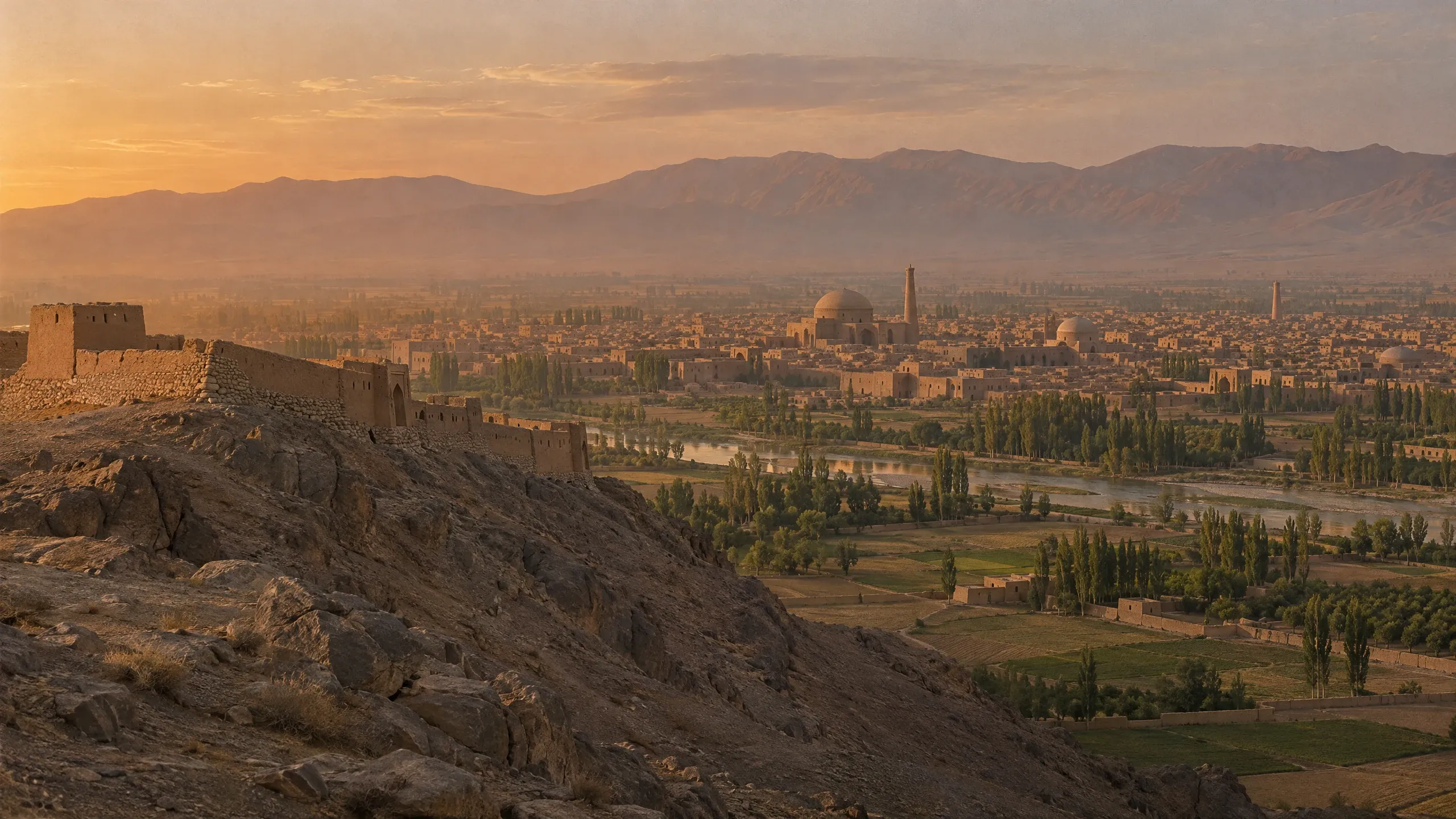
Isfahan, in central Iran, was the main capital of the Great Saljuq sultans in the late eleventh and early twelfth centuries. It was also, secretly, the headquarters of the Ismaili da’wa in the Saljuq lands. The chief da’i ’Abd al-Malik b. ’Attash directed the mission from Isfahan, and Hasan-i Sabbah trained there before he went to Egypt. After 1094 the Nizaris made their most daring attempt at an urban base here: Ahmad b. ’Attash held the citadel of Shahdiz, just outside the city, until Sultan Muhammad Tapar took it in 1107.1 The city’s later history lies outside the scope of this page.
Headquarters of the Persian da’wa
By the early 460s/1070s the Ismailis of the Saljuq realm had a single chief da’i, ’Abd al-Malik b. ’Attash, based in Isfahan. From there he revived the da’wa across Persia, from Kirman to Adharbayjan. He took his instructions from the da’wa headquarters in Fatimid Cairo, where al-Mustansir was Imam.2 Daftary’s dictionary describes him as a calligrapher and learned theologian who was respected for his learning even among Sunnis.3
Hasan-i Sabbah in Isfahan
’Abd al-Malik launched Hasan-i Sabbah’s career. In Ramadan 464 / May–June 1072 he met the young convert at Rayy, gave him a post in the da’wa and urged him to go to Cairo. In 467/1074–75 Hasan joined him in Isfahan. In 469/1076 Hasan set out from Isfahan for Egypt, travelling by way of Adharbayjan, Mayyafariqin, Mosul and Damascus.4
By 487/1094 Hasan had clearly replaced ’Abd al-Malik as leader of the Persian Ismailis. Daftary’s dictionary says ’Abd al-Malik seems to have spent his last years quietly at Alamut, where he died on an unknown date.3 In the succession crisis of 1094 the Persian da’wa, led from Alamut, recognised Nizar. The Ismailis of Isfahan went with it and broke with Cairo (see the Nizari–Musta’li split).5
Massacres in the Saljuq capital
Because Isfahan was the capital, the conflict between the Nizaris and the Saljuqs was felt there sharply. Daftary records that targeted killings by the Nizaris set off popular violence against anyone suspected of Ismailism. In about 486/1093 a bonfire was lit in Isfahan to burn suspected Ismailis. In 494/1101, after Sultans Barkiyaruq and Sanjar agreed to act together against the Nizaris, there were massacres in Isfahan and in Baghdad.6
The fear could reach the sultan’s court. Ibn al-Athir, cited by Daftary, reports that Saljuq officers asked permission to wear armour in Barkiyaruq’s presence. Daftary treats the hostile chronicles of these years as evidence of widespread panic, not as reliable counts of Nizari agents.7
Shahdiz
Shahdiz, earlier called Dizkuh, stood on the summit of Mount Suffa about eight kilometres south of Isfahan. Sultan Malikshah had rebuilt it. Ahmad, son of ’Abd al-Malik b. ’Attash, took the post of schoolmaster to the children of its Daylami garrison and gradually won the garrison over. By 494/1100 he held the castle.8
From Shahdiz Ahmad collected taxes in the surrounding districts. He kept a mission house (da’wat-khana) near Isfahan, and the sources say he made 30,000 converts. The Nizaris also took a second fortress, Khanlanjan (Khalanjan), about 30 kilometres south of the city. The Saljuqs mounted heavy campaigns against them, but by Daftary’s account no stronghold was lost in 494/1101.9
The siege of 1107
After Barkiyaruq died, Sultan Muhammad Tapar made the Nizaris his first target. In 500/1107 he besieged Shahdiz in person. Ahmad b. ’Attash opened negotiations, arguing that the Nizaris were true Muslims who differed from Sunnis only on the imamate, and offering tribute. Some jurists were ready to accept this. The Shafi’i scholar al-Samanjani opposed any terms and prevailed.10
Under the final agreement part of the garrison was given safe-conduct to the Nizari strongholds at Arrajan and in Quhistan. Ahmad stayed with about eighty men and fought to the last tower. His wife put on her jewels and threw herself from the ramparts. Ahmad was captured, paraded through Isfahan and skinned alive, and the heads of the defenders were sent to the Abbasid caliph al-Mustazhir. Khanlanjan was destroyed, and the Nizari forts at Arrajan were taken by Fakhr al-Din Chawli, atabeg of Fars.11
Daftary’s dictionary records that Shahdiz was demolished after it fell. With it went the last Nizari stronghold close to a major Saljuq city. Ahmad b. ’Attash’s long tenure there had shown how far the da’wa could reach into the heart of Saljuq power.12 The episode showed, in Hodgson’s terms, that the Nizaris could not keep strongholds near the main Saljuq cities. After 1107 they concentrated on the mountain territories of Rudbar, Qumis and Quhistan.13
The killing of al-Rashid
Isfahan saw one more famous Nizari killing. In Ramadan 532 / June 1138 the deposed Abbasid caliph al-Rashid, who had come to Isfahan, was killed there by four fida’is. It was the first act of the reign of Muhammad b. Buzurg-Ummid, and the sources say Alamut celebrated for a week.14
Footnotes
-
Farhad Daftary, The Isma’ilis: Their History and Doctrines, 2nd ed. (Cambridge University Press, 2007), pp. 311, 330, 336. ↩
-
Daftary, The Isma’ilis, p. 311. ↩
-
Farhad Daftary, Historical Dictionary of the Ismailis (Scarecrow Press, 2012), s.v. “’Abd al-Malik b. ’Attash”. ↩ ↩2
-
Daftary, The Isma’ilis, p. 312. ↩
-
Daftary, The Isma’ilis, pp. 324–325. ↩
-
Daftary, The Isma’ilis, pp. 329–330. ↩
-
Daftary, The Isma’ilis, p. 330. ↩
-
Daftary, The Isma’ilis, p. 330; Daftary, Historical Dictionary, s.v. “Ahmad b. ’Abd al-Malik b. ’Attash”, “Shahdiz”. ↩
-
Daftary, The Isma’ilis, p. 330; Daftary, Historical Dictionary, s.v. “Ahmad b. ’Abd al-Malik b. ’Attash”. ↩
-
Daftary, The Isma’ilis, pp. 335–336. ↩
-
Daftary, The Isma’ilis, p. 336. ↩
-
Daftary, Historical Dictionary, s.v. “Shahdiz”. ↩
-
Daftary, The Isma’ilis, pp. 338–339; M. G. S. Hodgson, “The Isma’ili State”, in J. A. Boyle (ed.), The Cambridge History of Iran, vol. 5 (Cambridge University Press, 1968). ↩
-
Daftary, The Isma’ilis, p. 356. ↩