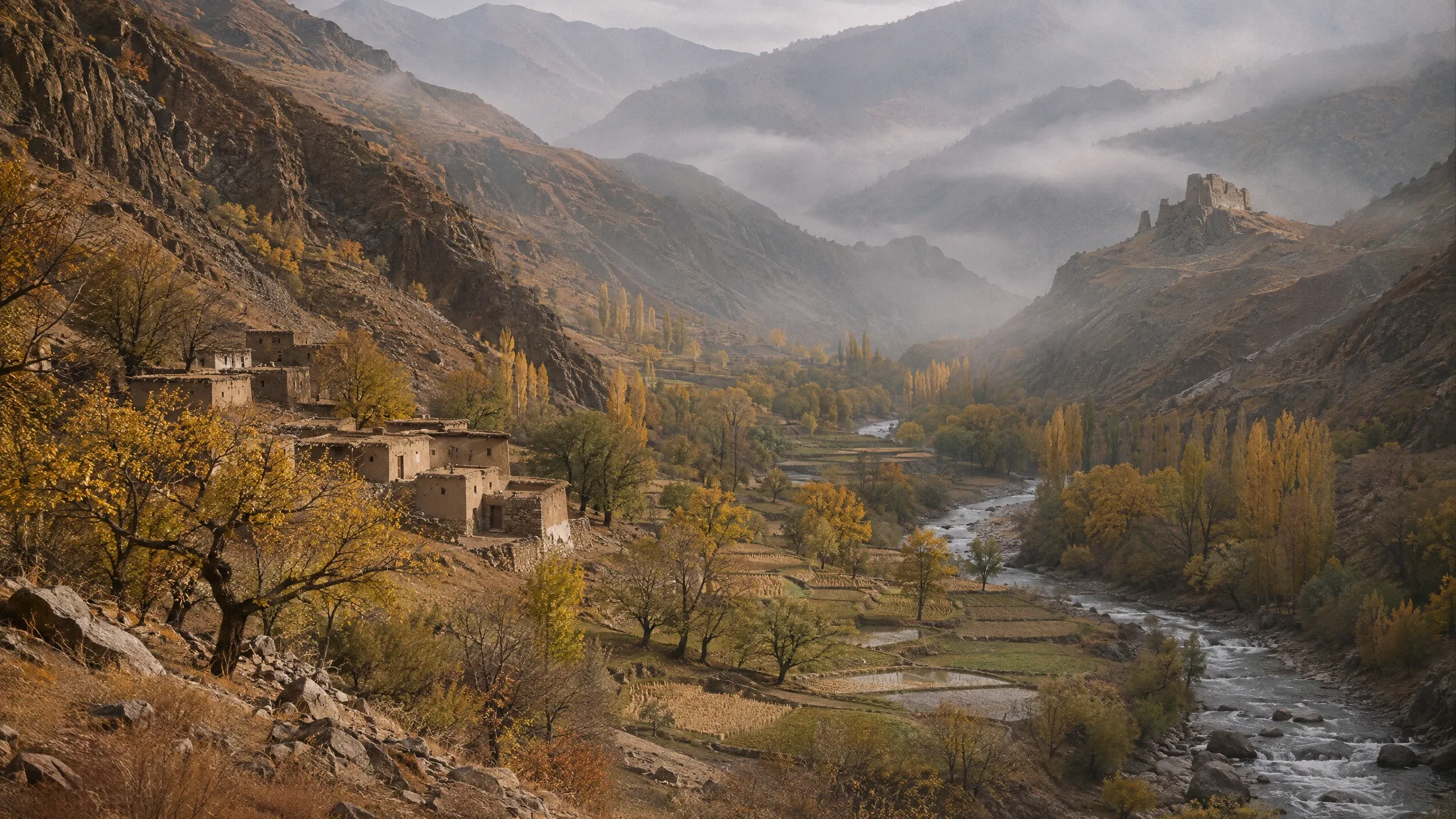
Rudbar (“river valley”) is the name later given to Daylaman, the highland part of medieval Daylam south of Lahijan and east of the Safidrud in the central Alborz. It covers the valleys of the Alamut river and the Shahrud. From 1090 to 1256 it was the core territory of the Nizari Ismaili state. The capital, Alamut, stood there, together with the great castle of Lamasar, the late fortress of Maymundiz and dozens of smaller strongholds.1 Rudbar is one of three Nizari territories in Persia, with Quhistan and Qumis. Its fall to Hülegü in November–December 1256 ended the Nizari state.2 (The coordinates given here are approximate.)
Daylam before the Nizaris
Daftary’s dictionary describes Daylam as the mountainous country along the southern Caspian coast. Its hard-to-reach highlands had long sheltered ’Alids escaping Abbasid persecution. The Justanid dynasty ruled it from the late eighth century, with their seat in the Alamut valley, and one Justanid, Wahsudan b. Marzuban (d. c. 251/865), built the castle of Alamut. Zaydi ’Alids set up their own rule in the region at the same time.3
The Justanid lands then passed to the Musafirids of Tarum, who followed the Qarmati form of Ismailism and had their seat at Shamiran. The Ismaili da’wa had been active in Daylam since the mid-ninth century. The Shi’i Buyids, who ruled Iraq and western Iran in the tenth and eleventh centuries, also came from Daylam.4
Why Hasan-i Sabbah chose Rudbar
By about 480/1087 Hasan-i Sabbah had decided that Daylam, with its tradition of resisting outside rule, was the best place to start an open revolt against the Saljuqs. Working from Damghan and later from Shahriyarkuh in Mazandaran, he sent the da’is Isma’il Qazwini, Muhammad Jamal Razi and Kiya Abu’l-Qasim Larijani into the district. He himself was appointed da’i of Daylam. Converts in the Alamut garrison, won over by Husayn Qa’ini, prepared the way for Hasan to take the castle on 6 Rajab 483 / 4 September 1090.5
From Alamut the Nizaris spread across Rudbar by winning over or seizing castles. In 486/1093 they took Anjirud. At Taliqan they defeated a force of 10,000 Sunnis from Rayy led by the Hanafi Abu Muhammad Za’farani. In Dhu’l-Qa’da 489 / November 1096 Buzurg-Ummid took Lamasar, which controlled the Shahrud approaches.6
A state of castles
Daftary’s dictionary sets out the principles of Nizari castle-building. Sites had to be defensible by a small garrison, have their own water and food, and lie near a friendly population. Each major castle had deep, roofed cisterns lined with limestone. In Rudbar, Alamut, Lamasar and their neighbours formed a defensive network that controlled the valleys and their farmland. Unlike Crusader castles, they were built for defence, not as bases for conquest.7
Under Buzurg-Ummid the Nizaris built two more important fortresses, Sa’adatkuh and Maymundiz. Work on Maymundiz began in Rabi’ I 520 / April 1126.8 Daftary’s dictionary places Maymundiz north of the present village of Shams Kilaya, west of Alamut. It notes that scholars disagree about its exact location and that it was built between 490 and 520/1097–1126, or, less probably, a century later.9 Under Muhammad b. Buzurg-Ummid the Nizaris gained further castles in the eastern Alborz, including Sa’adatkuh, Mubarakkuh and Firuzkuh, through Kiya Muhammad b. ’Ali Khusraw Firuz.10
Saljuq sieges
Rudbar was attacked many times. In 485/1092 the amir Arslan Tash besieged Alamut and was driven off. In 501/1107–08 or 502/1108–09 the vizier Diya’ al-Mulk Ahmad, a son of Nizam al-Mulk, and the amir Chawli invaded and failed. From 503/1109 Anushtagin Shirgir spent eight years on a campaign of attrition. He destroyed the crops of Rudbar every year and besieged Lamasar and Alamut. Hasan-i Sabbah sent his wife and daughters to Girdkuh. The siege ended in Dhu’l-Hijja 511 / April 1118, when news came of Sultan Muhammad Tapar’s death and the Saljuq troops left, abandoning their supplies to the Nizaris.11
Daftary follows Hodgson in calling the decades that followed a “period of stalemate”. The Nizaris had lost their footholds in the cities, but the Saljuqs could not dislodge them from their mountain territories. Rudbar’s conflicts became a matter of local raids against Qazwin and the Caspian dynasties, in which flocks of sheep and herds of cattle changed hands.12
The Mongol advance into Rudbar
In 1256 Hülegü sent his armies into Rudbar from several directions. Buqa-Temür and Köke-Ilgei came through Mazandaran, Tegüder and Ket-Buqa through Khuwar and Simnan, and Hülegü himself by way of Firuzkuh, Damavand and Rayy. Balaghai and Tutar came up from ’Iraq-i ’Ajam. Rukn al-Din Khurshah tried to negotiate. He offered to submit, sent his brother and son as hostages, and asked for a year’s delay and for Alamut and Lamasar to be spared. On 18 Shawwal 654 / 8 November 1256 Hülegü arrived before Maymundiz, where Khurshah was staying.13
The Mongols cut down the trees the Nizaris had planted to make mangonels, and brought up a Chinese ballista with a range of 2,500 paces. Bombardment began on 25 Shawwal / 15 November, and Khurshah came down on 29 Shawwal 654 / 19 November 1256. Daftary’s dictionary records that the Mongols then climbed up to Maymundiz and dismantled its buildings.14
Demolition
Khurshah’s officials went with Mongol envoys around Rudbar, ordering the castles to surrender. Juvayni writes that about forty castles were taken and pulled down. Alamut held out for a few weeks and Lamasar for about a year.15 Juvayni describes the demolition of Alamut, where the walls were so strong that pickaxes bounced off them. He counted the destruction of these castles as one of Hülegü’s great achievements.16
After 1256
Daftary’s dictionary notes that after 1256 the various parts of Daylam passed to the Hazaraspids of Ashkawar, the Bawandids, the Badusapanids of Ruyan, a new Zaydi dynasty and others. The Nizaris of Daylaman regrouped in the fourteenth century and held Alamut and Lamasar for short periods before local rulers expelled them. The Safavids incorporated the region in the sixteenth century and used Alamut as a state prison.17
Footnotes
-
Farhad Daftary, Historical Dictionary of the Ismailis (Scarecrow Press, 2012), s.v. “Daylam”; Farhad Daftary, The Isma’ilis: Their History and Doctrines, 2nd ed. (Cambridge University Press, 2007), p. 317. ↩
-
Daftary, Historical Dictionary, s.v. “Qumis”; Daftary, The Isma’ilis, pp. 353, 396. ↩
-
Daftary, Historical Dictionary, s.v. “Daylam”. ↩
-
Daftary, Historical Dictionary, s.v. “Daylam”, “Musafirids”. ↩
-
Daftary, The Isma’ilis, pp. 314–316. ↩
-
Daftary, The Isma’ilis, p. 324. ↩
-
Daftary, Historical Dictionary, s.v. “Architecture”. ↩
-
Daftary, The Isma’ilis, p. 344. ↩
-
Daftary, Historical Dictionary, s.v. “Maymundiz”. ↩
-
Daftary, The Isma’ilis, p. 356. ↩
-
Daftary, The Isma’ilis, pp. 319, 337; ’Ata-Malik Juvayni, The History of the World-Conqueror, tr. J. A. Boyle (Manchester University Press, 1958), vol. 2, p. 636. ↩
-
Daftary, The Isma’ilis, pp. 338–339, 356. ↩
-
Daftary, The Isma’ilis, pp. 394–395. ↩
-
Daftary, The Isma’ilis, p. 395; Daftary, Historical Dictionary, s.v. “Maymundiz”. ↩
-
Daftary, The Isma’ilis, p. 396; Juvayni, World-Conqueror, vol. 2, p. 717. ↩
-
Juvayni, World-Conqueror, vol. 2, pp. 718–719. ↩
-
Daftary, Historical Dictionary, s.v. “Daylam”, “Lamasar”, “Alamut”. ↩