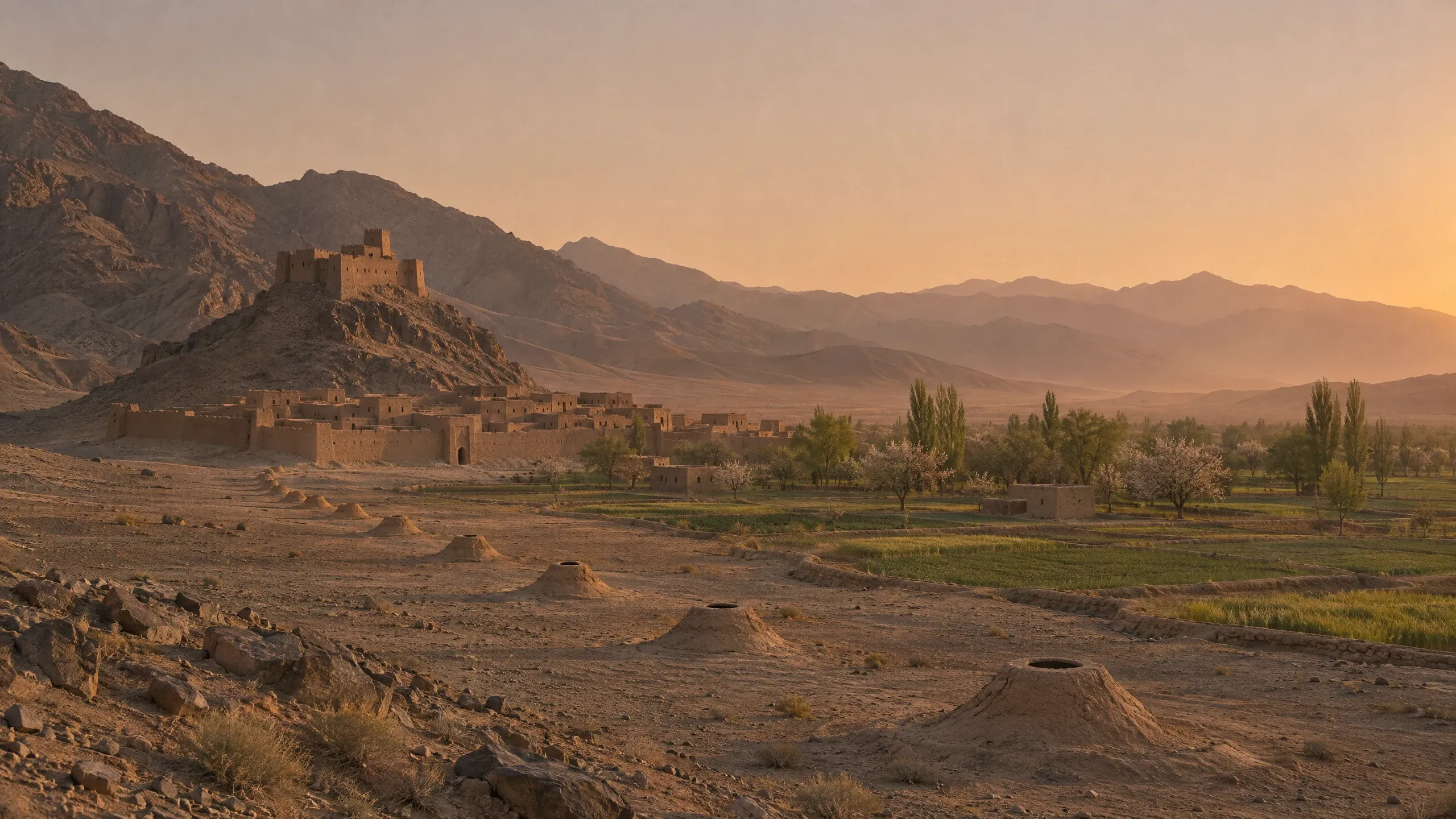
Quhistan (Persian Kuhistan, “the land of mountains”) was the medieval name for south-eastern Khurasan. Its main towns were Qa’in, Tun, Tabas, Zuzan and later Birjand, and it reached from south of Nishapur to the borders of Sistan. From 1091–92 it was one of the three territories of the Nizari Ismaili state, alongside Rudbar around Alamut and Qumis around Girdkuh.1 In the thirteenth century it was a refuge for scholars fleeing the Mongols, among them Nasir al-Din al-Tusi. Its Nizari population was massacred in 1257. Nizari communities have continued to live around Qa’in and Birjand to the present day.2 (The coordinates given here are those of Qa’in.)
The rising of 1091–1092
In 484/1091–92 Hasan-i Sabbah sent Husayn Qa’ini, a da’i from Quhistan who had helped win over the Alamut garrison, back to his home region. Daftary describes Quhistan as a barren region where the population was deeply unhappy with the harsh rule of a local Saljuq amir. As a result, the Ismaili da’wa there did not spread only by secret conversion and the capture of castles. It turned into what Daftary calls “a popular uprising against the Saljuqs”.3
The Ismailis took control of the main towns, including Tun, Tabas, Qa’in and Zuzan. They were placed under a single local chief appointed from Alamut, known as the muhtasham. With Rudbar and Quhistan both in their hands, the Persian Ismailis had in effect created an independent territorial state in two regions.3
Saljuq campaigns
Early in 485/1092 Malikshah, probably on Nizam al-Mulk’s advice, sent armies against both Rudbar and Quhistan. The Quhistan force under Qizil Sariq, reinforced from Khurasan and Sistan, concentrated on the castle of Dara, a dependency of Mu’minabad near the Sistan border. The campaign ended when Malikshah died later that year.4
In 494/1101 Sultans Barkiyaruq and Sanjar agreed to act together against the Nizaris, and the amir Bazghash ravaged Quhistan. Three years later Tabas was destroyed. In 498/1104–05 Nizaris from Turshiz raided as far west as Rayy.5 Under Buzurg-Ummid, Sanjar’s vizier led a force against Turaythith (Turshiz) in Quhistan in 520/1126. Turaythith was attacked again in 545/1150, and Muhammad b. Anaz raided Quhistan until 554/1159.6
Husayn Qa’ini was murdered in Quhistan at an unknown date. Hasan-i Sabbah’s son Ustad Husayn was suspected of involvement and executed. Daftary notes that the suspicion later proved unfounded.7
Government by the muhtasham
The Nizaris of Quhistan accepted the authority of a single chief, sometimes called muhtasham, appointed from Alamut. He usually lived at Tun, at Qa’in, or in the castle of Mu’minabad near Birjand. Daftary’s dictionary describes the Khurasani and Syrian strongholds as groups of smaller fortified sites near the towns, unlike the massive castles of Rudbar.8 Quhistan’s Nizaris also controlled important trade routes between Khurasan, Sistan and Kirman.9
The Qiyama in Quhistan
When Hasan II proclaimed the Qiyama at Alamut on 17 Ramadan 559 / 8 August 1164, the Nizaris of Khurasan and Quhistan were placed on his right. Juvayni describes a second ceremony at the castle of Mu’minabad on 28 Dhu’l-Qa’da 559 / 18 October 1164. There the ra’is Muzaffar, muhtasham of Quhistan, set up a pulpit as Hasan II had done at Alamut and read out the sermon sent to him. A certain Muhammad, son of Khaqan, then delivered Hasan’s oral message naming Muzaffar as his deputy.10
Juvayni, writing after the fall of the Nizari state and hostile to it, adds that the assembly played the harp and rebeck and drank wine on the steps of the pulpit. Daftary points out that outsiders did not notice the declarations at Alamut and Mu’minabad until much later, and that contemporary Sunni chroniclers such as Ibn al-Athir do not mention the Qiyama at all. He takes this as evidence that the Nizaris did not draw attention through any dramatic change in how they lived.11
Wars with neighbours
Under Nur al-Din Muhammad the Quhistanis fought the Ghurids, who attacked them in 590/1194 under Ghiyath al-Din. After Jalal al-Din Hasan made peace with the Sunni powers, the Ghurid attacks stopped. In 618/1221 the Nasrid ruler of Sistan, Yamin al-Din Bahramshah, was killed at Zarang by four fida’is from Quhistan, who had come from the fortress of Shahanshah near Nih.12
A refuge from the Mongols
In the 1220s Quhistan took in large numbers of refugees from the Mongol invasion of Khurasan, among them Sunni scholars. The muhtasham Shihab al-Din was so generous to them that complaints reached Alamut. The Sunni historian Minhaj al-Din Juzjani, author of the Tabaqat-i Nasiri, visited Quhistan three times between 621/1224 and 623/1226 and was received there.13
Around 624/1227 the young Nasir al-Din al-Tusi entered the service of the muhtasham Nasir al-Din ’Abd al-Rahim b. Abi Mansur at Qa’in. There he wrote the Akhlaq-i Nasiri (completed 633/1235), named after his patron. Daftary argues that there is no evidence these scholars were held against their will.14
In 644/1246 the muhtashams Shihab al-Din and Shams al-Din led a Nizari embassy to the enthronement of the Great Khan Güyük. The Mongols dismissed it with contempt. Further complaints then reached Möngke from Sunnis at his court, including one sent by Shams al-Din, a chief qadi of Qazwin.15
Conquest and massacre
Hülegü’s general Ket-Buqa crossed the Oxus in Muharram 651 / March 1253 and took several Quhistani castles. Tun and Turshiz were seized in Jumada I 651 / July 1253. When Hülegü entered Persia in April 1256 he chose Tun, which Ket-Buqa had not fully subdued, as his first target. Ket-Buqa and Köke-Ilgei besieged it for a week and took it in mid-Rabi’ II 654 / May 1256. According to Juvayni the Mongols killed all the inhabitants except the younger women; Rashid al-Din says they spared the artisans.16
When Rukn al-Din Khurshah surrendered in November 1256, he ordered the Quhistani castles to submit, and the muhtasham Shams al-Din was sent to arrange their demolition. In 1257, after Khurshah’s murder, the Mongol commander in Khurasan, Otegü-China, called the Quhistani Nizaris to large gatherings and slaughtered some 12,000 of them. Juvayni says this followed a decree of Möngke that no Nizari be spared, which repeated an earlier order of Chingiz Khan.17
After Alamut
Nizari communities survived in Quhistan. The poet Nizari Quhistani (1247–1320), born at Birjand into a land-owning Ismaili family, served the Kart rulers and the Mihrabanid governor of Quhistan. Daftary’s dictionary suggests he may have been the first post-Alamut Ismaili author to express Ismaili ideas in Sufi poetic forms. In the late fifteenth century Abu Ishaq Quhistani, from the Mu’minabad district east of Birjand, wrote the Haft bab, the earliest major Qasim-Shahi Nizari treatise in Persian.18
Daftary’s dictionary records that Khurasan later passed to the Karts and Sarbadarids, the Timurids and, from 915/1510, the Safavids. By the Qajar period the province held the largest concentration of Nizaris in Iran. Today Nizaris in southern Khurasan live mainly in Qa’in, Birjand and nearby villages such as Mu’minabad.19
Footnotes
-
Farhad Daftary, Historical Dictionary of the Ismailis (Scarecrow Press, 2012), s.v. “Khurasan”, “Qumis”. ↩
-
Farhad Daftary, The Isma’ilis: Their History and Doctrines, 2nd ed. (Cambridge University Press, 2007), pp. 378, 397; Daftary, Historical Dictionary, s.v. “Khurasan”. ↩
-
Daftary, The Isma’ilis, p. 319. ↩
-
Daftary, The Isma’ilis, p. 329. ↩
-
Daftary, The Isma’ilis, pp. 344, 357. ↩
-
Daftary, The Isma’ilis, p. 344. ↩
-
Daftary, The Isma’ilis, p. 353; Daftary, Historical Dictionary, s.v. “Architecture”. ↩
-
Daftary, The Isma’ilis, p. 384. ↩
-
Daftary, The Isma’ilis, pp. 358–359; ’Ata-Malik Juvayni, The History of the World-Conqueror, tr. J. A. Boyle (Manchester University Press, 1958), vol. 2, p. 691. ↩
-
Juvayni, World-Conqueror, vol. 2, p. 691; Daftary, The Isma’ilis, p. 362. ↩
-
Daftary, The Isma’ilis, pp. 374, 376, 384. ↩
-
Daftary, The Isma’ilis, p. 383. ↩
-
Daftary, The Isma’ilis, p. 378. ↩
-
Daftary, The Isma’ilis, p. 388. ↩
-
Daftary, The Isma’ilis, pp. 391–393. ↩
-
Daftary, The Isma’ilis, pp. 396–397; Juvayni, World-Conqueror, vol. 2, pp. 723–724. ↩
-
Daftary, Historical Dictionary, s.v. “Nizari Quhistani”, “Abu Ishaq Quhistani”. ↩
-
Daftary, Historical Dictionary, s.v. “Khurasan”. ↩