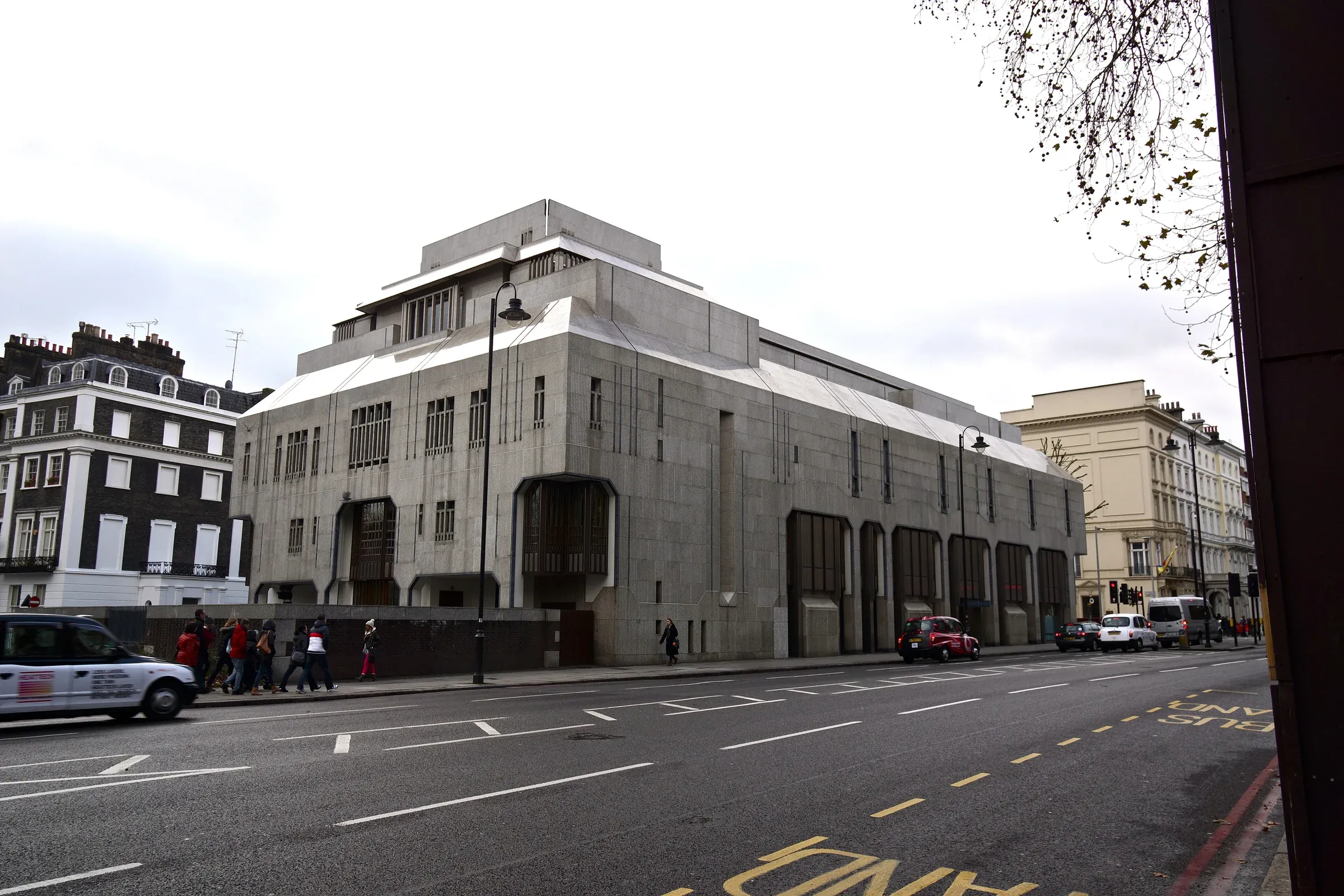
London is the home of the Ismaili Centre in South Kensington, the first purpose-built Ismaili religious and cultural centre in the West, and of the Aga Khan Centre at King’s Cross, which houses the Institute of Ismaili Studies, the Aga Khan University’s Institute for the Study of Muslim Civilisations and the Aga Khan Foundation (UK). It is also the setting of a relationship between the Ismaili Imams and the British Crown that, according to the Royal Household, goes back to Aga Khan I. For the community’s settlement in Britain see The Ismaili Diaspora.123
The Crown and the Imamat
The title “His Highness” has been accorded by British monarchs to the Ismaili Imams since Aga Khan I, “who was resident in India”, and has been “reconfirmed after each succession”. The Royal Household records that it was accorded to Aga Khan III by Queen Victoria in 1886, the year after his accession, and to Aga Khan IV by Queen Elizabeth II in July 1957, “approximately a fortnight after he succeeded his grandfather”. On 10 February 2025 King Charles III granted the title to Aga Khan V. The same statement notes that Aga Khan IV “and all his children, including Prince Rahim Aga Khan V, and his children, are British citizens”, that Aga Khan V’s mother is British, as was his paternal grandmother, and that Aga Khan IV was the Founding Patron of the King’s Trust.3
The Ismaili Centre, South Kensington
The foundation stone of the Ismaili Centre was laid in 1979. At the ceremony Aga Khan IV said: “It is my conviction that the building of this Centre is symbolic of a growing understanding of Islam. … This building and the prominence of the place it has been given indicate the seriousness and the respect the West is beginning to accord Muslim civilisation, of which the Ismaili community, though relatively small, is fully representative.”1
The Centre was opened on 24 April 1985 by Prime Minister Margaret Thatcher in the presence of Aga Khan IV, “joined by government ministers, members of Parliament, diplomats and leaders of the Ismaili community from around the world”. Its architect was Neville Conder of the Casson Conder Partnership of London; “traditional elements of the Islamic interior” were designed by Karl Schlamminger, “a German-born Muslim”. In his opening speech Aga Khan IV described the building as “a bridge between the culture of the community’s roots and that of its future as well as a symbol of the hopes of people who have lived through change and turbulence and have ultimately found security here in Britain”, a reference to the Ismailis who had come to Britain from East Africa; see The Ugandan Expulsion of 1972.41
The building stands at Cromwell Gardens, facing the Victoria and Albert Museum. Visitors enter past the invocation “Bismillah-ir-Rahman-ir-Rahim” and a seven-sided marble fountain; on the third floor a roof garden “designed on the model of classic Islamic gardens” has five interconnected fountains and a view of the museum’s domes. The Ismaili described it in 2010 as “the first high profile religious and cultural centre to be specially designed and built for the Ismaili community in the West”, followed by centres in Vancouver, Lisbon, Dubai and Dushanbe. See Ismaili Centres and Jamatkhana.1
According to the same account, a former head of the Ismaili Volunteer Corps recalled that before 1985 the community had gathered in “small and mobile Jamatkhanas”, and that the opening “gave us, for the first time, a real sense of identity”. Tens of thousands of people had toured the building by 2010, and it had taken part in London’s Open House each year since 2000. The Prince of Wales visited the Centre to inaugurate Spirit and Life, an exhibition of works from the Aga Khan Museum collection, and praised the community’s “emphasis on intellectual and cultural exploration as a means of integration”.1
The Aga Khan Centre, King’s Cross
The Aga Khan Centre at King’s Cross was opened by the Prince of Wales in 2018, in the presence of Aga Khan IV, who was visiting the United Kingdom as a guest of the government during his Diamond Jubilee year. The Mayor of London, Sadiq Khan, attended. Gulf News, reporting the opening from a press release, described the building as “the first London building designed by Japanese architects Maki and Associates”, whose design “is influenced by Islamic architectural heritage”; Fumihiko Maki also designed the Aga Khan Museum in Toronto and the Delegation of the Ismaili Imamat in Ottawa.25
The Centre houses the Institute of Ismaili Studies, the Aga Khan University’s Institute for the Study of Muslim Civilisations, the Aga Khan Foundation (UK) and the Aga Khan Library, London, which occupies two floors and includes “secure archival storage for rare books and manuscripts”. At the opening Aga Khan IV said: “I use the word ‘harmonising’ carefully — for our ideal here is not a chorus that sings in unison, but one that blends many distinctive voices into an intelligent, resonant whole.”2
Imamat institutions in Britain
AKDN dates the Aga Khan Foundation (UK) to 1973, the Institute of Ismaili Studies to 1977 and the Institute for the Study of Muslim Civilisations to 2002. It states that since 1973 the network has worked with British agencies, among them the Foreign, Commonwealth and Development Office, British International Investment and The King’s Trust International, on projects in Africa, South and Central Asia and the Middle East. These dates and the network’s description of its partnerships are institutional statements.6
The 2026 agreement
On 3 February 2026 Aga Khan V met the Mayor of London at City Hall. On 4 February, the first anniversary of his father’s death, he signed a Memorandum of Understanding between the United Kingdom and the Ismaili Imamat with Foreign Secretary Yvette Cooper at the Foreign, Commonwealth and Development Office, and was received by Prime Minister Keir Starmer at 10 Downing Street. AKDN states that the agreement covers climate change, the empowerment of women and girls and economic growth, and “establishes official representation between the two parties with a joint coordinating committee”. See The Seat of the Imamat for the Imamat’s other international agreements.6
Footnotes
-
The Ismaili, “Looking back on 25 years of the Ismaili Centre, London”, 2010, archived 2015, https://web.archive.org/web/2015/http://www.theismaili.org/cms/989/Looking-back-on-25-years-of-the-Ismaili-Centre-London. ↩ ↩2 ↩3 ↩4 ↩5
-
“Aga Khan Centre inaugurated in King’s Cross, London”, Gulf News, 2018, https://gulfnews.com/going-out/society/aga-khan-centre-inaugurated-in-kings-cross-london-1.2245985. ↩ ↩2 ↩3
-
The Royal Household, “The King is pleased to grant the new Aga Khan the title ‘His Highness’”, 10 February 2025, https://www.royal.uk/news-and-activity/2025-02-10/the-king-is-pleased-to-grant-the-new-aga-khan-the-title-his-highness. ↩ ↩2
-
The Ismaili, “Opening of the Ismaili Centre, London”, archived 12 September 2015, https://web.archive.org/web/20150912074652/http://www.theismaili.org/ismailicentres/london/opening-london. ↩
-
“Fumihiko Maki (1928–2024): the award-winning Japanese architect designed two beautiful buildings in Canada and one in London”, Barakah, 14 June 2024, https://barakah.com/2024/06/14/fumihiko-maki-1928-2024-the-award-winning-japanese-architect-designed-two-beautiful-buildings-in-canada-and-both-were-for-his-highness-the-aga-khan/. ↩
-
Aga Khan Development Network, “His Highness the Aga Khan meets UK Prime Minister, signs partnership agreement with UK”, London, 5 February 2026, https://the.akdn/en/resources-media/whats-new/news-release/his-highness-the-aga-khan-meets-uk-prime-minister-signs-partnership-agreement-with-uk-2026. ↩ ↩2