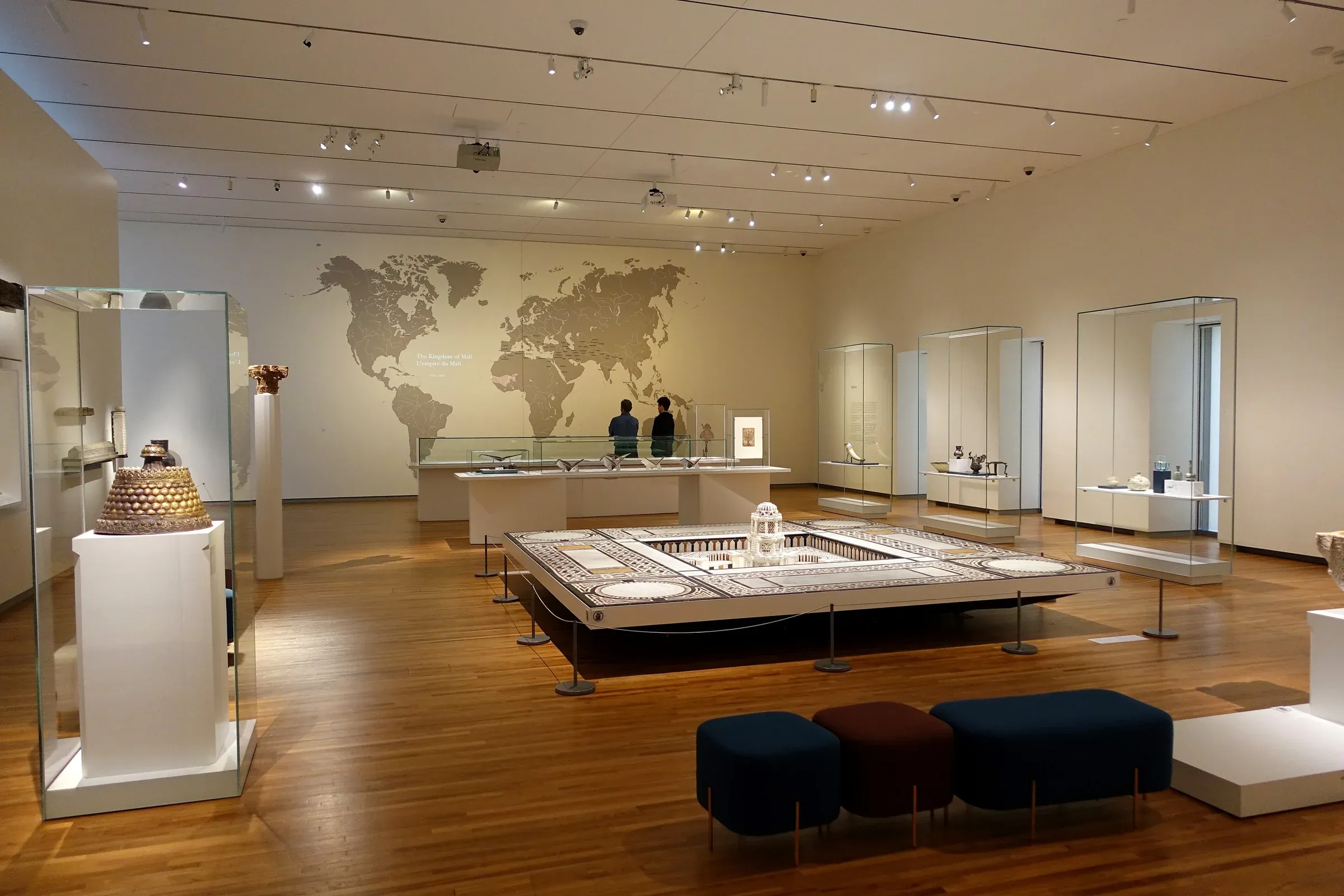
The Aga Khan Museum is a museum of the arts of Muslim civilisations in Toronto, opened to the public on Thursday 18 September 2014. It was founded by Aga Khan IV and is part of the Aga Khan Trust for Culture, the cultural agency of the Aga Khan Development Network. The museum describes its Permanent Collection as “over 1,200 masterpieces, including manuscripts, paintings, ceramics, and textiles from the 9th to the 21st century”. It shares a landscaped site on Wynford Drive with the Ismaili Centre, Toronto (see Ismaili Centres).123
The family collections
The museum’s core holdings derive from collections formed by the family of the Imams. In an interview published at the opening, Aga Khan IV, speaking with his brother Prince Amyn, “said the genesis of the family’s collection starts with their grandfather and uncle, both of whom were voracious collectors”: Aga Khan III and Prince Sadruddin Aga Khan. The same report records that the Harvard art historian Stuart Cary Welch encouraged the family “to focus on Islamic art during the 1950s and 1960s”, and that Prince Sadruddin filled his Geneva house, Bellerive, with Islamic ceramics; the museum imported some of his red display cabinets.4
Aga Khan IV began buying “a few artworks after his grandfather died in 1957”; by the 1990s he had narrowed his collecting “to Islamic art, particularly Indian miniature paintings that highlighted the architecture and gardens of the Mughal era”. The report gives the death of Prince Sadruddin in 2003 as a turning point, after which the family had to decide the future of his estate. He attributed his interest partly to finding, as a Harvard student in the mid-1950s, that his classmates knew little of Islamic art or culture.4
Exhibitions before the opening
Before the Toronto building existed, works intended for the museum were shown abroad. The architect Fumihiko Maki was photographed with Aga Khan IV “at an Aga Khan Museum exhibition held at the Louvre in 2007”. The press report of 2014 notes that the family had previously “lent pieces to major museums” but had not displayed “the full sweep of their holdings”.54
The choice of Toronto
The 2014 report states that the museum’s parameters “ruled out Paris and London, which have encyclopedic museums containing prized Islamic collections”. Aga Khan IV linked the choice of Toronto to the history of the Ismaili community in Canada, which “played a key role in accepting thousands of Nizari Ismailis who were living in Uganda” in 1972, and said that Canada was home to some 100,000 Ismailis. See The Ismaili Diaspora and The Expulsion from Uganda, 1972.4
The Wynford Drive project had a longer history. At the inauguration of the park in 2015 Aga Khan IV said that “the building process here on Wynford Drive began five years ago”, but that the project “actually began much earlier – back in 1996 – when we first started planning for a new Ismaili Centre in Toronto”.6
The building
The museum was designed by the Japanese architect Fumihiko Maki (1928–2024), a Pritzker Prize laureate. The 2014 report gave its area as 31,500 square feet and described “milky granite walls crenelated in a few places to make room for angled skylights”. The Ismaili’s opening announcement states that “the museum’s gallery spaces, an auditorium, a restaurant, and a shop are organised around a central courtyard”.42
Maki had a long association with the Imamat’s architecture. He served twice on the master jury of the Aga Khan Award for Architecture, in 1984–1986 and 1990–1992, and designed the Delegation of the Ismaili Imamat in Ottawa, opened in December 2008, and the Aga Khan Centre at King’s Cross in London, opened in June 2018. He died on 6 June 2024, aged 95.5
The park and the Ismaili Centre
The museum stands in a 6.8-hectare park designed by the Lebanese landscape architect Vladimir Djurovic, shared with the Ismaili Centre, Toronto, designed by the Indian architect Charles Correa. The Ismaili Centre was opened by Prime Minister Stephen Harper on 12 September 2014 in the presence of Aga Khan IV; “the Ismaili Centre and the Aga Khan Museum were opened on the same day in separate ceremonies.” Of the park, Aga Khan IV said that it “grows out of the inspiration of its Lebanese architect, Vladimir Djurovic”, and “possesses its own strong artistic identity”.36
Opening
The museum announced on 18 August 2014 that it would “open its doors to the public on Thursday, 18 September”, with “a collection of over 1 000 objects, representing more than ten centuries of human history and a geographic area stretching from the Iberian coast to China”, complemented by “a vibrant performing arts programme”. Its first temporary exhibitions were In Search of the Artist and The Garden of Ideas, which, according to the director Henry Kim, explored “past and present artists – how they were trained, what ideas motivated them, how they expressed individuality within highly structured art forms”. Anyone who bought a membership by 31 December 2014 was recognised as a Founding Member.2
Collection
The museum states that its collection has grown from more than 1,000 objects at the opening to “over 1,200 masterpieces”, spanning the ninth to the twenty-first century and comprising “manuscripts, paintings, ceramics, and textiles”. The Aga Khan Academies describe it as “the first museum in North America dedicated to showcasing art and artefacts from Muslim civilisations”. The 2014 report called the holdings “one of the top private collections of Islamic art anywhere”.1274
Programmes
From the outset the museum combined exhibitions with performance, lectures and teaching; the director described “exhibitions, performances, lectures, art classes, and courses” in the opening season. The museum states that “through its innovative online and in-person programs” it “reaches millions of people worldwide, fostering intercultural dialogue and understanding through the arts”. Its educational work extends to the network’s schools: in September 2022 students of the Aga Khan Academies in Hyderabad, Maputo, Mombasa and Nairobi and of the Aga Khan Mzizima Secondary School in Dar es Salaam were given a virtual tour of the permanent gallery.217
Place in the work of the Imamat
AKDN’s obituary of Aga Khan IV lists the museum among the cultural institutions of his Imamat, with the Award for Architecture, the Historic Cities Programme and the Music Programme. It is one of several Imamat buildings in Canada, together with the Ismaili Centres in Burnaby and Toronto, the Delegation in Ottawa and the Global Centre for Pluralism. See Toronto and Vancouver.85
Footnotes
-
Aga Khan Museum, “About”, https://agakhanmuseum.org/about/. ↩ ↩2 ↩3
-
The Ismaili, “Aga Khan Museum announces September opening date”, Toronto, 18 August 2014, https://the.ismaili/us/en/news/aga-khan-museum-announces-september-opening-date. ↩ ↩2 ↩3 ↩4 ↩5
-
The Ismaili (theismaili.org), “Opening of the Ismaili Centre, Toronto”, September 2014, archived 5 February 2016, https://web.archive.org/web/20160205115414/http://theismaili.org/ismailicentres/toronto/opening-toronto. ↩ ↩2
-
“The Aga Khan’s New Islamic Treasure Trove”, press report of 4 September 2014 reproduced by the Heritage Society (original publication not named on the reproduction), https://heritage.ismaili.net/node/80260. ↩ ↩2 ↩3 ↩4 ↩5 ↩6
-
“Fumihiko Maki (1928–2024): the award-winning Japanese architect designed two beautiful buildings in Canada and one in London”, Barakah, 14 June 2024, https://barakah.com/2024/06/14/fumihiko-maki-1928-2024-the-award-winning-japanese-architect-designed-two-beautiful-buildings-in-canada-and-both-were-for-his-highness-the-aga-khan/. ↩ ↩2 ↩3
-
Aga Khan IV, “Inauguration of the Aga Khan Park”, Toronto, 25 May 2015, https://www.akdn.org/speech/his-highness-aga-khan/inauguration-aga-khan-park-toronto. ↩ ↩2
-
Aga Khan Academies, “Aga Khan Schools students virtually tour the Aga Khan Museum”, September 2022, https://www.agakhanacademies.org/general/aga-khan-schools-students-virtually-tour-aga-khan-museum. ↩ ↩2
-
Aga Khan Development Network, “His Highness Prince Karim Aga Khan IV, 1936–2025” (2025), section “Patron of the arts”, https://the.akdn/en/resources-media/whats-new/spotlights/his-highness-prince-karim-aga-khan-iv-19362025. ↩