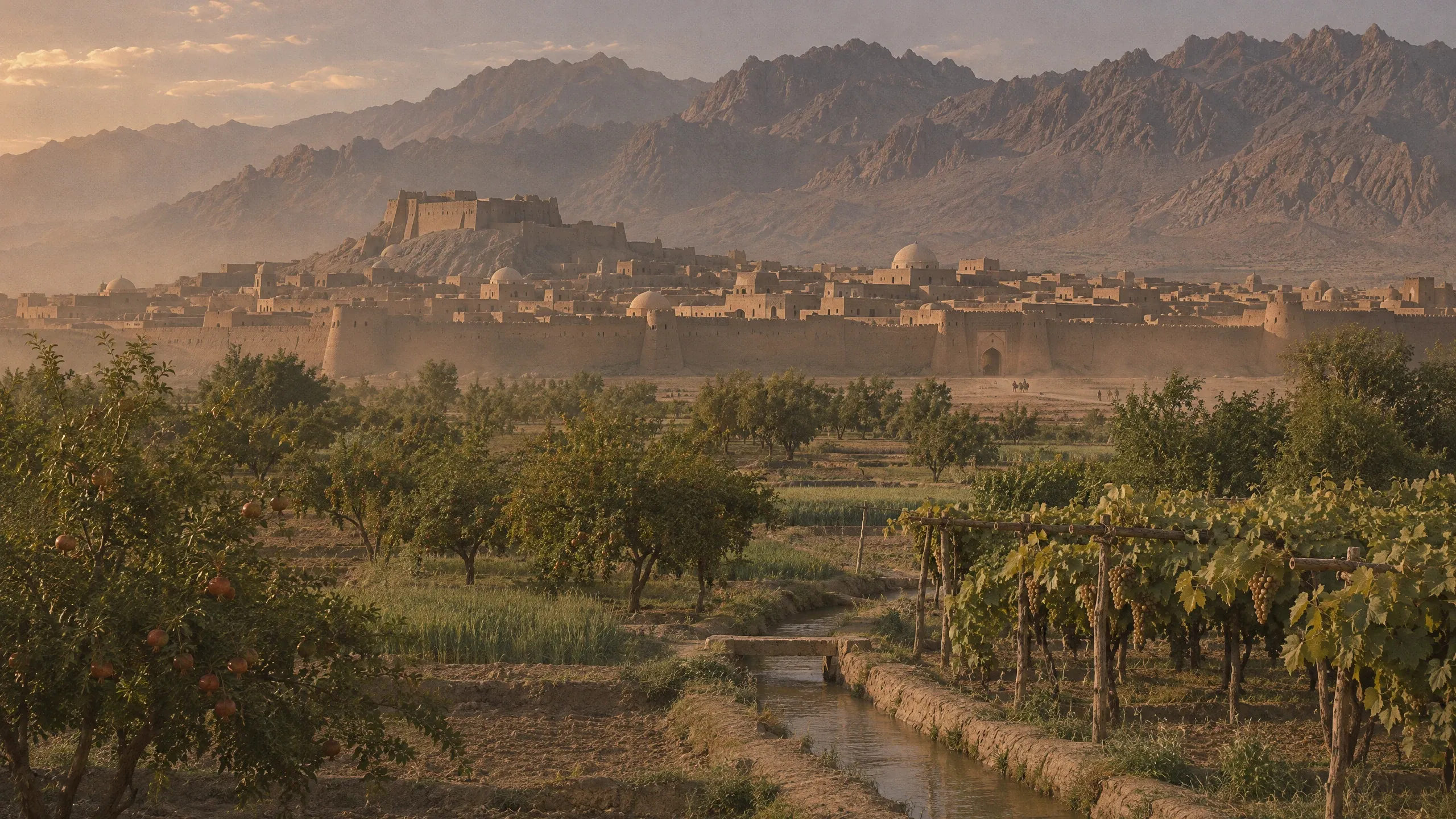
Qandahar and the Imams of Kerman
Qandahar, the chief city of southern and western Afghanistan, enters Ismaili history through the Imams’ wars in Kerman. In the late eighteenth century the Afghan and Baluchi forces of Azam Khan, an amir from Qandahar, invaded the Kerman frontier district of Narmashir and twice threatened the province governed by Imam Abu’l-Hasan Ali. An army of 7,000 under the Imam’s cousin Mirza Sadiq defeated him once; when he returned and reached the gates of Kerman, the Imam himself led his forces from Shahr-i Babak and defeated him outside the city, though the Afghans kept Narmashir and other border localities.1
Half a century later, Afghan refugees from Qandahar again crossed the Imam’s path. When Aga Khan I reached Shahr-i Babak in 1840, he found its citadel held by Kuhandil Khan and other Qandahari chiefs who had sought refuge in Persia after the British invasion of Afghanistan; he joined the siege that forced them to surrender.2
Flight from Persia
After his defeat at Rigan in 1257/1841, Aga Khan I escaped overland. From Rawar he crossed the Dasht-i Lut to Sarbisha, south-east of Birjand, and with his brothers and many soldiers and servants crossed the border to Lash va Juvayn in Afghanistan. Daftary marks this as the end of the Persian period of the Nizari Imamate, some seven centuries after the Alamut era. From there he advanced by way of Girishk to Qandahar.3
The city had been occupied since 1254/1839 by an Anglo-Indian army during the First Anglo-Afghan War (1838–1842), which had placed Shah Shuja al-Mulk on the throne of Kabul in place of Dust Muhammad, founder of Barakzay rule. Daftary notes that it has been argued that the British had encouraged the Aga Khan’s activities in Persia, and that his campaigns in Kerman helped frustrate Muhammad Shah’s campaign against Herat; whatever the truth of that, his association with the British after he entered Afghanistan is openly recorded in his autobiography and elsewhere.4
With the British at Qandahar
From Girishk the Aga Khan sent notice of his coming to Muhammad Timur, the British-appointed governor of Qandahar, and to Major Henry Rawlinson, the British political agent. Rawlinson had served in Persia in 1833–1839 and may have met the Aga Khan at Muhammad Shah’s coronation in Tehran. He granted the Imam a daily stipend of one hundred rupees for the duration of his stay.5
Soon after arriving in the summer of 1257/1841, the Aga Khan wrote to Sir William Macnaghten, the British envoy at Kabul, proposing to seize and govern Herat on behalf of the British and Shah Shuja. The proposal was apparently approved, but it was overtaken by events. Macnaghten was killed by the Afghans in December 1841, and in January 1842 the uprising of Dust Muhammad’s son Muhammad Akbar Khan destroyed the British-Indian garrison retreating from Kabul. The rising spread to Qandahar, and in the fighting that followed the Aga Khan helped General William Nott evacuate the British forces from the city in July 1842.6
The memoir’s account and its chronology
The ’Ibrat-afza gives the Imam’s own account. After eleven days as a guest at Sarbisha, he writes, “I decided to move to Qandahar, in order to be closer to my murids from every land.” From Girishk he sent a rider to Prince Muhammad Timur and to Rawlinson; khans and nobles came out to meet him four farsangs from the city, and he entered Qandahar, by the memoir’s date, on 17 Dhu’l-Qa’da 1257 (30 December 1841). Three days later he was allotted the stipend of 100 rupees a day.7
That date sits uneasily with Daftary’s summer of 1841 and with the letter to Macnaghten, who was killed by Afghan rebels on 23 December 1841. Beben and Mohammad Poor discuss the difficulty and note that a later Persian source misdates the arrival to Dhu’l-Qa’da 1258 (December 1842). The order of events in the memoir is clear even where the dates are not: after news came that Shah Shuja had been killed, the British decided to evacuate Qandahar, burned their surplus gunpowder, appointed Prince Safdar Jang governor and left, and the Aga Khan departed in their company.8
The Imam’s followers
During his stay he was visited by Nizari deputations from Kabul, Badakhshan, Bukhara and Sind, bringing their homage and dues. In the ’Ibrat-afza he describes encounters, during and after the evacuation, with Afghan chiefs he had fought at Shahr-i Babak, among them Mihrdil Khan and Kuhandil Khan.9
Departure for Sind
In the autumn of 1842 the Aga Khan left Qandahar for Sindh, leaving his brother Abu’l-Hasan Khan, the Sardar, in the city. His path then led through Sind, where he aided the British against the Talpur amirs and received a pension from Sir Charles Napier, to Kutch, Kathiawar and finally Bombay. His time in Qandahar thus marked the start of the alliance with British India that shaped the Imamate for the rest of the century.10
Footnotes
-
Farhad Daftary, The Isma’ilis: Their History and Doctrines, 2nd ed. (Cambridge University Press, 2007), p. 460. ↩
-
Daftary, The Isma’ilis, 2nd ed. (Cambridge University Press, 2007), p. 468; Daniel Beben and Daryoush Mohammad Poor, The First Aga Khan: Memoirs of the 46th Ismaili Imam (I.B. Tauris / Institute of Ismaili Studies, 2018), Introduction, p. 42. ↩
-
Daftary, The Isma’ilis, 2nd ed. (Cambridge University Press, 2007), p. 469. ↩
-
Daftary, The Isma’ilis, 2nd ed. (Cambridge University Press, 2007), pp. 469–470. ↩
-
Daftary, The Isma’ilis, 2nd ed. (Cambridge University Press, 2007), pp. 469–470. ↩
-
Daftary, The Isma’ilis, 2nd ed. (Cambridge University Press, 2007), p. 470; Beben and Mohammad Poor, The First Aga Khan (2018), Foreword, p. xxvii. ↩
-
Beben and Mohammad Poor, The First Aga Khan (2018), translation of the ’Ibrat-afza, pp. 111–113 and nn. 130–133. ↩
-
Beben and Mohammad Poor, The First Aga Khan (2018), translation of the ’Ibrat-afza, pp. 113–115 and nn. 133–138; Daftary, The Isma’ilis, 2nd ed. (Cambridge University Press, 2007), p. 470. ↩
-
Daftary, The Isma’ilis, 2nd ed. (Cambridge University Press, 2007), p. 470; Beben and Mohammad Poor, The First Aga Khan (2018), translation of the ’Ibrat-afza, nn. 138–141. ↩
-
Daftary, The Isma’ilis, 2nd ed. (Cambridge University Press, 2007), pp. 470–472. ↩