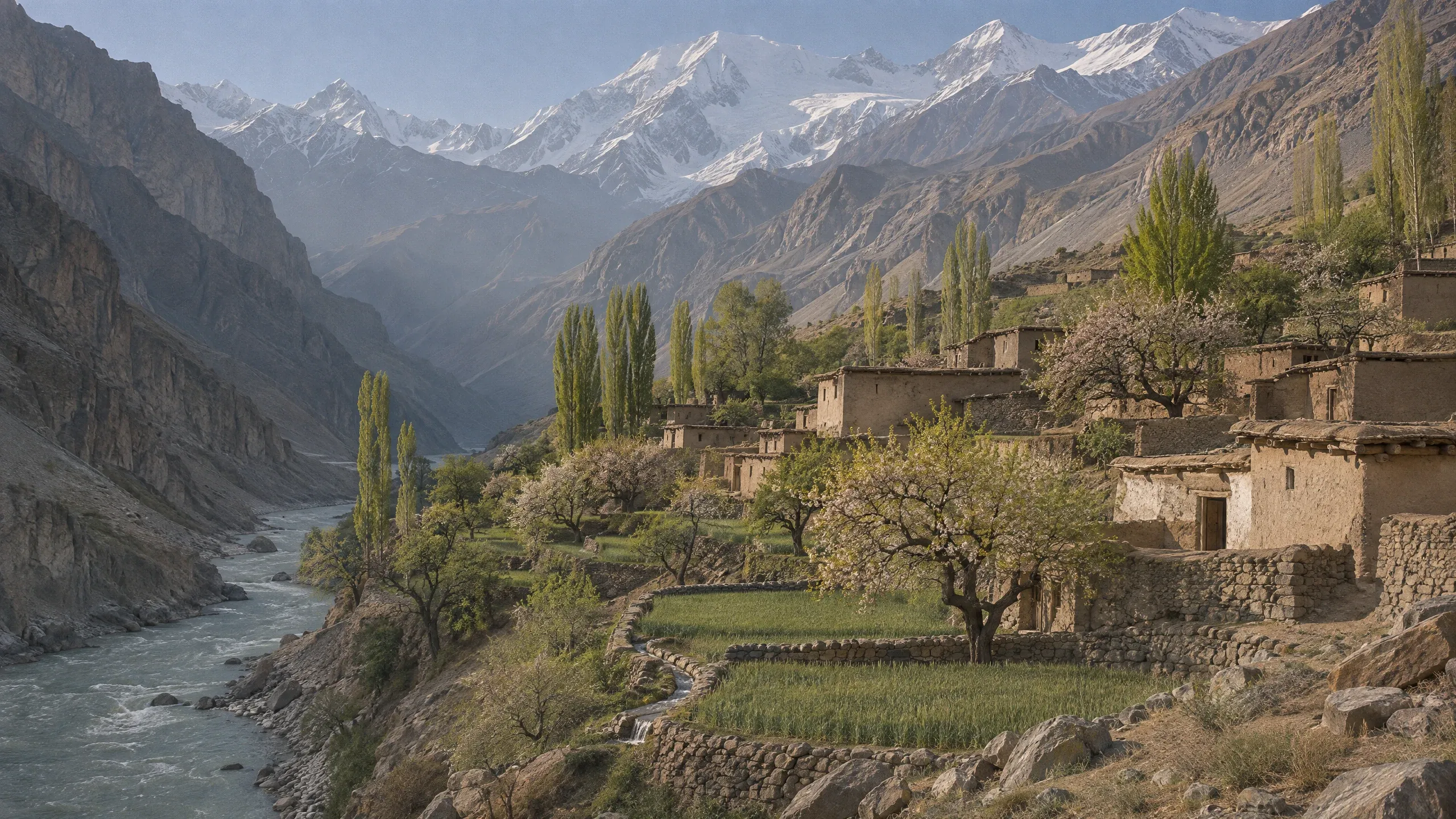
The region
Badakhshan is a mountainous region on the upper reaches of the Oxus (Amu Darya), more precisely of the Panj, the Oxus’s main headwater, protected by the Pamirs and the Hindu Kush. Its main Ismaili district has long been Shughnan, with Rushan and neighbouring valleys. Since an Anglo-Russian boundary commission of 1895 the right bank of the Panj has belonged to the north, today the Gorno-Badakhshan province of Tajikistan with its capital at Khorog, and the left bank to Afghanistan, with Faydabad as its chief town. The Nizari Ismailis of Badakhshan make up the bulk of the Ismailis of Afghanistan and Central Asia.1
Nasir-i Khusraw and the Nizari da’wa
The Ismailis of Badakhshan and other parts of Central Asia remained particularly devoted to the Fatimid da’i and poet Nasir-i Khusraw, whose teaching is the oldest layer of their tradition. They stayed outside the Nizari–Musta’li dispute of 1094 and the confines of the Nizari state for a time. Daftary dates their acknowledgement of the Nizari da’wa to the late Alamut period, through da’is sent from Quhistan, which local tradition, placing the beginning of the Nizari da’wa in the middle of the sixth/twelfth century, broadly confirms.2
According to tradition preserved in Shughnan, the Nizari da’wa there was begun by two da’is sent by the Imams of the Alamut period. The first, Sayyid Shah Malang, came from Khurasan and took control of Shughnan by deposing its ruler. He was followed by Mir Sayyid Hasan Shah Khamush, a Husaynid Alid who traced his descent to the Imam Musa al-Kazim. These two founded the local dynasties of pirs and mirs who ruled Shughnan, Rushan and other districts until modern times.3
Outside the Mongol catastrophe
Badakhshan escaped the Mongol conquest that destroyed the Nizari state in Persia in 1256 and remained in the hands of its own rulers. It was annexed to the Timurid empire under Timur’s great-grandson Abu Sa’id (855–873/1451–1469), and at the beginning of the tenth/sixteenth century it was conquered by the Ozbegs, whose rule was resisted by local dynasties, among them the Ismaili mirs of Shughnan and lesser Timurids led by the amir Mirza Khan (d. 926/1520).4
The region’s Nizaris did not produce any noteworthy author after Sayyid Suhrab Vali Badakhshani, who wrote around 856/1452, though they compiled local histories. Their thought kept something of the earlier Ismaili interest in cosmology that the Nizaris of Persia had largely abandoned, a legacy Daftary attributes to Nasir-i Khusraw’s works.5
Muhammad-Shahis in Badakhshan
When the Nizari Imamate split in the fourteenth century into the Muhammad-Shahi and Qasim-Shahi lines, the Muhammad-Shahis at first had more followers in northern Persia and Central Asia, including large numbers in Badakhshan. The Irshad al-talibin, a Muhammad-Shahi work written in Badakhshan in 929/1523 by Muhibb Ali Qunduzi, is one of the two surviving sources from that branch on the origins of the schism.6
In 913/1507 Shah Radi al-Din ibn Tahir, a Nizari leader who had earlier led the Nizaris of Quhistan and who may be the thirtieth Muhammad-Shahi Imam, came from Sistan to Badakhshan amid the disorder of the Ozbeg conquest and, with local Nizari help, established his rule over a large part of it. Quarrels broke out among his supporters, and in the spring of 915/1509 he was killed; his head was taken to Mirza Khan at the fortress of Zafar on the left bank of the Kokcha. Mirza Khan and his Timurid successors then severely persecuted the Muhammad-Shahi Nizaris of the region. Radi al-Din’s son was Shah Tahir Dakkani, the most famous Imam of the line, who made his career in the Deccan.7
Muhammad-Shahi Imams kept supporters in Badakhshan and around Kabul through the seventeenth century. One of them, Atiyyat Allah, also called Khudaybakhsh, evidently lived in Badakhshan and died there in 1074/1663. But by the beginning of the nineteenth century the Nizaris of the upper Oxus and Afghanistan generally followed the Qasim-Shahi line, the line of the Aga Khans.8
The Anjudan Imams and Badakhshan
The Qasim-Shahi Imams of the Anjudan period worked to bring the distant communities back under their control. Hereditary pirs had become largely autonomous, especially in Afghanistan, Badakhshan and other parts of Central Asia and in India, and often financially independent through the dues they collected. Mustansir bi’llah II began sending trusted da’is to Khurasan, Afghanistan, Badakhshan and elsewhere, and his successors summoned regional da’is to Persia for instruction. Abd al-Salam Shah invited the Muhammad-Shahis of Badakhshan and Afghanistan to transfer their allegiance to the Qasim-Shahis in a farman of 895/1490. Copies of the Pandiyat-i javanmardi, the Anjudan-period book of the Imam’s admonitions, are still preserved in Badakhshan and in Hunza and Chinese Turkistan.9
In the sixteenth century an Imam evidently planned to make Khayrkhwah-i Harati’s father da’i of Khurasan, Badakhshan and Kabul; after his murder, Khayrkhwah himself was appointed. In the second half of the seventeenth century the poet Mahmud Ali listed Qasim-Shahi da’is and teachers in Badakhshan among other regions. Despite such efforts, the local pir dynasties continued to lead the Nizari communities of Badakhshan into modern times.10
Keepers of the literature
Badakhshan’s Ismailis have been the chief preservers of Nizari literature in Persian. Most of it has survived secretly in private holdings in the region, where Tajik Persian and several local languages are spoken. A Soviet research expedition recovered a large number of manuscripts from Gorno-Badakhshan in 1959–1963, and the Institute of Ismaili Studies has recovered more since the 1990s. The collections include, besides Nasir-i Khusraw’s works, selections from Persian mystical poets the Nizaris regard as co-religionists, such as Sana’i, Attar and Rumi; the Zubdat al-haqa’iq of Aziz al-Din Nasafi (d. c. 661/1262) is preserved there as an Ismaili work.11
The nineteenth century produced a notable scholar in Mubarak-i Wakhani (1839–1903), a mystic poet, musician, astronomer and Ismaili religious scholar from Wakhan, whose life and esoteric thought are the subject of a study by Abdulmamad Iloliev.12
Links with the Imams in Persia and India
Badakhshani Nizaris kept contact with the Qasim-Shahi Imams as these moved from central Persia to Kerman and India. When Aga Khan I was a captive at Kerman in 1837–1838 he received the dues brought by deputations from Khurasan, Badakhshan and India, and at Qandahar in 1841–1842 he received deputations from Kabul, Badakhshan and Bukhara. Da’is from Badakhshan reintroduced Nizari Ismailism to Hunza in the early nineteenth century and, under Mir Ghazanfar, converted its whole population.13
Division and the Soviet period
In the nineteenth century the northern part of Badakhshan was annexed to various Central Asian khanates and came increasingly under Russian control, while the British extended their influence over Afghan Badakhshan; the 1895 boundary fixed the division along the Panj. Aga Khan III found it difficult to reach his followers there; his last contact was probably in 1923, through his emissary Pir Sabz Ali (d. 1938). In 1925 the Soviet government created the Autonomous Region of Gorno-Badakhshan. Until 1991 the Ismailis of Tajikistan were cut off from their Imam and could not practise their faith openly.14
After Tajik independence, the Nizaris of Tajikistan, numbering around 200,000, saw their Imam for the first time in 1995, when Aga Khan IV visited and tens of thousands gathered in Shughnan, Rushan and other districts. For the modern history of the region see Ismailis of Central Asia.15
Footnotes
-
Farhad Daftary, The Isma’ilis: Their History and Doctrines, 2nd ed. (Cambridge University Press, 2007), pp. 451, 495. ↩
-
Daftary, The Isma’ilis, 2nd ed. (Cambridge University Press, 2007), pp. 451–452. ↩
-
Daftary, The Isma’ilis, 2nd ed. (Cambridge University Press, 2007), p. 452. ↩
-
Daftary, The Isma’ilis, 2nd ed. (Cambridge University Press, 2007), p. 452. ↩
-
Daftary, The Isma’ilis, 2nd ed. (Cambridge University Press, 2007), pp. 408, 440. ↩
-
Daftary, The Isma’ilis, 2nd ed. (Cambridge University Press, 2007), pp. 414, 451. ↩
-
Daftary, The Isma’ilis, 2nd ed. (Cambridge University Press, 2007), pp. 451–452. ↩
-
Daftary, The Isma’ilis, 2nd ed. (Cambridge University Press, 2007), pp. 455–456. ↩
-
Daftary, The Isma’ilis, 2nd ed. (Cambridge University Press, 2007), pp. 432–433; see The Anjudan revival. ↩
-
Daftary, The Isma’ilis, 2nd ed. (Cambridge University Press, 2007), pp. 434, 438, 456. ↩
-
Daftary, The Isma’ilis, 2nd ed. (Cambridge University Press, 2007), pp. 408, 420, 495. ↩
-
Abdulmamad Iloliev, The Isma’ili-Sufi Sage of Pamir: Mubarak-i Wakhani and the Esoteric Tradition of the Pamiri Muslims (Cambria Press, 2008), Introduction. ↩
-
Daftary, The Isma’ilis, 2nd ed. (Cambridge University Press, 2007), pp. 465, 470, 495. ↩
-
Daftary, The Isma’ilis, 2nd ed. (Cambridge University Press, 2007), pp. 495–496. ↩
-
Daftary, The Isma’ilis, 2nd ed. (Cambridge University Press, 2007), p. 502. ↩