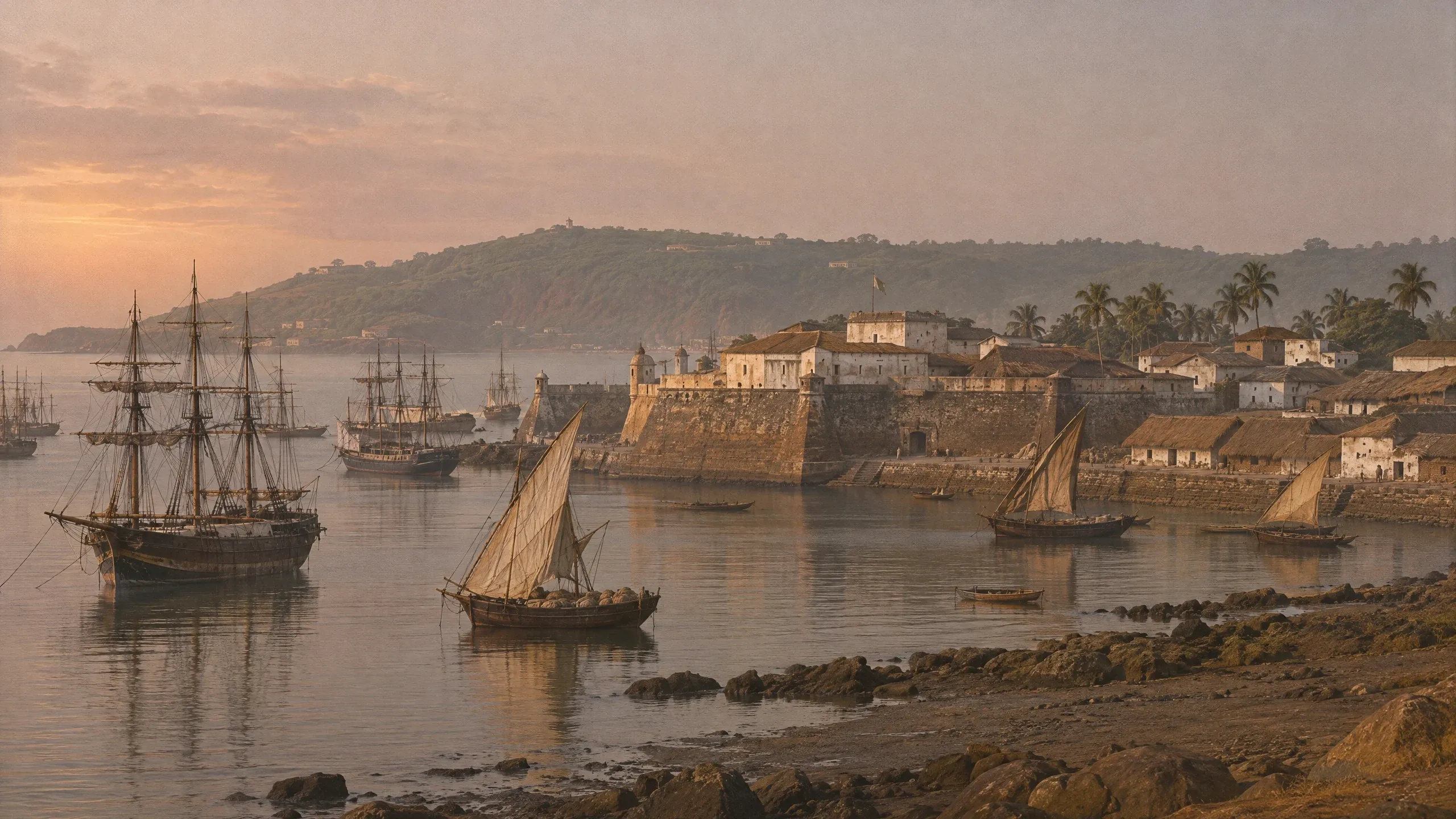
The Khojas and Bombay
By the early nineteenth century the Nizari Khojas of Sind, Kutch, Kathiawar and Gujarat were moving in growing numbers to the coastal towns of western India, above all Bombay, and from there across the Indian Ocean to East Africa, following the expansion of trade. Bombay had a Khoja jamat before any Imam lived there: in 1829, when Shah Khalil Allah’s successor was still in Persia, a dispute over the payment of dues to the Imam was already being fought out in the Bombay courts. See The Khojas.1
Arrival of the Imam
Aga Khan I came to India as a refugee from Persia. After leaving Karachi in Ramadan 1260/October 1844 and spending a year among the Khojas of Kutch and Kathiawar, he reached Bombay by way of Surat and Daman in Safar 1262/February 1846. The Persian government, still led by Hajji Mirza Aqasi, demanded his extradition under the Anglo-Persian treaty of 1229/1814. The British refused, but agreed to move him away from the Persian frontier to Calcutta, where he went in Jumada I 1263/April 1847.2
News of Muhammad Shah’s death reached him in Dhu’l-Hijja 1264/November 1848, two months after the event, and in Muharram 1265/December 1848 he returned to Bombay, hoping that the new shah, Nasir al-Din, would let him go home. His letters to the chief minister Amir Kabir failed, and after Amir Kabir’s fall in 1268/1852 a last appeal, accompanied by the gift of an elephant and a giraffe to the shah, restored some family lands to his relatives but not his own return. He resigned himself to permanent settlement in India.3
Seat of the Imamate
Daftary dates the modern period of Nizari history from the Imam’s settlement in Bombay: “The Nizari imamate had now been established in India, with Bombay serving as the seat of the Qasim-Shahi Nizari imams.” Aga Khan I was the first Imam of his line to set foot in India. The Khojas, for centuries the largest section of the Nizari community, had found it hard and dangerous to travel to Anjudan, Kahak, Shahr-i Babak, Kerman or Mahallat; now they flocked to pay homage, and they sent their dues more readily to his durkhana, his chief residence, in Bombay. The income allowed him to build elaborate headquarters and residences in Bombay, Poona and Bangalore and to support numerous relatives who joined him from Persia.4
It was in Bombay, in 1266/1850, that the Imam’s memoir, the ’Ibrat-afza, was written down on his behalf by the Persian poet Mirza Ahmad Viqar-i Shirazi (1232–1298/1817–1881), who spent a year in India as his guest. It was lithographed in Bombay in 1278/1862.5
The Imam’s court
Aga Khan I attended the Khoja jamatkhana of Bombay on major religious occasions and led the prayers there, and held a durbar every Saturday at which his followers came for his blessing. The British addressed him as His Highness; the Prince of Wales, the future Edward VII, visited him at his Bombay residence, the Aga Hall. As the head of a Muslim community he enjoyed the protection of the British authorities in India, which strengthened his hand in bringing the Khojas’ loosely organised communal institutions under his direct control.6
Disputes and the courts
Bombay was also where the Imam’s authority was contested. A faction led by Habib Ibrahim, first twelve in number and so known as the Barbhai, “twelve brothers”, had refused to pay the dassondh in 1829 and was expelled by the jamat; readmitted in 1835, it became the core of a lasting opposition. In 1847 Sir Erskine Perry ruled, in a case brought by two Khoja sisters, that Khoja custom rather than Islamic law governed inheritance. The dissidents, excommunicated again in 1848, set up their own jamatkhana; in 1267/1850 four of them were murdered at Mahim by Khojas loyal to the Imam, and four men were sentenced to death.7
In June 1862 the dissidents, led by Habib Ibrahim’s son Ahmed Habibbhai, sued the Aga Khan. Sir Joseph Arnould of the Bombay High Court heard the case in April and June 1866, the Imam testifying in person. His judgment of 12 November 1866 held that the Khojas were “Shia Imamee Ismailis”, that the Aga Khan was their spiritual head and hereditary Imam, and that he was entitled to the dues and to control of the community’s property. See The Aga Khan Case of 1866.8
Hasanabad
Aga Khan I spent his last years in Bombay with seasonal stays in Poona, and was a familiar figure at the Bombay racecourse. He died in Jumada I 1298/April 1881 and was buried in a shrine built for him at Hasanabad, in the Mazagaon area of the city. His great-grandson Abu’l-Hasan, only son of Shihab al-Din Shah, was buried beside him.9
Aga Khan II and Aga Khan III
His son Aga Khan II, who had joined him in Bombay in 1269/1853, led the community from Bombay for four years. He was appointed to the Bombay Legislative Council under the governor Sir James Fergusson, opened schools for Khoja children in Bombay and elsewhere, and was elected president of the Muhammadan National Association. On his death in 1302/1885 his son Sultan Muhammad Shah, Aga Khan III, was installed in Bombay at the age of eight, and grew up in Bombay and Poona under the supervision of his mother, Lady Ali Shah. His long Imamate is treated in The Twentieth Century.10
Footnotes
-
Daniel Beben and Daryoush Mohammad Poor, The First Aga Khan: Memoirs of the 46th Ismaili Imam (I.B. Tauris / Institute of Ismaili Studies, 2018), Introduction, pp. 26–27; Farhad Daftary, The Isma’ilis: Their History and Doctrines, 2nd ed. (Cambridge University Press, 2007), pp. 474–475. ↩
-
Daftary, The Isma’ilis, 2nd ed. (Cambridge University Press, 2007), p. 472; Beben and Mohammad Poor, The First Aga Khan (2018), Foreword, p. xxvii. ↩
-
Daftary, The Isma’ilis, 2nd ed. (Cambridge University Press, 2007), pp. 472–473; Beben and Mohammad Poor, The First Aga Khan (2018), Foreword, p. xxviii. ↩
-
Daftary, The Isma’ilis, 2nd ed. (Cambridge University Press, 2007), p. 473. ↩
-
Beben and Mohammad Poor, The First Aga Khan (2018), Foreword, pp. xxvi–xxviii. ↩
-
Daftary, The Isma’ilis, 2nd ed. (Cambridge University Press, 2007), pp. 473–474. ↩
-
Daftary, The Isma’ilis, 2nd ed. (Cambridge University Press, 2007), pp. 474–476. ↩
-
Daftary, The Isma’ilis, 2nd ed. (Cambridge University Press, 2007), p. 476; Joseph Arnould, Judgment by the Hon’ble Sir Joseph Arnould in the Khojah Case, otherwise known as the Aga Khan Case (Bombay Gazette Steam Press, 1866), https://archive.org/details/bk1209. ↩
-
Daftary, The Isma’ilis, 2nd ed. (Cambridge University Press, 2007), pp. 476, 480; Beben and Mohammad Poor, The First Aga Khan (2018), fig. 9. ↩
-
Daftary, The Isma’ilis, 2nd ed. (Cambridge University Press, 2007), pp. 477, 480. ↩