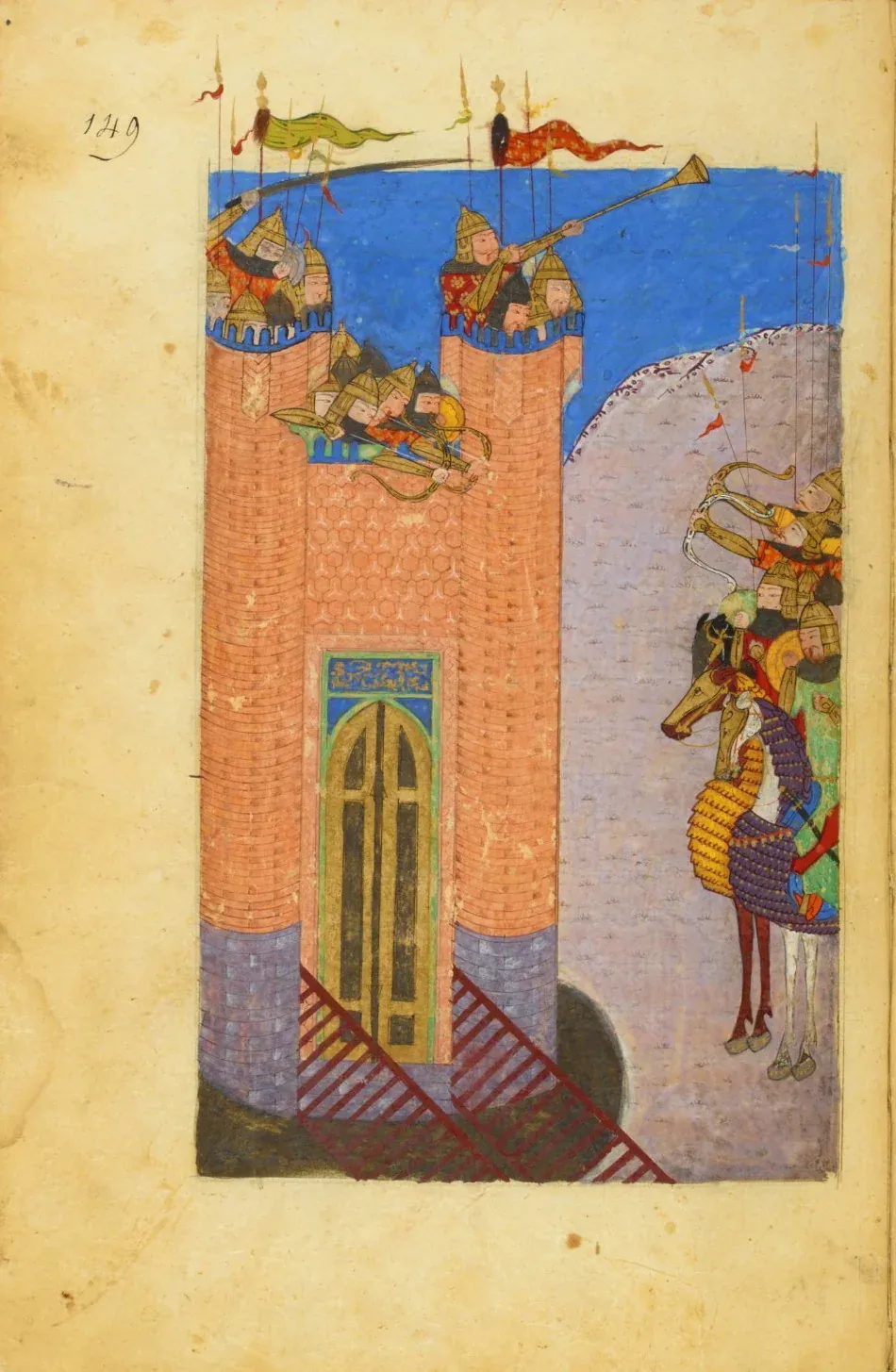
Between 1253 and 1256 Mongol armies under Ket-Buqa and then Hülegü, brother of the Great Khan Möngke, conquered the Nizari Ismaili state of Persia. The last lord of Alamut, Rukn al-Din Khurshah, surrendered at Maymundiz on 29 Shawwal 654 / 19 November 1256. Most of the castles of Rudbar were demolished, and in 1257 Khurshah was killed in Mongolia and the Nizaris of Persia were massacred. The state had lasted 166 years.1
Girdkuh held out until 1270. The Syrian castles survived the Mongols but passed to the Mamluk sultan Baybars by 1273.2 The main narrative comes from ’Ata-Malik Juvayni, who served in Hülegü’s entourage, drew up the terms of Khurshah’s surrender and wrote the official proclamation of victory. His account is that of a hostile eyewitness.3
First contacts, 1219–1221
The Nizaris were the first Muslim rulers to come to terms with the Mongols. Jalal al-Din Hasan III sent envoys to Chingiz Khan in the autumn of 616/1219, before the Mongols crossed the Oxus, and they met him in the spring of 618/1221 at Balkh or Taliqan.4 Chingiz took Bukhara and Samarqand in 1220 and Balkh in 1221, and his son Toluy massacred the populations of Marw and Nishapur. Refugees, among them Sunni scholars, found shelter in the Nizari castles of Quhistan.5
Between the Khwarazmians and the Mongols
Under Ala al-Din Muhammad III, who succeeded at the age of nine in 1221, the Nizaris were caught between the Mongols and the last Khwarazmshah, Jalal al-Din Mangubirni. They paid the Khwarazmians a reduced tribute and sent an envoy, Badr al-Din, to the Mongol court.6 In 1238 Nizari envoys travelled with those of the Abbasid caliph al-Mustansir to the kings of France and England to seek an alliance against the Mongols. The mission failed.7
In 644/1246 a Nizari embassy led by the Quhistani muhtashams Shihab al-Din and Shams al-Din attended the enthronement of the Great Khan Güyük. It was dismissed with contempt. The Mongol commander Eljigidei was ordered to use two of every ten soldiers against rebels, starting with the Ismailis.8
Möngke’s decision, 1252
The decision to destroy the Nizaris was taken under the Great Khan Möngke (r. 1251–1259). According to the Persian historians, the chief qadi of Qazwin, Shams al-Din, complained to the Mongol court about the Nizaris. In 650/1252 Möngke entrusted his brother Hülegü with the conquest of the Nizari state and the Abbasid caliphate. The Franciscan William of Rubruck, at the Mongol court in 1254, reported rumours that fida’is had been sent to kill Möngke.9
Ket-Buqa’s campaign, 1253–1255
An advance army of 12,000 men under the Nestorian Christian general Ket-Buqa was sent ahead in Jumada II 650 / August 1252. It crossed the Oxus in Muharram 651 / March 1253 and seized several castles in Quhistan. In Rabi’ I 651 / May 1253 Ket-Buqa reached Girdkuh with 5,000 men and built siege walls around it. Tun and Turshiz fell in Jumada I 651 / July 1253.10
In Shawwal 651 / December 1253 the garrison of Girdkuh made a night sortie that killed a hundred Mongols, among them the officer Buri. Girdkuh was weakened by cholera in the summer of 652/1254 but was reinforced from Alamut.10 At Alamut, according to the Persian historians, Muhammad III suffered from melancholia and quarrelled with his son Khurshah. On the last day of Shawwal 653 / 1 December 1255 he was murdered at Shirkuh near Alamut. The killer was named as his favourite, Hasan-i Mazandarani.11
Khurshah and Hülegü
Khurshah, born about 627/1230, sent an envoy to the Mongol commander Yasa’ur Noyan at Hamadan offering submission.12 Hülegü moved slowly. He left the Mongol camp in Sha’ban 651 / October 1253, reached Samarqand in Sha’ban 653 / September 1255 and crossed the Oxus in Dhu’l-Hijja 653 / January 1256. In mid-Rabi’ II 654 / May 1256 Ket-Buqa and Köke-Ilgei took Tun. Juvayni says that all were slaughtered except the younger women; Rashid al-Din says the artisans were spared.12
The last muhtasham of Quhistan, Nasir al-Din, submitted to Hülegü at Tus through the Kart ruler Shams al-Din.12 Khurshah’s vizier Shams al-Din Gilaki and Sayf al-Din Sultan Malik reached Hülegü on 17 Sha’ban / 9 September 1256. They asked for a year’s grace and for Alamut and Lamasar to be exempted from demolition.13
The march on Rudbar
In mid-Sha’ban 654 / September 1256 Hülegü set out from Bastam with his armies in several columns. Buqa-Temür and Köke-Ilgei advanced through Mazandaran; Tegüder and Ket-Buqa through Khuwar and Simnan; Hülegü himself through Firuzkuh, Damavand and Rayy; and Balaghai and Tutar from western Persia. Khurshah sent a son and then his brother Shiranshah with 300 men to the Mongol camp to buy time. Daftary notes that Hülegü had Nizaris near Qazwin secretly killed. On 10 Shawwal / 31 October Hülegü entered Rudbar through Taliqan.14
Maymundiz
On 18 Shawwal 654 / 8 November 1256 Hülegü stood before Maymundiz, the castle where Khurshah was staying. Trees that the Nizaris had planted were cut down to build mangonels, and a Chinese ballista (kaman-i gav) with a range of 2,500 paces was brought up. Juvayni drafted the yarligh, the decree offering terms. The fida’is opposed surrender, and an unusually mild autumn allowed the siege to continue.15
Bombardment began on 25 Shawwal / 15 November. Nasir al-Din Tusi and the other outside scholars at Khurshah’s court urged him to surrender. Khurshah first sent down his son and his brother Iranshah. On Sunday 29 Shawwal 654 / 19 November 1256 he came down himself, with Tusi, the physician Asil al-Din Zuzani and the vizier Mu’ayyad al-Din. He had ruled for one year.15
The fall of the Rudbar castles
Some fida’is fought on in Maymundiz for three days. Around forty castles in Rudbar were then surrendered on Khurshah’s orders and demolished. Alamut, under its commander Muqaddim al-Din, and Lamasar at first refused. Balaghai besieged Alamut, which surrendered at the end of Dhu’l-Qa’da 654 / December 1256 after its garrison was given three days to remove its belongings.16
Juvayni examined the castle’s library, kept Qur’ans, “choice books” and astronomical instruments, and burned the rest (see the Alamut library). He described the castle’s water channels and storerooms before the Mongols demolished it.17 Lamasar, under Tayir-Buqa’s siege, held out for a year and surrendered after an outbreak of cholera at the end of 655 AH / late 1257. Hülegü left Rudbar in Dhu’l-Hijja 654 / January 1257, and Khurshah’s family was sent to Qazwin.16
Khurshah’s death and the massacres
On 1 Rabi’ I 655 / 9 March 1257 Khurshah set out for Mongolia with nine companions, guarded by Bujrai. Möngke refused to receive him at Karakorum, because Girdkuh and Lamasar had not been surrendered. On the return journey, at the edge of the Khangai mountains, Khurshah and his companions were put to the sword in spring 655/1257.18
A general massacre of the Nizaris followed. Khurshah’s family at Qazwin was killed by Qaraqai Bitikchi. In Quhistan, Juvayni says, the Nizaris were summoned to large gatherings and slaughtered, about 12,000 of them, by Otegu-China. Juvayni presents this as Möngke’s decree that none should be spared, echoing an order of Chingiz Khan. Daftary notes that, despite Juvayni’s claims, the Persian Nizaris “were not totally extirpated by the Mongols”.19
Girdkuh, 1253–1270
Girdkuh was the last Persian Nizari outpost. Its garrison held out for thirteen years after Alamut fell, and seventeen years after the Mongols first besieged it. It finally surrendered for want of clothing on 29 Rabi’ II 669 / 15 December 1270, under Hülegü’s son Abaqa. The survivors were killed, and the Mongols went on using the castle.20
Syria
The Syrian Nizaris chose their own leaders after 1256. The Mongols took Baghdad in Safar 656 / February 1258 and killed the last Abbasid caliph in Baghdad, al-Musta’sim. In 658/1260 Masyaf and three other Nizari castles surrendered to the Mongols. After the Mamluk victory at ’Ayn Jalut on 25 Ramadan 658 / 3 September 1260, the Nizaris recovered them.21
The Mamluk sultan Baybars then brought the Syrian castles under his control. He appointed and deposed their chief da’is, taxed the gifts they received and from 665/1267 took tribute from them. Ullayqa and Rusafa surrendered in Shawwal 669 / May 1271. Khawabi, Qulay’a, Maniqa and Qadmus followed by Dhu’l-Qa’da 671 / May 1273, and Kahf, the last independent Nizari stronghold in Syria, fell in Dhu’l-Hijja 671 / July 1273.22 Baybars then used Nizari fida’is against his own enemies. Ibn Battuta found the Syrian castles still inhabited by Ismailis in 726/1326.23
Aftermath
The Mongols ended the Nizari state but not the Nizari community. The Imamate continued in Khurshah’s descendants, beginning with his son Shams al-Din Muhammad, but the Imams lived in hiding and were inaccessible to most of their followers.24 Those who survived the massacres in Rudbar and Quhistan, Daftary writes, became “completely disorganized” and lived clandestinely outside their old fortress communities. Without the central leadership that Alamut had provided, the Nizari communities of Persia, Syria, Central Asia and India developed locally and independently of one another.25
Footnotes
-
Farhad Daftary, The Isma’ilis: Their History and Doctrines, 2nd ed. (Cambridge University Press, 2007), pp. 395–397. ↩
-
Daftary, The Isma’ilis, pp. 398–400. ↩
-
Daftary, The Isma’ilis, pp. 304–305. ↩
-
Daftary, The Isma’ilis, pp. 376, 383. ↩
-
Daftary, The Isma’ilis, pp. 382–383. ↩
-
Daftary, The Isma’ilis, pp. 386–387. ↩
-
Daftary, The Isma’ilis, p. 388. ↩
-
Daftary, The Isma’ilis, p. 388. ↩
-
Daftary, The Isma’ilis, p. 388. ↩
-
Daftary, The Isma’ilis, pp. 391–392. ↩
-
Daftary, The Isma’ilis, p. 394. ↩
-
Daftary, The Isma’ilis, p. 394. ↩
-
Daftary, The Isma’ilis, p. 396; ’Ata-Malik Juvayni, The History of the World-Conqueror, tr. J. A. Boyle (Manchester University Press, 1958), vol. 2, pp. 717–719. ↩ ↩2
-
Juvayni, World-Conqueror, vol. 2, pp. 719–720. ↩
-
Daftary, The Isma’ilis, pp. 396–397. ↩
-
Daftary, The Isma’ilis, pp. 397, 410. ↩
-
Daftary, The Isma’ilis, p. 398. ↩
-
Daftary, The Isma’ilis, p. 398. ↩
-
Daftary, The Isma’ilis, pp. 398, 400. ↩
-
Daftary, The Isma’ilis, p. 402. ↩
-
Daftary, The Isma’ilis, pp. 402–403. ↩
-
Daftary, The Isma’ilis, pp. 410–411. ↩