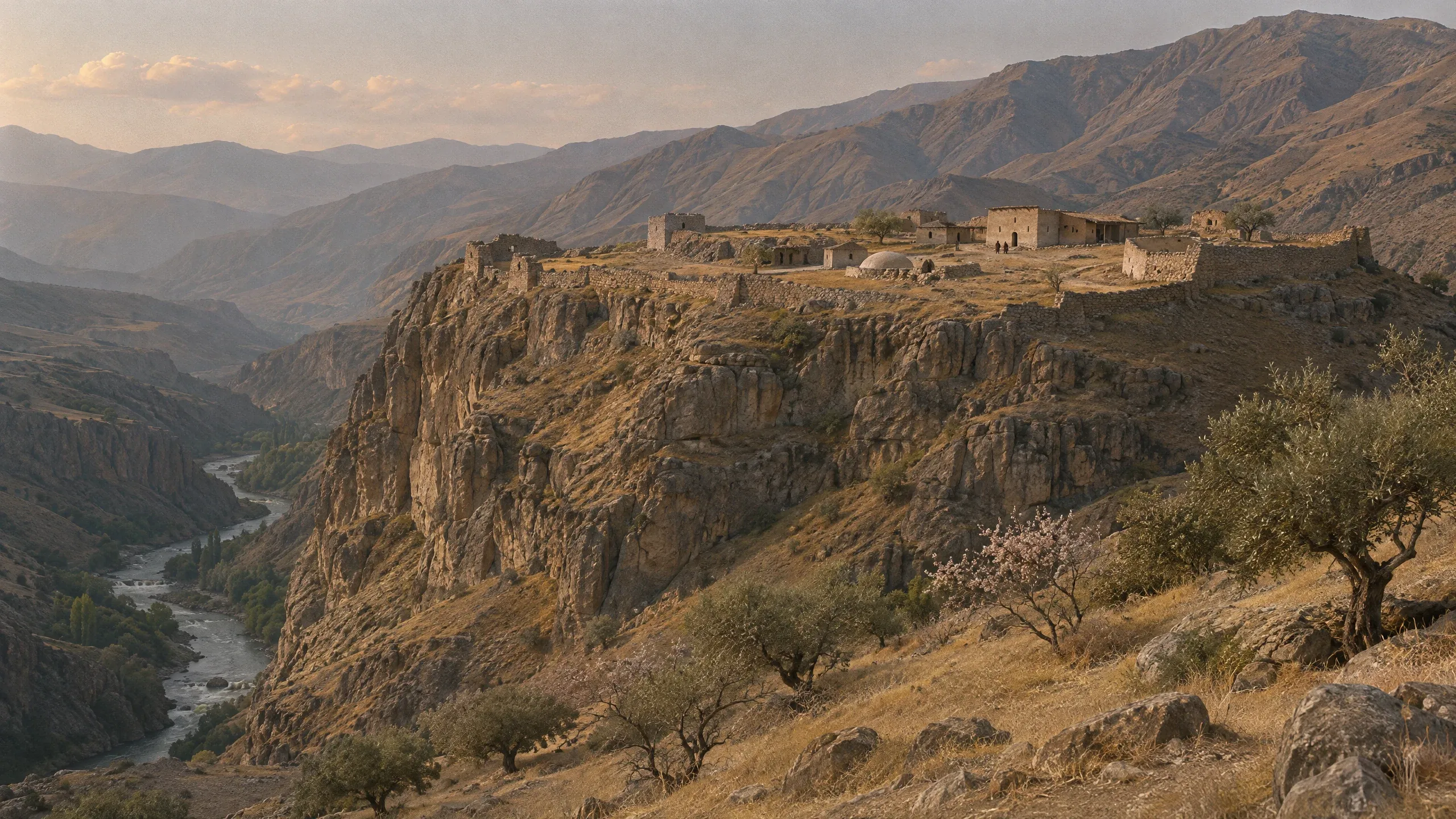
Lamasar, also spelled Lanbasar and in Juvayni Lammasar, was the second great fortress of the Nizari Ismailis in Rudbar, after Alamut itself. It stands above the upper Shahrud valley about 43 kilometres north-east of Qazwin and three kilometres north of the village of Shahristan-i Bala. Daftary calls it the largest castle the Nizaris held in Daylaman.1 It covered the western approach to Alamut from the Shahrud and was the residence of Kiya Buzurg-Ummid for two decades. The Imam Hasan II was killed there in 1166. When the Mongols came in 1256 it was the last castle in Rudbar to surrender.2 (The coordinates given here are approximate.)
Site and defences
Lamasar sits on a high rock above the Shahrud, a tributary of the Safidrud, west of the Alamut valley. Like the other main Persian castles of the Nizaris, it was chosen and built to withstand long sieges. Daftary’s dictionary lists the requirements: a site that a small garrison could defend, its own water and food, and a friendly Ismaili or Shi’i population nearby. Each major castle had deep, roofed water cisterns lined with limestone. The Nizari strategy was defensive, unlike the Crusader practice of building castles as bases for attack.3
Under Buzurg-Ummid, Lamasar received large water reserves and cisterns, which still survive, together with fine buildings and gardens. Daftary groups it with Alamut, Girdkuh and Qa’in as the large-scale Persian castles. Most of the Syrian Nizari fortresses were smaller. Unlike the Syrian castles, the Persian ones carry no building inscriptions, so their construction history has to be pieced together from the chronicles.3
Capture: 1096 or 1102
The Nizari sources quoted by the Persian historians say that the holder of Lamasar, Rasamuj, first accepted the authority of Hasan-i Sabbah. He then went back on the agreement and planned to give the castle to the Saljuq amir Nushtagin. Hasan sent Kiya Buzurg-Ummid with three other chiefs, Kiya Abu Ja’far, Kiya Abu ’Ali and Kiya Garshasb, to take it by force.4
The date of the capture is disputed. Daftary dates the assault to Dhu’l-Qa’da 489 / November 1096. Juvayni gives a later date: Buzurg-Ummid and his men “climbed up by stealth in the night of the 24th of Dhu’l-Qa’da, 495 [10th of September, 1102] and slew the inhabitants”. In Juvayni’s telling, the occupants were attacked because they had refused to accept the da’wa. Daftary’s dictionary gives 489/1096 and calls Juvayni’s 495/1102 the less likely date.5
Buzurg-Ummid’s castle
Buzurg-Ummid became governor of Lamasar and, according to Juvayni, “resided in that castle for 20 years and did not come down until he was summoned by Hasan”. The summons came when Hasan-i Sabbah was dying in 1124 and named him as successor.6 He rebuilt Lamasar into a major stronghold using local labour. Daftary credits Lamasar with greatly strengthening the defence of Rudbar, since any army coming up the Shahrud had to deal with it before it reached Alamut.7
Saljuq forces attacked it repeatedly. During the eight-year attrition campaign of the amir Anushtagin Shirgir (1109–1118), the Saljuqs destroyed the crops of Rudbar every year and besieged Lamasar and the other castles of the district. They gave up in 1118 when news came that Sultan Muhammad Tapar had died. In 538/1143 the garrison drove off another attack sent by Sultan Mas’ud. Daftary’s dictionary notes that the Saljuqs besieged Lamasar many times without success.8
The death of Hasan II, 1166
Lamasar is where the Qiyama period suffered its first crisis. Hasan II, who proclaimed the Qiyama at Alamut in 1164, was stabbed to death at Lamasar on 6 Rabi’ I 561 / 9 January 1166. His killer was a brother-in-law, Hasan b. Namawar, of a Daylami family that Daftary’s sources link to a branch of the Buyids. His son Nur al-Din Muhammad succeeded him and continued the doctrine of the Qiyama.9
The Mongol siege, 1256–1257
When the Imam Rukn al-Din Khurshah negotiated with Hülegü in 1256, he asked that Alamut and Lamasar be spared from demolition. After he surrendered at Maymundiz in November 1256, his agents went with Mongol envoys to the castles of Rudbar and ordered them to surrender. Juvayni says about forty castles were dismantled. The commanders of Alamut and Lamasar refused. Daftary suggests they may have believed their Imam was acting under compulsion, as a form of taqiyya.10
Hülegü went on to Lamasar while Balaghai besieged Alamut. Juvayni was at the foot of Lamasar when he asked Hülegü’s permission to inspect the Alamut library. Khurshah went with Hülegü and spoke to the Alamut garrison on their behalf, but Lamasar would not submit even at his urging. Hülegü left Tayir-Buqa with a force of Mongols and Persians to continue the siege. Lamasar held out for about another year until cholera killed most of the garrison. The survivors surrendered at the end of 655 AH (late 1257).11
After the Nizari state
The Mongols partly rebuilt Lamasar for their own use. Daftary’s dictionary adds that by the mid-fourteenth century the Nizaris of Daylaman, who had regrouped, held Lamasar from time to time before local rulers drove them out. The castle then changed hands among the regional dynasties of Daylam, including the Zaydi Amir Kiya’i Sayyids, the Hazaraspids and the Gawbaras, until the Safavids took the region in the sixteenth century.12 Today it is one of the best-preserved Nizari sites in Rudbar. Its cisterns are the most visible remains of Buzurg-Ummid’s building work.7
Footnotes
-
Farhad Daftary, Historical Dictionary of the Ismailis (Scarecrow Press, 2012), s.v. “Lamasar”; Farhad Daftary, The Isma’ilis: Their History and Doctrines, 2nd ed. (Cambridge University Press, 2007), p. 324. ↩
-
Daftary, Historical Dictionary, s.v. “Lamasar”; Daftary, The Isma’ilis, pp. 344, 363, 396. ↩
-
Daftary, Historical Dictionary, s.v. “Architecture”; Daftary, The Isma’ilis, p. 324. ↩ ↩2
-
Daftary, The Isma’ilis, p. 324. ↩
-
Daftary, The Isma’ilis, p. 324; ’Ata-Malik Juvayni, The History of the World-Conqueror, tr. J. A. Boyle (Manchester University Press, 1958), vol. 2, p. 678; Daftary, Historical Dictionary, s.v. “Lamasar”. ↩
-
Juvayni, World-Conqueror, vol. 2, p. 678; Daftary, The Isma’ilis, p. 344. ↩
-
Daftary, The Isma’ilis, p. 324; Daftary, Historical Dictionary, s.v. “Lamasar”. ↩ ↩2
-
Daftary, The Isma’ilis, pp. 337, 357; Daftary, Historical Dictionary, s.v. “Lamasar”. ↩
-
Daftary, The Isma’ilis, p. 363; Daftary, Historical Dictionary, s.v. “Hasan II”. ↩
-
Daftary, The Isma’ilis, pp. 394, 396; Juvayni, World-Conqueror, vol. 2, p. 717. ↩
-
Daftary, The Isma’ilis, p. 396; Juvayni, World-Conqueror, vol. 2, pp. 717–719. ↩
-
Daftary, Historical Dictionary, s.v. “Lamasar”. ↩