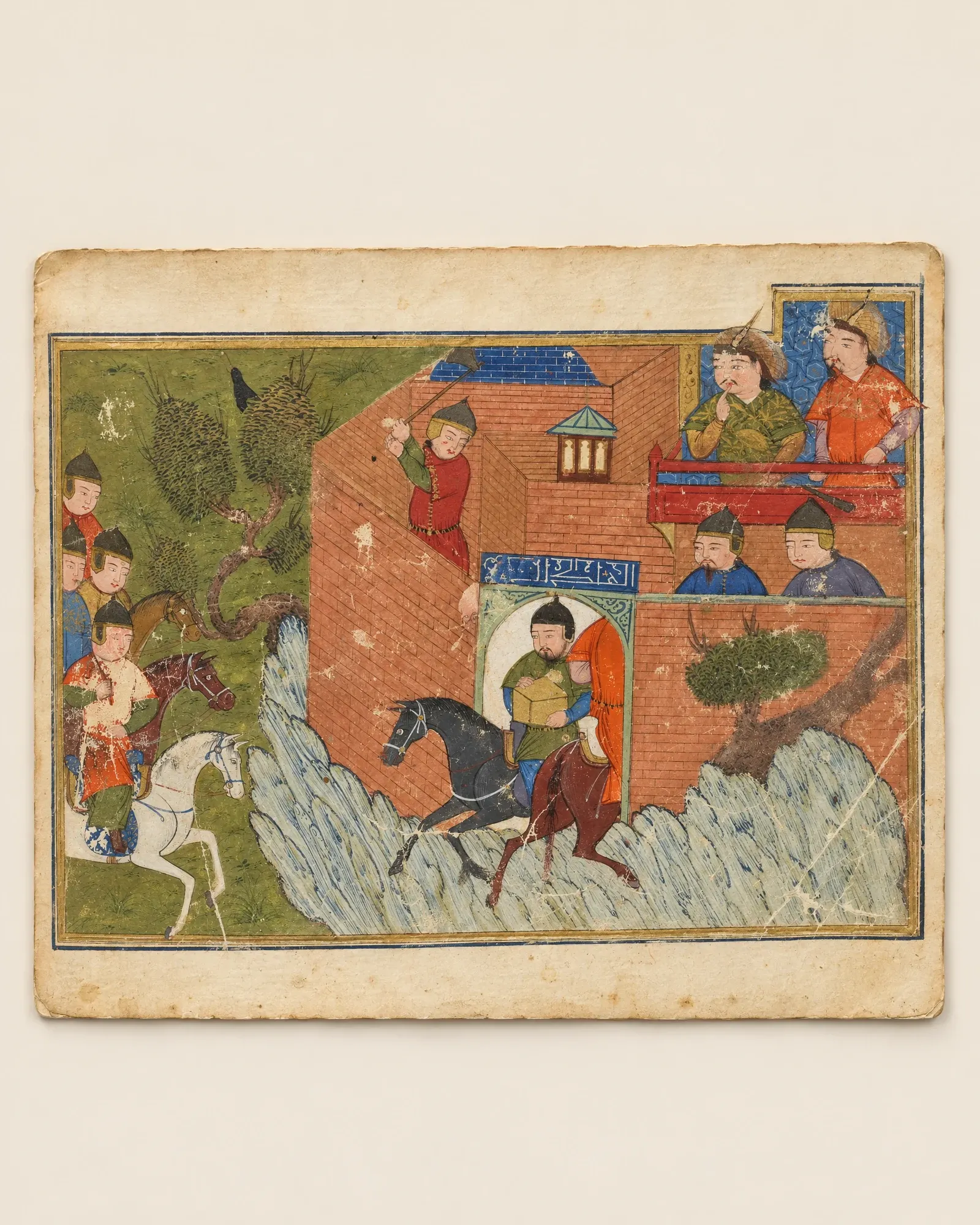
Rukn al-Din Khurshah (Khwurshah, c. 1230–1257) was the eighth and last lord of Alamut and is counted by the Nizari Ismailis as their twenty-seventh Imam. He came to power in December 1255, as Hülegü’s army was advancing into Iran. After a year of negotiation he surrendered to the Mongols at Maymundiz in November 1256. The Nizari state, which had lasted 166 years, came to an end, and the castles of Rudbar were demolished. Khurshah was killed in Mongolia in 1257. The line of Nizari Imams continued through his son Shams al-Din Muhammad.1
Accession
Khurshah was born around 627/1230, the eldest son of Ala al-Din Muhammad III, and received the nass as a child. In his father’s last years the two were estranged. According to the Persian historians, Nizari leaders who wanted to come to terms with the Mongols planned to put him in charge. When Muhammad III was murdered at Shirkuh on 1 December 1255, Khurshah succeeded him and had the murderer, Hasan-i Mazandarani, executed.2
First moves
Khurshah first strengthened his position with his neighbours. The Nizaris finished a campaign in western Daylam and took a fortress in Khalkhal that they had been besieging. He sent messengers to Gilan and other neighbouring states to announce his accession. He then sent an envoy to Yasa’ur Noyan, the Mongol commander at Hamadan, offering submission. Yasa’ur replied that Khurshah must present himself in person before Hülegü, who was about to arrive.3 Daftary notes that the sources are ambiguous about Khurshah’s real intentions in the negotiations that followed.4
Hülegü’s approach
Hülegü had left his camp in Sha’ban 651 / October 1253 and advanced slowly. He reached Samarqand in Sha’ban 653 / September 1255 and crossed the Oxus in Dhu’l-Hijja 653 / January 1256. He entered Khurasan in Rabi’ I 654 / April 1256, and in mid-Rabi’ II / May 1256 his generals took Tun in Quhistan and killed its inhabitants.5 The last muhtasham of Quhistan, Nasir al-Din, submitted to Hülegü at Tus through the Kart ruler Shams al-Din.5
Negotiations
Khurshah’s embassy, led by his vizier Shams al-Din Gilaki and Sayf al-Din Sultan Malik, reached Hülegü on 17 Sha’ban 654 / 9 September 1256. It asked for a year’s grace and for Alamut and Lamasar to be spared. Hülegü moved against Rudbar from Bastam in mid-Sha’ban / September with four armies. Buqa-Temür and Köke-Ilgei came through Mazandaran, Tegüder and Ket-Buqa through Khuwar and Simnan, and Hülegü himself by way of Firuzkuh, Damavand and Rayy, while Balaghai and Tutar advanced from ’Iraq-i ’Ajam.6
On 17 Ramadan / 8 October Khurshah sent his son, or a young brother, whom Hülegü returned on account of his youth, and on 5 Shawwal / 26 October his brother Shiranshah with 300 men. He ordered the governor of Girdkuh, the qadi Taj al-Din Mardanshah, to submit. Hülegü meanwhile had Nizaris near Qazwin secretly killed. On 10 Shawwal 654 / 31 October 1256 he broke camp at Pishkildara and advanced on Rudbar through Taliqan.7
Maymundiz
On 18 Shawwal 654 / 8 November 1256 Hülegü arrived before Maymundiz, where Khurshah was staying. The Mongols cut down the trees the Nizaris had planted to build mangonels. They also brought a Chinese ballista (kaman-i gav) with a range of 2,500 paces. When Khurshah asked for a yarligh, or decree, granting him safe conduct, it was drawn up by Hülegü’s secretary, the historian ’Ata-Malik Juvayni. Some zealous fida’is opposed surrender, and the unusually mild autumn, which allowed the siege to continue, worked against the defenders.8
Bombardment resumed on 25 Shawwal / 15 November. Tusi and other outside scholars living with the Nizaris urged surrender. Khurshah sent out his son and his brother Iranshah first. On Sunday 29 Shawwal 654 / 19 November 1256 he came down from Maymundiz with Tusi, the physician Asil al-Din Zuzani and his vizier Mu’ayyad al-Din. He had reigned for about a year. Some fida’is fought on in the castle for three more days.9
The castles surrender
Khurshah’s officials went with Mongol envoys around Rudbar and ordered the castles to surrender. About forty were taken and demolished. Alamut, under its commandant Muqaddim al-Din, and Lamasar at first refused. Balaghai besieged Alamut until it surrendered, and its garrison was given three days to leave. At the end of Dhu’l-Qa’da 654 / December 1256 the Mongols entered and began demolishing it.10
Juvayni examined the Alamut library before it was burned. He saved copies of the Qur’an, other choice books, including some Ismaili works, and astronomical instruments.10 Lamasar held out for about a year and surrendered at the end of 655 AH (late 1257). Girdkuh resisted until December 1270.11
Journey to Mongolia and death
Hülegü left Rudbar in Dhu’l-Hijja 654 / January 1257, and Khurshah’s family was sent to Qazwin. Khurshah’s emissaries went with Mongol envoys to the Syrian castles, instructing them to hold the castles as Hülegü’s subjects until he arrived. On 1 Rabi’ I 655 / 9 March 1257 he set out for Mongolia with nine companions under the guard Bujrai.12
Möngke refused to see him at Karakorum because Girdkuh and Lamasar had still not been handed over. On the way back, near the Khangai mountains in north-western Mongolia, Khurshah and his companions were put to the sword in spring 655/1257.13
The massacres
A general massacre of the Nizaris followed. Khurshah’s family at Qazwin was killed by Qaraqai Bitikchi. In Khurasan, Otegü-China summoned the Nizaris of Quhistan to gatherings and slaughtered about 12,000 of them. Juvayni, writing for the conquerors, states that Möngke ordered that none should be spared, echoing an order of Chinggis Khan. He celebrated the destruction of the Nizaris as one of Hülegü’s great achievements.14 The Nizari community survived, however. The Imamate passed to Khurshah’s son, Shams al-Din Muhammad, and Nizari history entered its post-Alamut period.15
Footnotes
-
Farhad Daftary, The Isma’ilis: Their History and Doctrines, 2nd ed. (Cambridge University Press, 2007), pp. 395–397; Farhad Daftary, Historical Dictionary of the Ismailis (Scarecrow Press, 2012), appendix “Nizari Imams”. ↩
-
Daftary, The Isma’ilis, pp. 391–392. ↩
-
Daftary, The Isma’ilis, p. 392. ↩
-
Daftary, Historical Dictionary, s.v. “Rukn al-Din Khurshah”. ↩
-
Daftary, The Isma’ilis, p. 394. ↩
-
Daftary, The Isma’ilis, p. 394. ↩
-
Daftary, The Isma’ilis, p. 395. ↩
-
Daftary, The Isma’ilis, pp. 395–396. ↩
-
Daftary, The Isma’ilis, p. 396; ’Ata-Malik Juvayni, The History of the World-Conqueror, tr. J. A. Boyle (Manchester University Press, 1958), vol. 2, pp. 718–720. ↩ ↩2
-
Daftary, The Isma’ilis, pp. 396, 398. ↩
-
Daftary, The Isma’ilis, p. 396. ↩
-
Daftary, The Isma’ilis, pp. 396–397. ↩
-
Daftary, The Isma’ilis, p. 397; Juvayni, World-Conqueror, vol. 2, pp. 723–725. ↩
-
Daftary, The Isma’ilis, pp. 397, 410. ↩