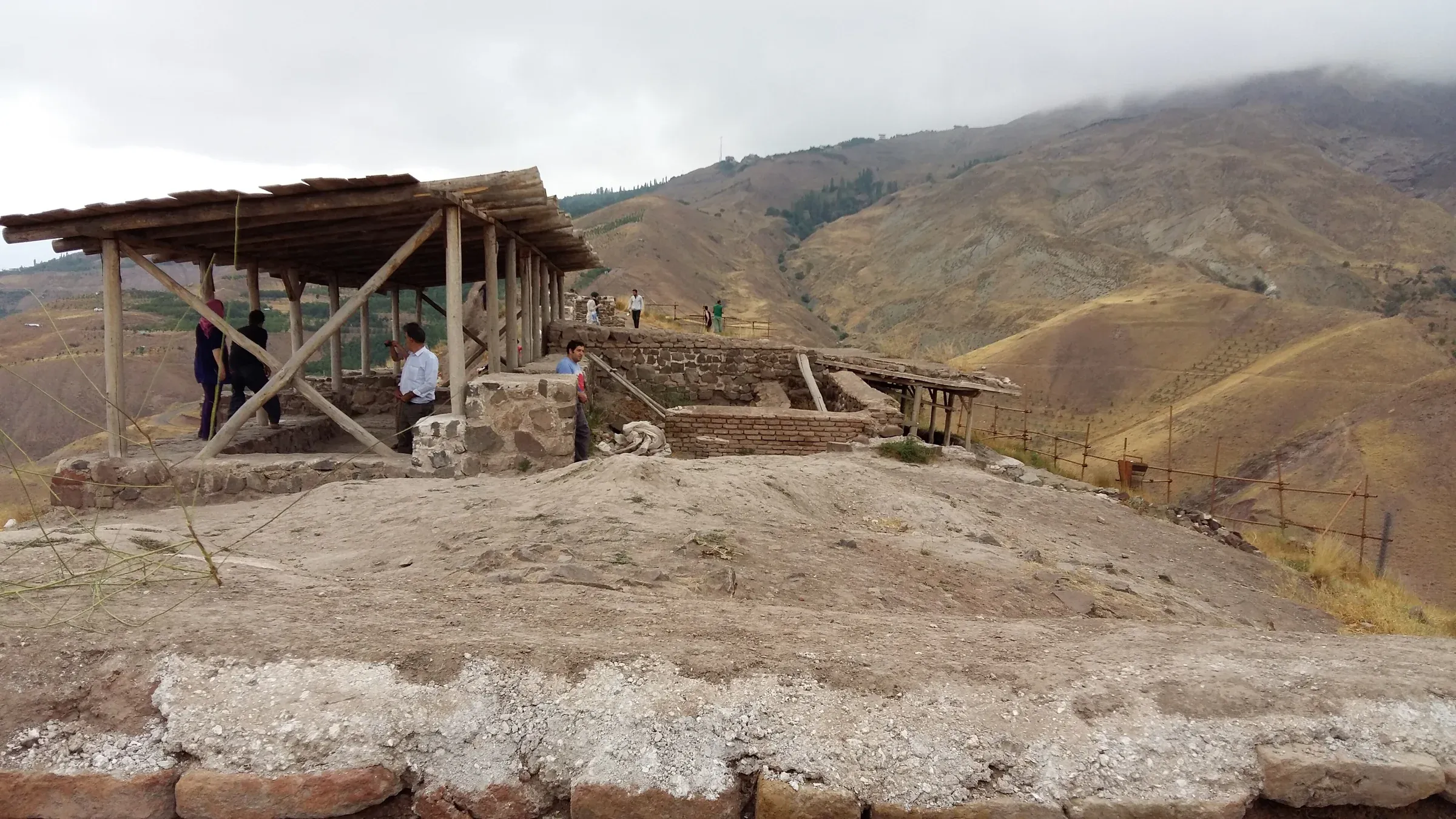
The castle of Alamut held the most famous library of the Nizari Ismaili state. It was used by Nizari scholars and by outside visitors for more than a century and a half. It was broken up in December 1256, after the Mongol conquest, when the Persian historian ’Ata-Malik Juvayni selected the books he wanted to keep and burned the rest.1 No catalogue survives, and almost everything known about the collection comes from Juvayni, who called it a library “the fame of which had spread throughout the world”.2
Founding and growth
Nizari tradition credits Hasan-i Sabbah, who took Alamut in 1090 and lived there until his death in 1124, with founding “an impressive library” at the castle. Daftary notes that the other major Nizari fortresses in Persia and Syria were later equipped with significant collections of manuscripts, documents and scientific instruments.3 He also notes collections in Quhistan and Syria with religious and scientific works and equipment, alongside the one at Alamut.4
Hasan-i Sabbah was himself a scholar, trained in theology and astronomy, and the libraries reflected the Ismaili tradition of learning inherited from the Fatimids. Lewis observes that patronage of learning was one of the recognised duties of a Muslim ruler, and that the Ismaili Imams “had not been backward in this respect”.5
What the collection held
The library contained the religious literature of the community. This included the treatises of Hasan-i Sabbah and of later lords of Alamut, the Nizari chronicles of the castle and the da’wa, and Ismaili doctrinal works.6 Its holdings also included non-Ismaili books. Juvayni found there a history of the Caspian provinces of Jil and Daylam written for the Buyid ruler Fakhr al-Dawla, which recorded that the Justanid rulers had begun building the castle in 246/860–61.7
The library also served as an archive. Juvayni saw in it “several of Sanjar’s firmans”, decrees of the Saljuq sultan in which, he wrote, Sanjar “conciliated and flattered” the Nizaris. From these he deduced how far the sultan had sought peace with them.8 Juvayni also mentions astronomical instruments kept with the books: kursis (parts or stands of astrolabes), armillary spheres and “complete and partial astrolabes”.9
Scholars at Alamut
Daftary notes that the Nizaris extended their patronage to outside scholars, “including Sunnis, Twelver Shi’is and even non-Muslims”.3 In the thirteenth century, as the Mongols advanced across Central Asia, many scholars took refuge in the Nizari castles of Quhistan and Rudbar.10 Lewis notes that the library attracted a number of outside scholars under Ala al-Din Muhammad (r. 1221–1255).5
The most famous of them was Nasir al-Din Tusi. He served the Nizari governor of Quhistan from about 1227 and later lived at Alamut until 1256. Daftary describes the castle library as one of the best collections available to a scholar of his time.11 The Rawdat al-taslim, the main surviving Nizari doctrinal work of the late Alamut period, was completed in 640/1243 under Tusi’s influence. It is one of the few books from the Nizari collections to have survived.12
The Rawda was completed under the supervision of a high-ranking Nizari official, and Daftary suggests it may have been compiled by a team working under Tusi’s direction. Its chief compiler may have been Salah al-Din Hasan-i Mahmud, known as Hasan-i Salah Munshi, a secretary at the Nizari court. Such a project depended on the library: the compilers drew on earlier Ismaili works and on the teachings of the Alamut period, which the Rawda sets out in systematic form.12
A refuge for scholars in Quhistan
The Quhistani castles and their governors played a large part in this patronage. When Chingiz Khan’s armies destroyed Bukhara and Samarqand in 1220 and massacred the populations of Marw and Nishapur, refugees, among them Sunni scholars, found shelter with the Nizaris of Quhistan.13 The muhtasham Shihab al-Din was so generous to the refugees that complaints reached Alamut, and he was replaced by Shams al-Din. The Sunni historian Minhaj-i Siraj Juzjani, author of the Tabaqat-i Nasiri, visited Quhistan three times between 621/1224 and 623/1226 and was received at the Nizari courts.13
Tusi’s time among the Nizaris shows what such patronage could produce. Daftary counts almost three decades spent in their castles, “a most productive period in his career”, during which he wrote numerous treatises on astronomy, philosophy, theology and other subjects. His Akhlaq-i Nasiri, completed in Quhistan in 633/1235, was named after his patron, the muhtasham Nasir al-Din.14
The Qazwin inspection
The library had been culled once before the Mongols came. In 1210 Jalal al-Din Hasan III repudiated the Qiyama and adopted Sunni law. To convince the people of Qazwin, the Nizaris’ old enemies, of his sincerity, he invited the city’s scholars to inspect the Alamut library and burn the books they considered heretical.15
Juvayni relates that the works removed included treatises by Hasan-i Sabbah and by Hasan III’s own predecessors. Jalal al-Din ordered them “to be burnt in the very presence of those Qazvinis”, while cursing their authors. Juvayni says he had seen a letter that Hasan III dictated to the notables of Qazwin on the matter.16 Daftary notes that later Nizaris explained Hasan III’s policy as a return to taqiyya, the precautionary concealment of belief.15
Juvayni and the destruction of 1256
Rukn al-Din Khurshah surrendered to Hülegü at Maymundiz on 19 November 1256. Alamut, under its commander Muqaddim al-Din, held out for some weeks longer. It surrendered at the end of Dhu’l-Qa’da 654 / December 1256, and its garrison was given three days to leave.17 Juvayni, then serving as Hülegü’s secretary, describes what followed:
Now when I was at the foot of Lammasar, being desirous of inspecting the library, the fame of which had spread throughout the world, I suggested to the King that the valuable books in Alamut ought not to be destroyed. He approved my words and gave the necessary orders; and I went to examine the library, from which I extracted whatever I found in the way of copies of the Koran and [other] choice books … I likewise picked out the astronomical instruments … As for the remaining books, which related to their heresy and error and were neither founded on tradition nor supported by reason, I burnt them all.18
Daftary notes that among the books Juvayni saved were some Ismaili works.17 The most important was the Sargudhasht-i Sayyidna, a biography of Hasan-i Sabbah and the earliest of the Nizari chronicles, which Juvayni quotes at length.19 Juvayni also describes the castle’s storerooms and water system. Its galleries and tanks were cut into the rock, and its stores of wine, vinegar and honey had been laid down, he was told, since Hasan-i Sabbah’s time. The Mongols then demolished the castle.20
What survived
The loss shaped all later study of the Nizaris. Daftary writes that the Persian Nizaris “evidently did not produce any voluminous religious literature” during the Alamut period. The bulk of what they did produce was destroyed in the Mongol invasions, including the burning of the Alamut library, or perished soon afterwards under the Ilkhanids.21
Only a handful of Nizari doctrinal works survive directly from the period. They include the anonymous Haft bab-i Baba Sayyidna of about 596/1199–1200 and a few works associated with Tusi. The Syrian Nizaris, who wrote in Arabic, preserved some earlier Fatimid texts.21 The Fatimid libraries of Cairo had already been dispersed by the Ayyubids after 1171.22
After the library
Some of the people and objects of the library passed into Mongol service. Tusi joined Hülegü’s entourage, and Hülegü later founded an observatory for him at Maragha in Azerbaijan. Juvayni, who had burned the Ismaili books, was appointed governor of Baghdad in 657/1259 and held the post for more than twenty years until his death in 681/1283.23
The Ismaili literature that did survive was kept elsewhere: in Yemen, India, Syria and the Pamir valleys of Badakhshan. Lewis describes how such manuscripts reached European scholars only in the twentieth century, from San’a in Yemen in 1903 and from Shughnan on the upper Oxus. He notes that the recovered texts are almost entirely religious, and that historical works “are both few in number and poor in content”. This is the gap left by the loss of the Alamut chronicles.24
The library in the Persian histories
The Nizari chronicles that Juvayni used survive only in the works of the Persian historians. Juvayni began his history around 650/1252 and stopped work in 658/1260. He wrote his account of the Ismailis soon after the fall of Alamut, basing it “on the Nizari chronicles and other texts and records which Juwayni found at Alamut and elsewhere, and which have not survived”.19
Rashid al-Din’s Jami’ al-tawarikh, completed in 710/1310, has a fuller account than Juvayni’s. It quotes the Nizari chronicles more extensively and preserves details that Juvayni ignored. Some scholars have wondered how Rashid al-Din could have fuller access to Nizari sources than the man who destroyed the library. Daftary considers it most likely that he had direct access to some Ismaili books that had originally belonged to the Alamut collection.25
Footnotes
-
Farhad Daftary, The Isma’ilis: Their History and Doctrines, 2nd ed. (Cambridge University Press, 2007), p. 396. ↩
-
’Ata-Malik Juvayni, The History of the World-Conqueror, tr. J. A. Boyle (Manchester University Press, 1958), vol. 2, p. 719. ↩
-
Daftary, The Isma’ilis, p. 355. ↩
-
Bernard Lewis, The Assassins: A Radical Sect in Islam (Weidenfeld and Nicolson, 1967), p. 84. ↩ ↩2
-
Daftary, The Isma’ilis, pp. 303–305, 376. ↩
-
Juvayni, World-Conqueror, vol. 2, pp. 719–720. ↩
-
Lewis, The Assassins, p. 59, quoting Juvayni; Daftary, The Isma’ilis, p. 342. ↩
-
Juvayni, World-Conqueror, vol. 2, p. 719 and n. 5. ↩
-
Daftary, The Isma’ilis, p. 383. ↩
-
Daftary, The Isma’ilis, pp. 378–379. ↩
-
Daftary, The Isma’ilis, pp. 378–379. ↩
-
Lewis, The Assassins, p. 79, quoting Juvayni. ↩
-
Juvayni, World-Conqueror, vol. 2, p. 719. ↩
-
Juvayni, World-Conqueror, vol. 2, pp. 719–720; Daftary, The Isma’ilis, p. 396. ↩
-
Daftary, The Isma’ilis, pp. 6, 253. ↩
-
Daftary, The Isma’ilis, pp. 305, 379. ↩
-
Lewis, The Assassins, pp. 17–18. ↩
-
Daftary, The Isma’ilis, pp. 305–306. ↩