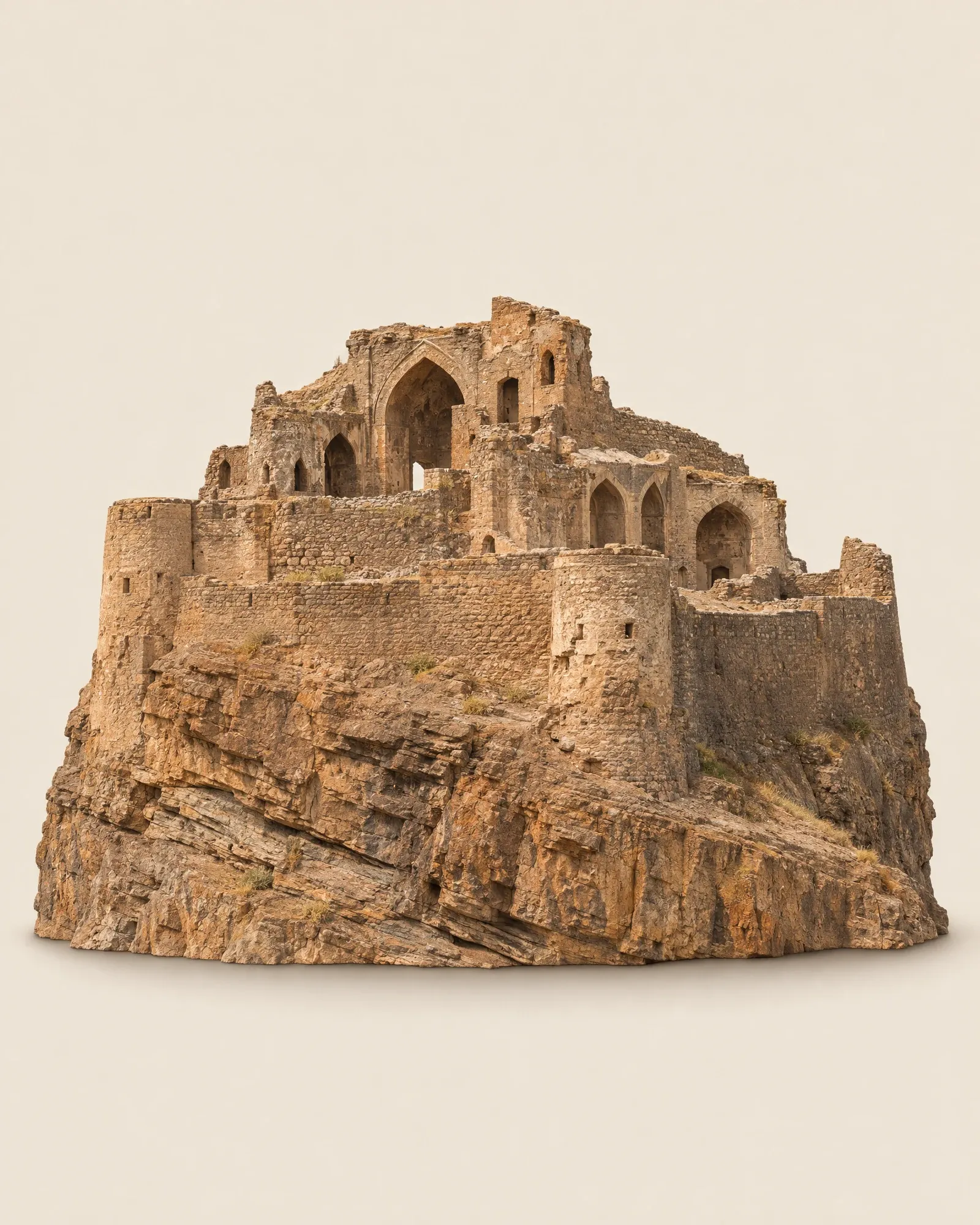
Jalal al-Din Hasan III (1166/7–1221) was the sixth lord of Alamut and is counted by the Nizari Ismailis as their twenty-fifth Imam. On his accession in 1210 he reversed the policy of his father, Nur al-Din Muhammad II. He repudiated the doctrine of the Qiyama, ordered his followers to observe the shari’a in its Sunni form, and sought reconciliation with the Abbasid caliphate and neighbouring Sunni rulers. Sunni contemporaries called him the “new Muslim” (naw-musalman). For the first time the Nizari state was recognised by the leading powers of the Muslim world. Hasan was also, according to Daftary, the first Muslim ruler to come to terms with the Mongols.1
Heir and critic
Hasan was born in 562/1166–67, the eldest son of Muhammad II, and received the nass designating him as successor in childhood. The Persian historians say that in Muhammad II’s later years a breach grew between father and son. Hasan was unhappy with the doctrine and practices of the Qiyama and wanted closer relations with the Sunni world. He wrote secretly to several Sunni rulers with whom he hoped to have good relations later.2
Accession and reform
Muhammad II died, possibly of poison, in Rabi’ I 607 / September 1210. Hasan succeeded him with the honorific Jalal al-Din, which had by then become customary for the lords of Alamut. According to the Persian historians, he at once publicly repudiated the Qiyama, declared his adherence to Sunni Islam and ordered his followers to observe the shari’a in its Sunni form. He informed the caliph al-Nasir, the Khwarazmshah Muhammad and other rulers of the change.3
He ordered mosques and baths to be built in every Nizari village, as signs that these were ordinary Muslim communities. He invited Sunni jurists (faqihs) from Iraq and Khurasan to instruct his people. Daftary notes that Arabic sources date the new policy in Syria to 608/1211–12, when the Syrian Nizaris too were ordered to follow the Sunni shari’a and build mosques.4
Recognition by the caliph
The Abbasid caliph accepted Hasan’s “new orthodoxy”. In Rabi’ I 608 / August 1211 al-Nasir issued a decree confirming his adherence to Sunni Islam. Hasan was now recognised as an amir among other amirs, and his rights to the Nizari territories were officially acknowledged.5
Hasan’s mother made the pilgrimage to Mecca in 609/1213 under al-Nasir’s patronage and was received with great honour. The caliph persuaded the nobility of Gilan to let four of their daughters marry Hasan. One of these wives, a sister of Kayka’us b. Shahanshah, ruler of Kutum, became the mother of his successor, Ala al-Din Muhammad III.5
The Qazwin inspection
The people of Qazwin, long hostile neighbours of Rudbar, remained sceptical for some time. Hasan invited religious scholars and notables of Qazwin to Alamut, let them inspect its library and allowed them to burn any books they judged heretical. After this the Qazwinis too were convinced. The episode is one of the few recorded events in the history of the Alamut library before its destruction in 1256.6
How the Nizaris understood it
All the Nizaris of Rudbar, Qumis, Quhistan and Syria seem to have accepted the new policy without question. The Syrian Nizaris, and probably others, adopted the Shafi’i school of law.7 For the Nizaris, Hasan was the infallible Imam, who had received the nass and could interpret the shari’a for his community as he saw fit.
As it was explained later, the Nizaris regarded his declarations as a reimposition of taqiyya, precautionary concealment of belief, which had been lifted during the Qiyama. Later Nizari doctrine, set out in the Rawdat al-taslim (640/1243), treated the period from Hasan III onward as a new era of concealment (satr).8
Political rewards
Daftary emphasises the political advantages. The Nizaris had failed in their revolt and had been pushed to the margins as “heretics” in their fortress communities, and many seem to have tired of this isolation. Recognition brought territorial security and peace, especially in Quhistan and Syria, where the Nizaris’ position had been constantly under threat. The Ghurid attacks on Quhistan ended, and in Syria the Nizaris received Ayyubid help against the Franks.9
When fida’is killed Raymond, son of Bohemond IV, in the cathedral of Tartus in 610/1213, Bohemond besieged Khawabi in 611/1214–15. The Ayyubid rulers al-Zahir of Aleppo and al-‘Adil came to the Nizaris’ relief.10
Campaigns in the west
Hasan III took an active part in regional politics. According to al-Nasawi, secretary to the Khwarazmshah Jalal al-Din, he first recognised the suzerainty of the Khwarazmshah and then allied himself with al-Nasir. He was also close to Muzaffar al-Din Özbeg, the Eldiguzid ruler of Arran and Adharbayjan (r. 1210–1225).11
In 610/1213–14 he led an army to Adharbayjan, the first lord of Alamut to leave Rudbar on campaign. In 611/1214–15, near Hamadan, the allied forces defeated Mengli, the rebellious ruler of ’Iraq-i ’Ajam, and Hasan received Abhar and Zanjan. He was away from Alamut for about a year and a half. In 614/1217 fida’is killed the rebel Ighlamish, reportedly at the caliph’s request.11
First contacts with the Mongols
Hasan’s reign coincided with the Mongol invasion of Central Asia. Chinggis Khan took Bukhara and Samarqand in 1220 and Balkh in 1221. According to Daftary, Hasan was the first Muslim ruler to offer submission. His envoys made overtures as early as autumn 616/1219 and met Chinggis Khan in spring 618/1221 at Balkh or Taliqan.12
Around the end of his reign many Sunnis, including scholars fleeing the Mongols, found refuge in the Nizari towns and castles of Quhistan. The muhtasham Shihab al-Din was so generous to them that complaints reached Alamut.13 In 618/1221 four fida’is from Quhistan killed Yamin al-Din Bahramshah, ruler of Sistan, at Zarang.14
Death and succession
Hasan III died of dysentery in Ramadan 618 / November 1221, after eleven years in power. His vizier accused his Sunni wives and his sister of poisoning him, and they were put to death. His son Ala al-Din Muhammad III, then nine years old, succeeded him, with the vizier as regent. Hasan III’s Sunni policies were never formally renounced, but they were gradually relaxed under his son.15
Footnotes
-
Farhad Daftary, The Isma’ilis: Their History and Doctrines, 2nd ed. (Cambridge University Press, 2007), pp. 375–377; Farhad Daftary, Historical Dictionary of the Ismailis (Scarecrow Press, 2012), appendix “Nizari Imams”. ↩
-
Daftary, The Isma’ilis, p. 375. ↩
-
Daftary, The Isma’ilis, p. 375. ↩
-
Daftary, The Isma’ilis, pp. 375, 389. ↩
-
Daftary, The Isma’ilis, p. 376. ↩
-
Daftary, The Isma’ilis, p. 376. ↩
-
Daftary, The Isma’ilis, pp. 376, 380. ↩
-
Daftary, The Isma’ilis, p. 376. ↩
-
Daftary, The Isma’ilis, p. 389. ↩
-
Daftary, The Isma’ilis, pp. 377, 382–383. ↩
-
Daftary, The Isma’ilis, pp. 376, 383. ↩
-
Daftary, The Isma’ilis, p. 384. ↩
-
Daftary, The Isma’ilis, pp. 377–378. ↩