What is known
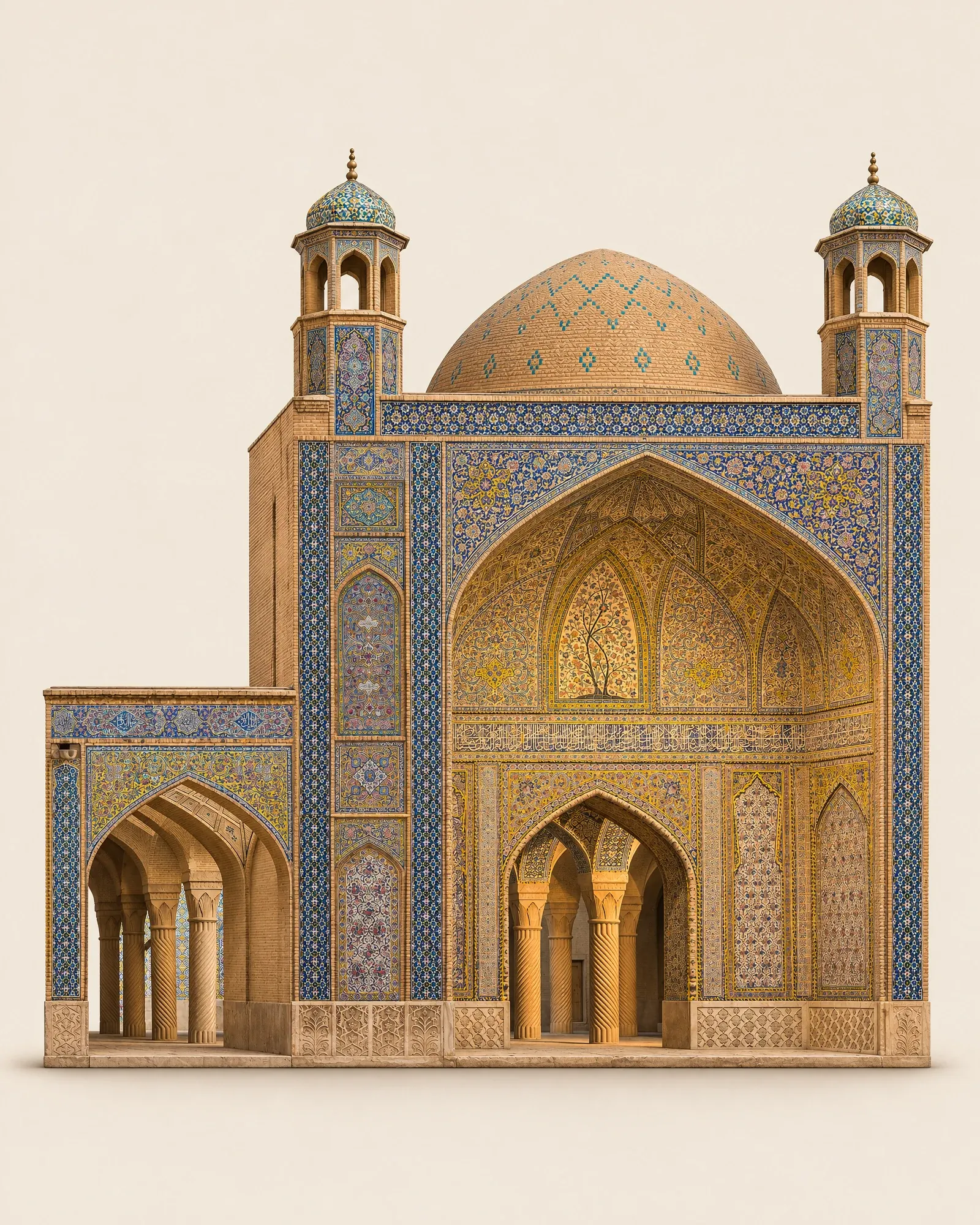
Sayyid Ali, the forty-first Imam of the Qasim-Shahi line, succeeded his father Shah Nizar II, who died at Kahak in Dhu’l-Hijja 1134/September 1722. According to his tombstone, Sayyid Ali died in 1167/1754, giving him an Imamate of about thirty-two years. His grave is in the largest chamber of the mausoleum at Kahak, the building that was once part of Shah Nizar’s residence. Daftary notes that Shah Nizar and his immediate successor lived at Kahak, which was later abandoned as the residence of the Imams, although the family kept a foothold there until at least the beginning of the nineteenth century.1
No writings, farmans or contemporary references to Sayyid Ali himself have been identified; Daftary records only his name, his burial and the date on his tombstone. What can be described is the transformation of Persia during his lifetime, which changed the position of his successors more than anything since the fall of Alamut.2
Kahak in Sayyid Ali’s time
Kahak, about thirty-five kilometres north-east of Anjudan and north-west of Mahallat, stood on the caravan road between Qumm and Arak, with a Safavid caravanserai. In the compound and garden of the mausoleum where Sayyid Ali is buried there are tombstones inscribed in Khojki characters, left by Khoja pilgrims who made the long and dangerous journey from India to see the Imam. Some ginans call Kahak the abode of the Imams. Daftary concludes that by this period close relations had developed between the Imams and their Khoja followers in Sind, Panjab and Gujarat.3
Outside sources describe the same traffic. Nadir Shah’s chronicler Muhammad Kazim Marvi reports that Sayyid Ali’s son and successor received many pilgrims and substantial tithes from followers in India, centred on Ahmadabad in Gujarat. In 1818 a British official in Gujarat, James Macmurdo, reported that the Khojas made pilgrimage to a place eight days’ march north-west of Isfahan, where they paid an annual tax on their property to a living saint.4
The fall of the Safavids
Sayyid Ali’s Imamate began in catastrophe. In the early eighteenth century the Safavid realm suffered repeated incursions by Afghan tribal forces from the east, who captured the capital, Isfahan, in October 1722 (Muharram 1135), the year of Shah Nizar’s death. The Afghan invasion reached Kahak itself. In the years that followed, the Safavid commander Nadir Quli Beg rose to power through campaigns against the Afghans and became the de facto ruler of Persia, until he set aside the Safavids and had himself crowned shah in 1736.5
Nadir Shah abandoned the Safavid sponsorship of Twelver Shi’ism. To reduce tension with his Sunni subjects and neighbours, he proposed that Shi’ism, as the Ja’fari madhhab, be recognised as a fifth school of law alongside the four Sunni schools. The policy had little success abroad, but by displacing the Twelver religious establishment of the Safavid era it changed the position of the Nizari Imams. Beben and Mohammad Poor argue that after the collapse of the Safavid state the Imams were no longer pressed to conceal their claim to the Imamate.6
From concealment to visibility
Under the late Safavids the Imams had lived as local notables and landholders around Anjudan, disguised as Twelver Shi’is and respected as sayyids; Beben and Mohammad Poor find no evidence that any Imam after Murad Mirza openly expressed a claim to the Imamate. Within a generation that changed. His son Hasan Ali, known as Sayyid Hasan Beg, served as a commander in Nadir Shah’s army, apparently with Nadir’s full knowledge of his position as Imam, and Daftary calls him the first Imam of the line to emerge from concealment and obscurity.7
The base for that emergence had been laid by Sayyid Ali’s father. Shah Nizar had settled formerly nomadic followers from Khurasan, known as Ata Allahis after his Sufi name, in the district of Sirjan in Kerman. The nineteenth-century Kerman historian Ahmad Ali Khan Vaziri described them as personal devotees of the Imams as descendants of Ja’far al-Sadiq rather than as Ismailis in the strict sense. They gave the family a constituency in south-eastern Persia.8
The Khoja route under threat
The collapse of order after the Safavids endangered the link with India. Vaziri relates that Khojas travelling to the Anjudan and Mahallat area to visit the Imam and deliver their dues were often plundered and killed between Nain and Yazd by Bakhtiyari tribesmen, besides suffering extortion from officials on the way. Beben and Mohammad Poor add that the Khojas were then moving from inland regions towards the coasts of Sind and Gujarat and benefiting, as merchants, from the growth of Indian Ocean trade, so the dues at stake were growing.9
A chronological problem
The tombstone date sits awkwardly with what is reported of his son. Daftary places Nadir Shah’s expulsion of the Afghans and overthrow of the Safavids within Hasan Ali’s Imamate, and has Hasan Ali move to Shahr-i Babak towards the end of Nadir’s reign (1148–1160/1736–1747). Beben and Mohammad Poor likewise describe Hasan Ali as Imam in Nadir’s service and in contact with Nadir’s grandson Shahrukh after 1747. If Sayyid Ali died only in 1167/1754, these activities would fall within his lifetime, with Hasan Ali acting as the family’s leader before formally succeeding him; alternatively the reading or attribution of the tombstone date may need revision. The sources available do not resolve the difficulty, and the dates on this page follow the tombstone as reported by Daftary.10
Succession
Sayyid Ali was succeeded by his son Hasan Ali, who towards the end of Nadir Shah’s reign moved the seat of the Imamate from the Qumm region to Shahr-i Babak in Kerman, opening the Kerman period of the Imamate.11
Footnotes
-
Farhad Daftary, The Isma’ilis: Their History and Doctrines, 2nd ed. (Cambridge University Press, 2007), pp. 456–459. ↩
-
Daftary, The Isma’ilis, 2nd ed. (Cambridge University Press, 2007), pp. 458–459. ↩
-
Daftary, The Isma’ilis, 2nd ed. (Cambridge University Press, 2007), pp. 456–457. ↩
-
Daniel Beben and Daryoush Mohammad Poor, The First Aga Khan: Memoirs of the 46th Ismaili Imam (I.B. Tauris / Institute of Ismaili Studies, 2018), Introduction, p. 25 and n. 68. ↩
-
Beben and Mohammad Poor, The First Aga Khan (2018), Introduction, pp. 21–22; Daftary, The Isma’ilis, 2nd ed. (Cambridge University Press, 2007), p. 457. ↩
-
Beben and Mohammad Poor, The First Aga Khan (2018), Introduction, pp. 22–23. ↩
-
Beben and Mohammad Poor, The First Aga Khan (2018), Introduction, pp. 21–23; Daftary, The Isma’ilis, 2nd ed. (Cambridge University Press, 2007), p. 459. ↩
-
Daftary, The Isma’ilis, 2nd ed. (Cambridge University Press, 2007), p. 457; Beben and Mohammad Poor, The First Aga Khan (2018), Introduction, pp. 24–25. ↩
-
Daftary, The Isma’ilis, 2nd ed. (Cambridge University Press, 2007), p. 459; Beben and Mohammad Poor, The First Aga Khan (2018), Introduction, pp. 25–26. ↩
-
Daftary, The Isma’ilis, 2nd ed. (Cambridge University Press, 2007), pp. 458–459; Beben and Mohammad Poor, The First Aga Khan (2018), Introduction, pp. 22–23, 27. ↩
-
Daftary, The Isma’ilis, 2nd ed. (Cambridge University Press, 2007), p. 459; Beben and Mohammad Poor, The First Aga Khan (2018), Introduction, pp. 24, 26–27. ↩