Succession and return to Kahak
Khalil Allah Ali, known as Shah Khalil Allah and in modern scholarship as Khalil Allah III, succeeded his father Abu’l-Hasan Ali as the forty-fifth Imam of the Qasim-Shahi line in 1206/1792. Soon after his accession he moved the seat of the Imamate from Kerman back to Kahak in central Persia, where he stayed for about twenty years.1
The return followed the collapse of the family’s position in Kerman. His father had governed the province, but in 1207/1792 Agha Muhammad Khan Qajar seized Shiraz and sent his nephew Fath Ali Khan to take Kerman, replacing Abu’l-Hasan’s cousin Mirza Sadiq as governor. When the Qajars finally took Kerman from Lutf Ali Khan Zand in 1209/1794, Agha Muhammad Khan massacred many of its inhabitants but spared the Nizaris. The Imam’s relatives at Shahr-i Babak were allowed to move to Kahak and given new landed properties there in compensation, and a few hundred Ata Allahi families were settled outside Kerman.2
Under the early Qajars
Beben and Mohammad Poor state that Agha Muhammad Khan appointed Shah Khalil Allah as the chief official of Kahak. The French diplomat Rousseau, who wrote a notice on the Imam and the Ismailis of Persia in the early nineteenth century, observed that although the local Twelver clergy opposed him, he was favoured by the shah because of the revenues his Indian followers brought into the country. Shah Khalil Allah had good relations with the second Qajar monarch, Fath Ali Shah (1212–1250/1797–1834), who was even reported, groundlessly in Daftary’s judgement, to have secretly become an Ismaili.3
His father’s switch of allegiance from the Zands to Agha Muhammad Khan during the siege of Kerman in 1790–1791 underlay this favour. Beben and Mohammad Poor describe it as laying the foundation for half a century of close and beneficial relations between the Imamate and the Qajars, which lasted until the revolt of Shah Khalil Allah’s son in 1840.4
Family and the Ni’mat Allahis
Shah Khalil Allah married Bibi Sarkara, daughter of Muhammad Sadiq Mahallati, a Nizari sayyid and poet who was perhaps a brother of Abu’l-Hasan Ali. Muhammad Sadiq was a Ni’mat Allahi Sufi, initiated by Muzaffar Ali Shah under the name Sidq Ali Shah; he died in 1230/1815 and was buried in Qumm. Bibi Sarkara bore the next Imam, Hasan Ali Shah, at Kahak in 1219/1804.5
Her brother Muhammad Ali, known as Izzat Ali Shah, was a prominent Ni’mat Allahi dervish, initiated by Majdhub Ali Shah, the order’s thirty-eighth qutb, and later close to Mast Ali Shah. He spent most of his life in Mahallat, where the Imam’s influence by then extended, and died there around 1245/1829. Shah Khalil Allah himself carried a Ni’mat Allahi Sufi name but, Daftary notes, took no active interest in Sufism.6
The move to Yazd
In 1230/1815 Shah Khalil Allah moved to Yazd, which lies between Isfahan and Kerman on the route to Baluchistan and Sind. Daftary thinks the move was most probably intended to bring the Imam closer to his Khoja followers, who still made the dangerous journey to see him in Persia. He left his wife and children at Kahak, to live on the proceeds of the family’s estates around Mahallat.7
Murder at Yazd, 1817
Two years later, in 1232/1817, the Imam was killed. A dispute broke out between some of his followers and local shopkeepers, and the Nizaris involved, having used violence in the market, took refuge in his house and refused to come out. Mulla Husayn Yazdi, a Twelver cleric who resented the spreading influence of the Nizaris, gathered a mob and attacked the house. In the uproar Shah Khalil Allah and several of his followers, including a Khoja, were murdered, and the house was plundered. Daftary describes the Imam as a victim of the intrigues of the Twelver authorities.8
Fath Ali Shah ordered his governor of Yazd, Hajji Zaman Khan, to send Mulla Husayn and his accomplices to Tehran for punishment. Mulla Husayn was bastinadoed and had his beard plucked out, but no one was executed for the murder, and Beben and Mohammad Poor note that the killers were never caught. The episode shows both how precarious the Imamate’s position in Persian society remained and how close it had grown to the political elite.9
Burial at Najaf
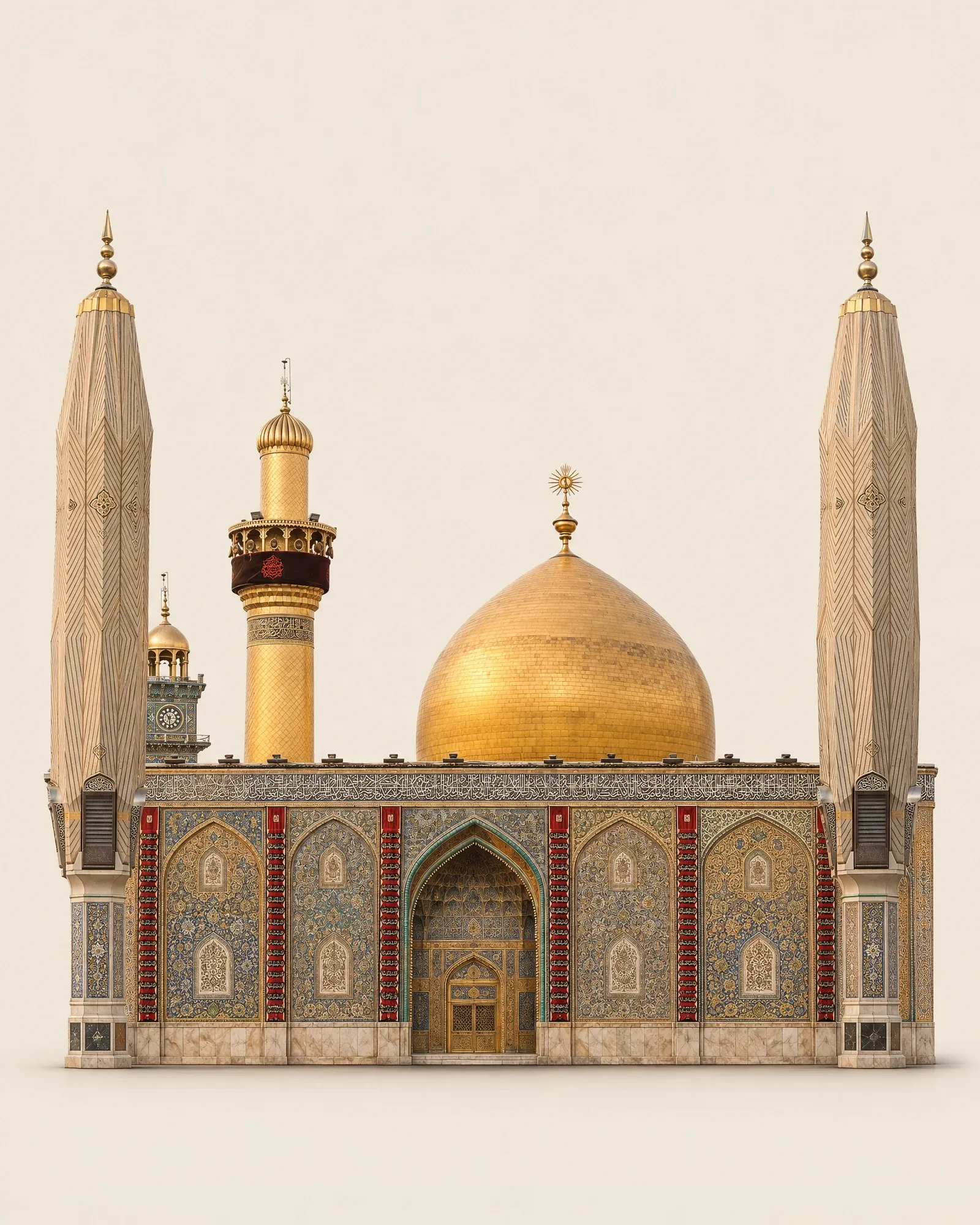
Shah Khalil Allah was taken for burial to the Shi’i shrine city of Najaf in Iraq, where a mausoleum was built for him and for some of his relatives and descendants, far from the Persian villages where his ancestors lie. Daftary calls him the forty-fifth and last Qasim-Shahi Imam to spend his entire Imamate, of some twenty-five years, in Persia.10
Aftermath and the title Aga Khan
His eldest son, Muhammad Hasan, known as Hasan Ali Shah, was thirteen when he became the forty-sixth Imam. The family’s lands at Kahak, entrusted to Imani Khan Farahani, husband of the Imam’s daughter Shah Bibi, were lost to disputes, and Hasan Ali Shah and his mother moved to Qumm, where their situation worsened. His mother went to the Qajar court to seek justice. Fath Ali Shah added to the family’s lands around Mahallat, gave the young Imam his daughter Sarv-i Jahan Khanum in marriage, appointed him governor of Qumm and gave him the honorific title Aga Khan. The compensation for Shah Khalil Allah’s murder thus created the title by which his successors are known; see The Aga Khan title.11
Footnotes
-
Farhad Daftary, The Isma’ilis: Their History and Doctrines, 2nd ed. (Cambridge University Press, 2007), p. 462. ↩
-
Daftary, The Isma’ilis, 2nd ed. (Cambridge University Press, 2007), p. 462. ↩
-
Beben and Mohammad Poor, The First Aga Khan: Memoirs of the 46th Ismaili Imam (I.B. Tauris / Institute of Ismaili Studies, 2018), Introduction, p. 28, citing Rousseau, “Mémoire sur les Ismaélis”, pp. 279–280; Daftary, The Isma’ilis, 2nd ed. (Cambridge University Press, 2007), p. 463. ↩
-
Beben and Mohammad Poor, The First Aga Khan (2018), Introduction, p. 28. ↩
-
Daftary, The Isma’ilis, 2nd ed. (Cambridge University Press, 2007), pp. 462–463; Beben and Mohammad Poor, The First Aga Khan (2018), Introduction, p. 28. ↩
-
Daftary, The Isma’ilis, 2nd ed. (Cambridge University Press, 2007), p. 463. ↩
-
Daftary, The Isma’ilis, 2nd ed. (Cambridge University Press, 2007), pp. 463–464; Beben and Mohammad Poor, The First Aga Khan (2018), Introduction, p. 28. ↩
-
Daftary, The Isma’ilis, 2nd ed. (Cambridge University Press, 2007), p. 463. ↩
-
Daftary, The Isma’ilis, 2nd ed. (Cambridge University Press, 2007), p. 463; Beben and Mohammad Poor, The First Aga Khan (2018), Introduction, pp. 28–29. ↩
-
Daftary, The Isma’ilis, 2nd ed. (Cambridge University Press, 2007), p. 463. ↩
-
Daftary, The Isma’ilis, 2nd ed. (Cambridge University Press, 2007), pp. 463–464; Beben and Mohammad Poor, The First Aga Khan (2018), Introduction, p. 29. ↩