Overview
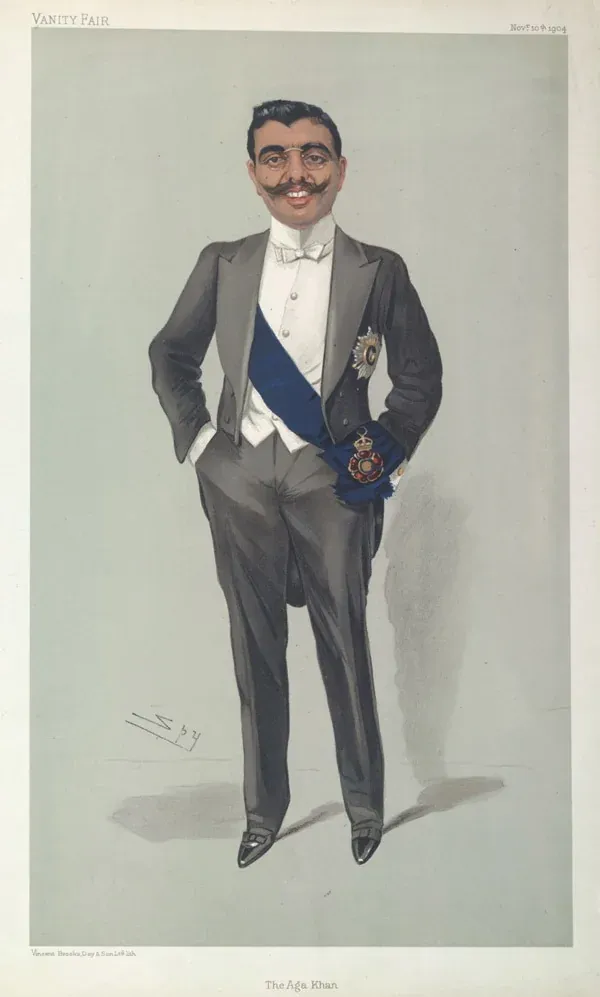
Aga Khan is the hereditary title of the Imams of the Qasim-Shahi Nizari Ismailis since the early nineteenth century. It is not a religious title and does not come from Ismaili tradition. It was a royal honorific, a laqab, granted by the Qajar ruler of Persia, Fath Ali Shah, to the forty-sixth Imam, Hasan Ali Shah, around 1817, and it stayed in the family. Daftary glosses it as “lord and master” or “chief master or lord”. Every Imam since has been known by it, numbered from Aga Khan I, and in modern usage the title has become, for outsiders, almost a synonym for the Ismaili Imamate.1
The Imams before the title
The Imams of the eighteenth century had already moved close to the Persian state. Abu’l-Hasan Ali, the forty-fourth Imam, served the Zand ruler Karim Khan as beglerbegi (governor) of Kerman, where he was known by the name Sayyid Abu’l-Hasan Kahaki. His son Shah Khalil Allah moved from Kerman to Yazd in 1230/1815, where he lived as a prominent Shi’i sayyid and received his followers from India and elsewhere. The family thus had standing among Persian notables before any Qajar title was bestowed.2
Origin: compensation for a murder
The title came out of a killing. In 1232/1817 Shah Khalil Allah was murdered at Yazd during a dispute between his followers and local shopkeepers, encouraged by a Twelver mulla. The Imam’s eldest son, Muhammad Hasan, known as Hasan Ali Shah, succeeded him at the age of thirteen. The family’s lands at Kahak were lost to disputes, and Hasan Ali Shah and his mother moved to Qumm in reduced circumstances. His mother went to the Qajar court in Tehran to seek justice.3
Fath Ali Shah, anxious to avoid trouble with the Imam’s followers, had the murderer punished, though no one was put to death. As compensation he added to the family’s lands around Mahallat, gave the young Imam one of his own daughters, Sarv-i Jahan Khanum, in marriage, appointed him governor of Qumm, and bestowed on him the honorific title of Agha Khan. Beben and Mohammad Poor note that little more is known about this part of his life until Fath Ali Shah’s death in 1834.4
Meaning and spelling
Daftary gives the Persian form as Agha Khan, more correctly transcribed Aqa Khan, and its meaning as lord and master. Because of the royal title and the family’s deep roots in the Mahallat district, Hasan Ali Shah became generally known in Persia as Agha Khan Mahallati. In Europe the title was simplified to Aga Khan, the form now standard in English.5
All three spellings appear in the scholarship. The first Persian edition of the Imam’s memoir, the ’Ibrat-afza, was published in Tehran in 1325 Sh./1946 under the name Muhammad Hasan al-Husayni Aqa Khan Mahallati. Hamid Algar’s 1969 study of his revolt is titled “The Revolt of Agha Khan Mahallati and the Transference of the Isma’ili Imamate to India”. Beben and Mohammad Poor describe Hasan Ali Shah as “the first Ismaili Imam to bear the title of Aqa Khan” and then adopt the form Aga Khan.6
A hereditary title
The title remained hereditary among Hasan Ali Shah’s successors, the Nizari Imams of modern times. Daftary uses it to number the Imams from the forty-sixth onward:
- Aga Khan I, Hasan Ali Shah (Imam 1232–1298/1817–1881);
- Aga Khan II, Aqa Ali Shah (1298–1302/1881–1885);
- Aga Khan III, Sultan Muhammad Shah (from 1302/1885);
- Aga Khan IV, Shah Karim al-Husayni, generally designated in the West as His Highness Prince Karim Aga Khan.
The title passed with the Imamate, not to every son. Aga Khan I’s brothers were known by other names and titles, such as Abu’l-Hasan Khan, called the Sardar, and Muhammad Baqir Khan; he was survived by three sons, Aqa Ali Shah, Aqa Jangi Shah and Aqa Akbar Shah, of whom only the first succeeded as Imam and as Aga Khan. The present Imam, Aga Khan V, continues the numbering.7
In Persia and Afghanistan
In Persia the title marked the Imam as a member of the Qajar elite. As Agha Khan he married into the royal family, governed Qumm and later Kerman, and dealt with the court as a great notable. The same status made his later conflict with the government a political rebellion as much as a religious affair. After he left Persia in 1257/1841, later shahs maintained relations with him through gifts and marriages: Nasir al-Din Shah agreed to marry one of his daughters to the Imam’s son Jalal Shah, who died in Tehran the following year.8
In British India
In India the Persian honorific became the name by which the British state knew the Imam. Aga Khan I came to be officially addressed by the British as His Highness, and the Prince of Wales, the future Edward VII, visited him at his Bombay home, the Aga Hall. As the recognised head of a Muslim community, he enjoyed the protection of the British establishment, which strengthened his authority.9
The title also entered Indian law. The suit brought by Khoja dissidents in 1866 became known as the Aga Khan Case. In his judgment Sir Joseph Arnould described the defendant’s ancestors as “the hereditary chiefs or Imams of the Ismailis”, to whom the Khoja community had always been bound by spiritual allegiance and whom it regarded as its murshids or spiritual heads, and he upheld the Aga Khan’s rights over the community. See The Aga Khan Case of 1866.10
Title and Imamate
The distinction between the honorific and the religious office matters. To his followers Hasan Ali Shah was Imam by descent from Ali and Fatima through the line of the Nizari Imams, whatever title the Qajars gave him; to the Persian court he was Agha Khan, a sayyid notable and royal son-in-law; to the British he was His Highness the Aga Khan. Daftary dates the modern period of Nizari history from his settlement in Bombay, and the title he brought from Persia became the public name of the Imamate in that period, carried by his successors into the twentieth and twenty-first centuries.11
Footnotes
-
Farhad Daftary, The Isma’ilis: Their History and Doctrines, 2nd ed. (Cambridge University Press, 2007), pp. 413, 463–464; Daniel Beben and Daryoush Mohammad Poor, The First Aga Khan: Memoirs of the 46th Ismaili Imam (I.B. Tauris / Institute of Ismaili Studies, 2018), Foreword, pp. xxii–xxiii. ↩
-
Daftary, The Isma’ilis, 2nd ed. (Cambridge University Press, 2007), pp. 459–462. ↩
-
Daftary, The Isma’ilis, 2nd ed. (Cambridge University Press, 2007), pp. 462–463; Beben and Mohammad Poor, The First Aga Khan (2018), Introduction, p. 29. ↩
-
Daftary, The Isma’ilis, 2nd ed. (Cambridge University Press, 2007), pp. 463–464; Beben and Mohammad Poor, The First Aga Khan (2018), Foreword, pp. xxii–xxiii; Introduction, p. 29 and nn. 77–78. ↩
-
Daftary, The Isma’ilis, 2nd ed. (Cambridge University Press, 2007), p. 464. ↩
-
Beben and Mohammad Poor, The First Aga Khan (2018), Introduction, pp. 1, 11 and nn. 25, 27. ↩
-
Daftary, The Isma’ilis, 2nd ed. (Cambridge University Press, 2007), pp. 464, 466, 473, 477, 480, 496. ↩
-
Daftary, The Isma’ilis, 2nd ed. (Cambridge University Press, 2007), pp. 464–469, 473. ↩
-
Daftary, The Isma’ilis, 2nd ed. (Cambridge University Press, 2007), p. 474. ↩
-
Joseph Arnould, Judgment by the Hon’ble Sir Joseph Arnould in the Khojah Case, otherwise known as the Aga Khan Case (Bombay Gazette Steam Press, 1866), https://archive.org/details/bk1209; Daftary, The Isma’ilis, 2nd ed. (Cambridge University Press, 2007), p. 476. ↩
-
Daftary, The Isma’ilis, 2nd ed. (Cambridge University Press, 2007), pp. 463–464, 473–474. ↩