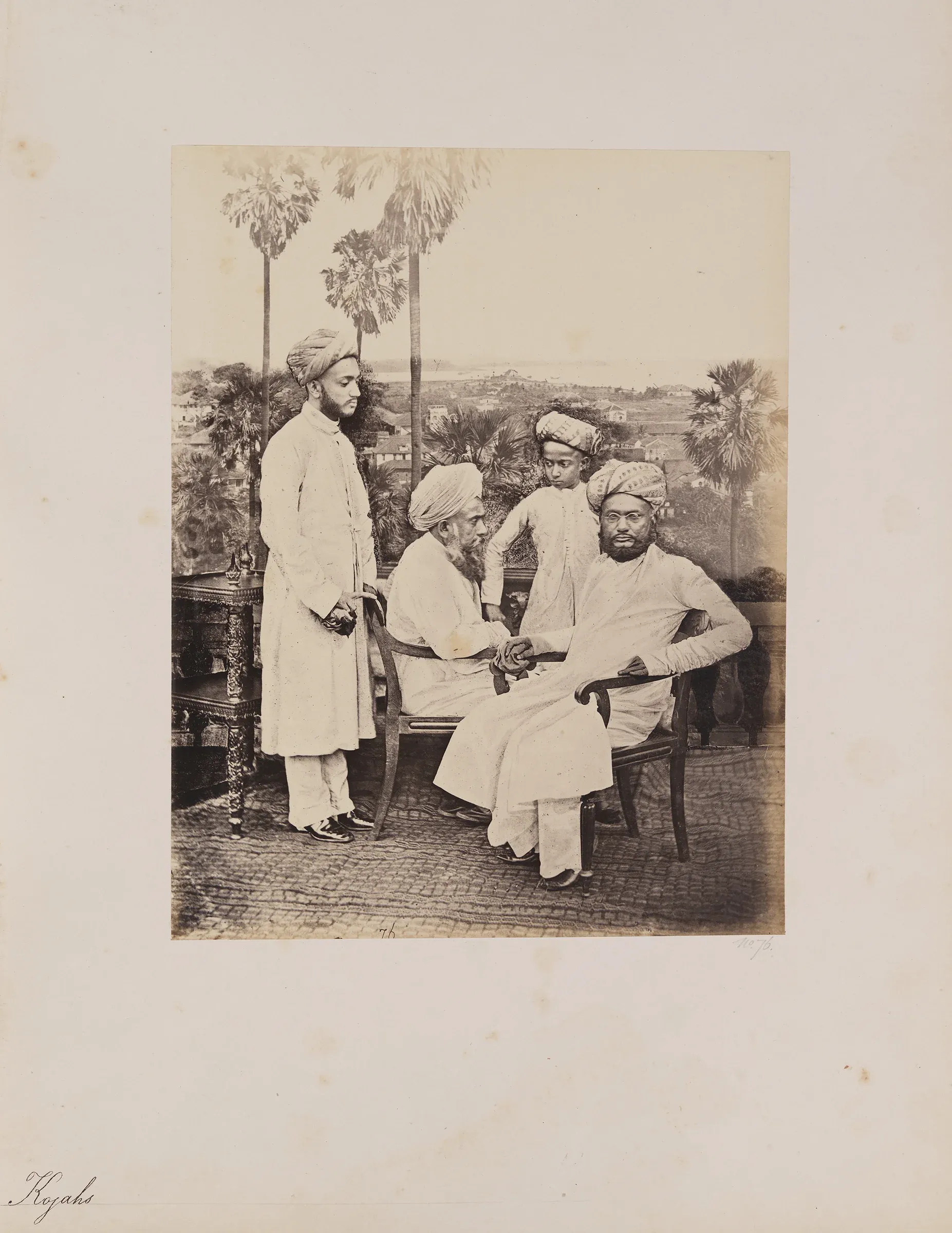
Khoja is the name of a cluster of South Asian communities that grew out of a single caste. The caste was concentrated in Sindh, Kutch, Kathiawar and Gujarat, and from the nineteenth century also in Bombay. Most Khojas were traders. The diaspora that began in the nineteenth century took them to Muscat, Zanzibar and the East African coast, and later to Western Europe and North America. Today three communities use the name: Ismaili Khojas, who follow the Aga Khan; Ithna’ashari (Twelver) Khojas; and Sunni Khojas.1
For most of its history, the Khoja community was one of the Satpanth communities, the communities of the pirs whose devotional life was carried in the ginans. How this caste of Lohana and Bhatia origin became a Muslim community with three separate denominational identities is one of the central themes of modern South Asian religious history.2
The name and its origin
Khoja tradition says the community descends mainly from the Lohanas, and to a lesser extent the Bhatias. These were Hindu trading castes of Sindh and Gujarat who claimed Kshatriya status. Tradition credits their conversion to Pir Sadr al-Din. He is said to have given the converts the title khwaja, Persian for “lord” or “master”, in place of the Lohana title thakkur, which carried a similar meaning. Daftary dates Sadr al-Din’s death to somewhere between 770/1369 and 819/1416. Asani calls him a fifteenth-century preacher-saint of Persian origin.34
Asani notes that the name marked three things at once: an occupation (trade), a social position (a caste) and a religious affiliation (Satpanth). As late as the nineteenth century, gazetteers recorded Khojas in north-east Kathiawar who were still addressed as thakkur and wore waistcoats in the Lohana style. Widow remarriage was taboo, as among the Lohanas, and property passed only to males.5
Satpanth itself was made up of several subgroups. Each centred on a particular pir or sayyid lineage and often on a particular occupation. The Khojas were the disciples of Sadr al-Din’s line. Other groups were the Shamsis of Punjab, who trace their conversion to Pir Shams, and the Momnas and Imamshahis of Gujarat.67
Caste institutions
In early nineteenth-century Bombay, the Khojas functioned as an endogamous caste with corporate institutions. A crier summoned members to meetings, where disputes were arbitrated and excommunication was decided by vote. The caste held communal dinners, using cooking vessels owned by the community.8
Two officers ran each congregation: the mukhi and his assistant, the kamadia. Both titles come from Sanskrit. Their duties included collecting religious dues, above all the tithe (dasond), and presiding over ceremonies in the jamatkhana. The names were later adopted by non-Khoja Nizari communities as well. Tradition traces the office of mukhi to Pir Sadr al-Din, who is said to have appointed mukhis in Sindh, Punjab and Kashmir.910
The community also had its own script, Khojki, a refined form of the Lohanaki script used by the Lohanas. It was used to write ginans and to keep accounts. Its use outlasted the pirs by centuries: Khojki was taught in community schools until the early twentieth century, where it was called “Sindhi” or Khwajah Sindhi.1112
Religious practice before the reforms
In the early nineteenth century, Khoja practice combined elements that colonial observers struggled to classify. Ginans were recited, among them the Dasa Avatara, attributed to Pir Sadr al-Din. Arabic namaz was said only at the two Ids. The community’s own ritual prayer, said three times a day, was in Gujarati with Arabic and Persian phrases. Funerals and marriages were often conducted by Sunni officiants. Khojas observed Muharram, and wealthy families shipped their dead for burial at Karbala.13
The ghat-pat ceremony, in which participants sipped water consecrated with pellets of Karbala clay, resembled a purification rite of the Shaktipanthi Lohanas. In matters of inheritance, Khoja custom followed Hindu practice rather than Islamic law. One later writer said Khoja personal law was “caught within the meshes of Hindu law”.1415
Pilgrimage and tithes
The Khojas sent tithes and pilgrims to the Nizari Imams in Iran for centuries. At the mausoleum of Imam Shah Nizar II at Kahak, Daftary found tombstones with inscriptions in Khojki. They are evidence of the long and dangerous journeys Khojas made to see the Imam. Kahak is named in some ginans as the residence of the Imams.16
The Kirman historian Ahmad Ali Khan Vaziri wrote that after the fall of the Safavids, Khoja pilgrims travelling to the Imams near Anjudan and Mahallat were often robbed and killed between Na’in and Yazd. According to Daftary, concern for the pilgrims’ safety and for the flow of tithes was the main reason Imam Hasan Ali moved to Shahr-i Babak in Kirman during the reign of Nadir Shah (1736–1747), closer to the Persian Gulf ports. A later Imam, Abu’l-Hasan Ali, is reported to have received 20,000 tumans a year in religious dues from India.17
Daftary sums up the situation: by the nineteenth century the Khojas had for several centuries formed the most important section of the Nizari community, yet few could make the journey to the Imam.18
The Imam in Bombay
That changed when Aga Khan I left Iran after his conflict with the Qajar state. Asani dates his move to India to 1841. Daftary places his arrival in Bombay in 1846, after a journey through Sindh, Kutch and Kathiawar, and his settlement there in 1848. Bombay had the largest Khoja population, and it became the seat of the Imamate. Khojas now sent their dues to the Imam’s durkhana, his residence. He attended the Bombay jamatkhana on major occasions, held a public audience (durbar) on Saturdays, and appointed the mukhis and kamadias of the larger jamats himself.1920
The Imam’s assertion of authority over communal property caused conflict. In 1829, while he was still in Persia, some Bombay Khojas refused to pay the dasond. They were expelled from the jamat and became known as the Barbhai, “twelve brothers”. In 1847, a case brought by two Khoja sisters asked whether Khoja custom or Islamic law should govern inheritance. The Imam supported the Islamic rules, which give daughters a share. The Barbhai supported the custom that excluded them. Sir Erskine Perry ruled for custom, a judgement that in effect recognised the Khojas as a distinct community. In 1850 four members of the Barbhai party were murdered in the Mahim jamatkhana. Four Khojas were sentenced to death for the killings.21
In 1861 Aga Khan I circulated a document setting out Nizari Ismaili practice on marriage, ablution and funerals, and asked every Khoja family to sign it. Most did. The dissidents, who held that the Khojas had always been Sunni, were expelled again in 1862.22
The courts decide
In 1866 the dissidents sued the Aga Khan in the Bombay High Court. They demanded control of communal property and the election of mukhis. They argued that the Khojas had been Sunnis ever since Pir Sadr al-Din converted them from Hinduism. In November 1866 Justice Joseph Arnould ruled for the Aga Khan on every point. The judgement defined the Khojas as “a sect of people whose ancestors were Hindu in origin, which was converted to and has throughout abided in the faith of the Shia Imami Ismailis”. It also confirmed the Aga Khan’s right to the community’s dues and property. The Aga Khan Case has its own page.2324
Asani notes that Arnould and the Khoja witnesses could not understand each other’s world-views. The witnesses could not define their Islam in terms the judge recognised, and some of their statements pointed to several religious affiliations at once. Arnould therefore set their evidence aside and sorted the material into the categories “Hindu”, “Sunni”, “Shia” and “Ismaili” that he took from Western historians of Islam. The judgement also turned the conversion narrative, in which the pirs converted Hindus by adapting Hindu ideas, into an official, legally sanctioned history.25
A second suit followed. In 1905, while Aga Khan III was in East Africa, his cousin Hajji Bibi and her son Samad Shah sued him, claiming among other things that the family were Twelver Shi’is. In 1908 Justice Russell ruled against them. The judgement established that the Nizari Khojas were distinct from the Ithna’ashari Shi’is.26
Three communities
The lawsuits gave legal force to divisions that had been forming for decades. The plaintiffs of 1866 and their followers became the Sunni Khojas. Those who rejected the Aga Khan’s authority after the 1908 case formed the Khoja Ithna’ashari community. Most of the caste remained Ismaili Khojas. Asani argues that sectarian affiliation replaced caste as the main basis of Khoja identity in this period.2728
From Khoja to Ismaili
In the twentieth century Aga Khan III reshaped Ismaili Khoja identity with two main tools. The first was written constitutions, the first issued in 1905 and later revised, which set up councils and regulated marriage and divorce. The second was farmans, his directives, which were printed in Gujarati, Sindhi, Hindustani and later English and read out in jamatkhanas. Arabic and Persian personal names, rare before, became common from the early twentieth century. Hindu-derived names such as Nanji, Ramji and Dewji continued in many families as surnames.29
After the Partition of 1947 the changes went further. Rituals of birth, marriage and death that had Indic features were removed or reformulated. The old daily prayer, attributed to Pir Sadr al-Din, called on the Imam as pir and Nikalank and traced a chain from the ten avatars to the Imams. In the 1950s it was replaced by a new prayer in six parts, each opening with Qur’anic verses.30
Asani calls the result a transformation “from Indic caste to Muslim denomination”. He quotes Aga Khan III’s remark that the community had survived “because it has always been fluid”. The Khoja name lived on in Ithna’ashari and Sunni institutions. Among Ismailis it increasingly gave way to “Ismaili”, which also included non-Khoja Nizaris in Central Asia, Iran, Syria and elsewhere. Their history is followed in From Persia to Bombay and The Twentieth Century.31
Footnotes
-
Ali S. Asani, “Khoja,” Encyclopaedia Iranica, vol. XVI, fasc. 5 (2020), pp. 539–541, https://iranicaonline.org/articles/khoja/. ↩
-
Ali S. Asani, “From Satpanthi to Ismaili Muslim: The Articulation of Ismaili Khoja Identity in South Asia,” in Farhad Daftary (ed.), A Modern History of the Ismailis (London: I.B. Tauris, in association with the Institute of Ismaili Studies, 2011), introduction. ↩
-
Asani, “Khoja,” p. 539. ↩
-
Farhad Daftary, The Isma’ilis: Their History and Doctrines, 2nd ed. (Cambridge: Cambridge University Press, 2007), p. 443. ↩
-
Asani, “From Satpanthi to Ismaili Muslim,” section “Locating Khoja Identity within Changing Contexts.” ↩
-
Asani, “From Satpanthi to Ismaili Muslim,” section “Locating Khoja Identity within Changing Contexts.” ↩
-
Daftary, The Isma’ilis, pp. 442–443, 448. ↩
-
Asani, “Khoja,” p. 539, citing Jim Masselos. ↩
-
Daftary, The Isma’ilis, pp. 473–474. ↩
-
Daftary, The Isma’ilis, p. 443. ↩
-
Asani, “Khoja,” p. 539. ↩
-
Asani, “From Satpanthi to Ismaili Muslim,” section “Reorienting understanding and practice of faith.” ↩
-
Asani, “Khoja,” pp. 539–540. ↩
-
Asani, “Khoja,” pp. 539–540, quoting Hamid Ali and citing John N. Hollister. ↩
-
Daftary, The Isma’ilis, p. 474. ↩
-
Daftary, The Isma’ilis, p. 457. ↩
-
Daftary, The Isma’ilis, pp. 459–460. ↩
-
Daftary, The Isma’ilis, p. 473. ↩
-
Asani, “Khoja,” p. 540. ↩
-
Daftary, The Isma’ilis, pp. 472–474. ↩
-
Daftary, The Isma’ilis, pp. 474–475. ↩
-
Daftary, The Isma’ilis, p. 475. ↩
-
Daftary, The Isma’ilis, pp. 475–476. ↩
-
Asani, “From Satpanthi to Ismaili Muslim,” section on the colonial courts. ↩
-
Asani, “From Satpanthi to Ismaili Muslim,” section on the colonial courts. ↩
-
Daftary, The Isma’ilis, p. 481. ↩
-
Asani, “From Satpanthi to Ismaili Muslim,” section on the colonial courts. ↩
-
Asani, “Khoja,” p. 540. ↩
-
Asani, “From Satpanthi to Ismaili Muslim,” section “Reorienting understanding and practice of faith.” ↩
-
Asani, “From Satpanthi to Ismaili Muslim,” section “Reorienting understanding and practice of faith.” ↩
-
Asani, “From Satpanthi to Ismaili Muslim,” introduction. ↩