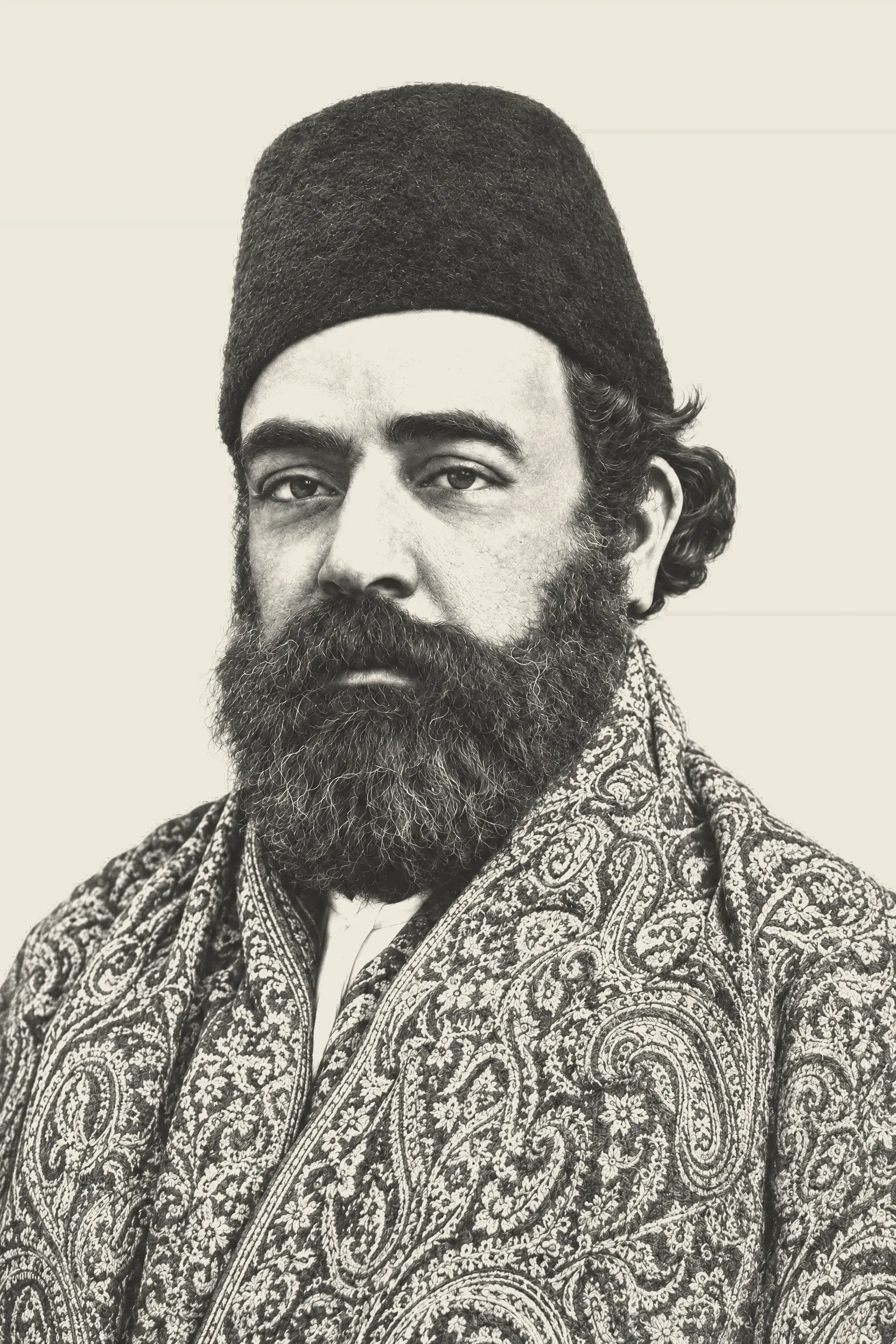
Early life
Aqa Ali Shah, who became Aga Khan II, was the eldest son of Aga Khan I and his only son by the Qajar princess Sarv-i Jahan Khanum, daughter of Fath Ali Shah. He was born at Mahallat in 1246/1830. When his father’s conflict with the Qajars broke out in 1840, the boy was taken to Iraq, where he studied Arabic, Persian and Nizari teachings.1
In the late 1840s he seems to have been allowed to return to Persia and to act on his father’s behalf there, at a time when the family was negotiating, without success, for Aga Khan I’s own return. In 1269/1853 he and his mother joined the Imam in Bombay. Sarv-i Jahan Khanum lived there until her death in 1299/1882, a year after her husband.2
Heir apparent
During his father’s long Imamate in India, Aqa Ali Shah acted as his representative among the Khojas. He visited the communities of Sind and Gujarat and organised their jamatkhanas, the congregational and prayer halls that served as the centres of Khoja religious life. For a time he lived in Karachi, where his third son, Sultan Muhammad Shah, the future Aga Khan III, was born in 1294/1877.3
These were the decades in which Aga Khan I brought the Khojas’ communal institutions under the Imam’s control and won the judgment of 1866 in the Bombay High Court, which recognised the Khojas as Shia Imami Ismailis and the Aga Khan as their spiritual head. Aqa Ali Shah inherited a community whose relationship to the Imam had been defined in British law; see The Aga Khan Case of 1866.4
Imam, 1881–1885
He succeeded his father in Jumada I 1298/April 1881. His Imamate lasted only four years. He kept up his father’s friendship with the British and was appointed to the Bombay Legislative Council when Sir James Fergusson was governor of Bombay. He opened schools for Khoja children in Bombay and elsewhere and gave financial help to poor Khoja families. Daftary notes that he took a particular interest in his followers outside India, in Central Asia, Burma and East Africa, regions to which the Khojas had been migrating with the expansion of Indian Ocean trade.5
His public role extended beyond his own community. Daftary attributes his standing among Indian Muslims to the growing prosperity of the Khoja community as well as to his own policies. He was elected president of the Muhammadan National Association, a body of Indian Muslims, and held the post until his death, using it to promote educational and philanthropic projects for the benefit of all Indian Muslims. In this he anticipated the much larger public career of his son.6
The Ni’mat Allahi friendships
Like his father, Aga Khan II maintained close relations with the Ni’mat Allahi Sufi order. Before leaving Persia he had developed close ties with Rahmat Ali Shah, qutb of one of the order’s branches, who had been his father’s guest at Mahallat in 1249/1833, and after Rahmat Ali Shah’s death in 1278/1861 paid for Quran recitation at his grave in Shiraz. He kept close relations too with Rahmat Ali Shah’s uncle and one of his successors as qutb, Munawwar Ali Shah (d. 1301/1884). In Bombay he entertained several notable Persian Ni’mat Allahis, among them Rahmat Ali Shah’s son Muhammad Ma’sum Shirazi, Na’ib al-Sadr (d. 1344/1926), known in the order as Ma’sum Ali Shah and author of the celebrated Sufi work Tara’iq al-haqa’iq. He visited India in 1298/1881, attended Aga Khan I’s funeral and stayed with Aqa Ali Shah for an entire year. Safi Ali Shah (d. 1316/1898), eponymous founder of one of the most important branches of the order, first came to India in 1280/1863 at Aqa Ali Shah’s invitation. On a second visit he spent four years there and, at the Imam’s request, completed and lithographed his versified Sufi work Zubdat al-asrar. Returning by way of Iraq, he stayed at the Aga Khan’s houses in Najaf and Karbala and won over certain Twelver ulama who had objected, on account of Aqa Ali Shah’s Ismaili faith, to his marriage to a Qajar princess.7
Family
That princess, Shams al-Muluk, daughter of Mirza Ali Muhammad Nizam al-Dawla by one of Fath Ali Shah’s daughters, became Aga Khan II’s third wife and bore his only surviving son, Sultan Muhammad Shah. His two elder sons by an earlier marriage predeceased him. The eldest, Shihab al-Din Shah, also called Khalil Allah, born around 1268/1851–1852, had been expected to succeed him; he wrote several treatises in Persian on Nizari doctrine, died in Safar 1302/December 1884 and was buried at Najaf. His only son, Abu’l-Hasan, died shortly afterwards and was buried beside Aga Khan I at Hasanabad in Bombay. His full brother Nur al-Din Shah was killed in a riding accident at Poona early in the same year.8
Death and succession
A noted sportsman and tiger hunter, Aga Khan II died in Dhu’l-Qa’da 1302/August 1885 of pneumonia contracted during a day’s hunting near Poona, within a year of losing his two elder sons. His body was later buried in the family mausoleum at Najaf, where his grandfather Shah Khalil Allah also lies. He was succeeded by his son Sultan Muhammad Shah, Aga Khan III, who was installed in Bombay at the age of eight under the close supervision of his mother, Shams al-Muluk, known in British India as Lady Ali Shah, and whose Imamate of seventy-two years would carry the community into the twentieth century.9
Footnotes
-
Farhad Daftary, The Isma’ilis: Their History and Doctrines, 2nd ed. (Cambridge University Press, 2007), pp. 464, 477. ↩
-
Daftary, The Isma’ilis, 2nd ed. (Cambridge University Press, 2007), pp. 472–473, 477. ↩
-
Daftary, The Isma’ilis, 2nd ed. (Cambridge University Press, 2007), p. 477. ↩
-
Daftary, The Isma’ilis, 2nd ed. (Cambridge University Press, 2007), pp. 476–477. ↩
-
Daftary, The Isma’ilis, 2nd ed. (Cambridge University Press, 2007), p. 477; Beben and Mohammad Poor, The First Aga Khan: Memoirs of the 46th Ismaili Imam (I.B. Tauris / Institute of Ismaili Studies, 2018), Introduction, pp. 25–26. ↩
-
Daftary, The Isma’ilis, 2nd ed. (Cambridge University Press, 2007), p. 477. ↩
-
Daftary, The Isma’ilis, 2nd ed. (Cambridge University Press, 2007), pp. 467–468, 477, 479. ↩
-
Daftary, The Isma’ilis, 2nd ed. (Cambridge University Press, 2007), p. 480. ↩
-
Daftary, The Isma’ilis, 2nd ed. (Cambridge University Press, 2007), pp. 463, 480. ↩