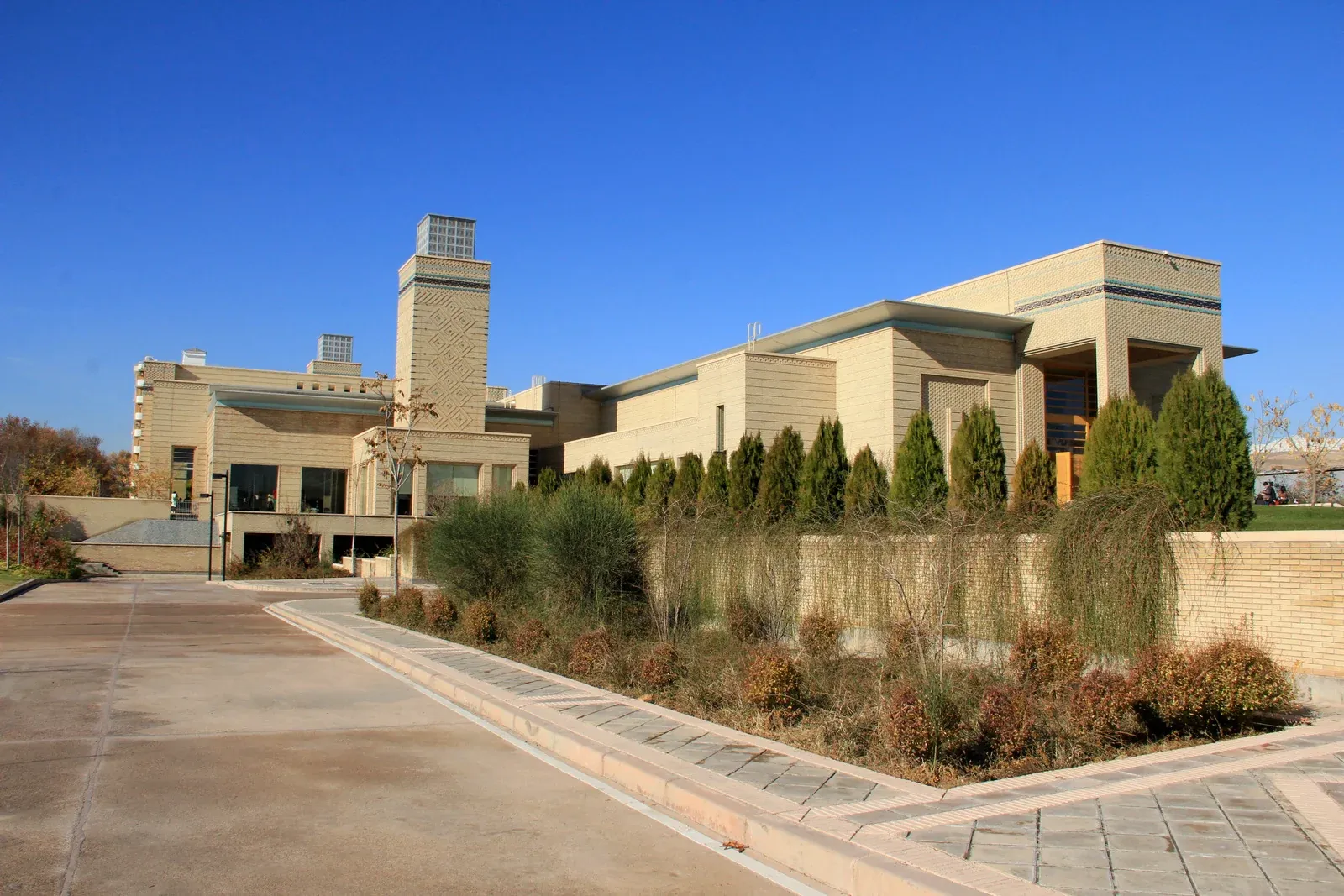
Dushanbe, the capital of Tajikistan, is the seat of the Ismaili Centre, Dushanbe, opened on 12 October 2009 by President Emomali Rahmon and Aga Khan IV, the first Ismaili Centre in Central Asia. The city is also the administrative base of the Aga Khan Development Network’s work across Tajikistan, which reaches into the Ismaili heartland of Gorno-Badakhshan and its capital, Khorog. For the community of the Pamirs see Ismailis of Central Asia and Badakhshan.12
A presence of a thousand years
The Ismaili of 2012 described Central Asia as “a region that has been home to Ismaili Muslims for more than a thousand years”. At the opening of the Centre, Aga Khan IV said that the ceremony “represents a milestone in the history of the Ismaili Muslim Community’s presence in Central Asia, a presence which dates back to the second century of Islam”, and that the Tajik community had contributed “some of the greatest names in the fields of theology, philosophy, poetry and the sciences”. He singled out Nasir Khusraw: “the passage of a millennium has not diminished Nasir Khusraw’s relevance nor dulled the lustre of his poetry”, and recalled that “the 1000th anniversary of the birth of Syedna Nasir-i-Khusraw coincided with our foundation stone ceremony five years ago”.34
AKDN in Tajikistan
AKDN began large-scale work in Tajikistan after the dissolution of the Soviet Union in 1991. It states that it has “committed over $1 billion between 1995 and 2018” in the country, that it covers “all regions of the country” and that it employs “over 3,500 people in health care, education, business” and other fields. A reception at the Ismaili Centre on Imamat Day, 11 July, marked “the 15th anniversary of the signing of an Agreement of Cooperation between the Government of Tajikistan and the AKDN”. See AKDN.523
The network’s agencies in the country include the First Microfinance Bank Tajikistan, established by AKDN for clients “many of whom live in remote areas and are dependent on remittances”, and Pamir Energy, which “provides energy for about 99 percent of the population of Gorno-Badakhshan”. AKDN states that the Aga Khan Foundation “has supported 326,000 farmers”, that community organisations it established “connect over 1.4 million constituents”, and that the Aga Khan Agency for Habitat “has helped over 465,000 people mitigate the impact of natural disasters” and “responded to over 200 emergencies”.2
The University of Central Asia, founded in 2000 by a treaty between Kazakhstan, the Kyrgyz Republic, Tajikistan and Aga Khan IV, is described by AKDN as a “secular, internationally chartered, not-for-profit University”. Its first campus opened at Naryn, Kyrgyz Republic, on 19 October 2016, on a 252-hectare site given by the Kyrgyz government; its Tajik campus is at Khorog. See Aga Khan University for the Imamat’s other university.65
Designing the Centre
The Centre stands on Ismoili Somoni Avenue, “named after the founder of the Samanid dynasty (early 10th century) and considered Tajikistan’s national hero”. Its architects, FNDA Architecture, state that they won it in an international competition, and that the project “had a specific mandate to bring the architectural heritage of Tajikistan back to Tajikistan”, drawing on “the great buildings of Samarkand, Bukhara and Khiva”. Secondary accounts name the firm’s principal as the Canadian architect Farouk Noormohamed.78
Archnet describes the building, “located amidst gardens and waterfalls off a main thoroughfare”, in “sandstone baked brick and glazed blue and turquoise tiles”, which “acknowledges the vernaculars of the 10th century mausoleum of the Samanids as well as the grand courtyards of Samarkand, Bukhara and Khiva”. The complex “includes a resource centre, classrooms, multi-purpose spaces, courtyards and an amphitheatre”. According to the architects’ photo essay, the carved wooden beams “were designed by artisans from Khorog, the decorative plaster work on the walls was fashioned by Dushanbe craftsmen and carpets adorning the walls were handmade across Central Asia”.74
Because Tajikistan lies in a highly seismic region, the architects used “an elastic wood roof diaphragm to transfer structural stress in case of an earthquake”, and a heating and cooling system “based on water-source heat pumps used for the first time on this scale in the region”. FNDA states that the design team was awarded gold medals for architecture and interior design by the Central Asian chapter of the International Union of Architects.48
Opening, 12 October 2009
The Ismaili reported that President Rahmon and Aga Khan IV “toured the facility prior to the Opening Ceremony”. Aga Khan IV called the Centre “a place … for peaceful contemplation of the spirit”, which “will have a space for congregational gathering, just like the array of Ismaili Centres in major cities across the world … from London to Vancouver and Lisbon to Dubai”, and hoped that “people of all faiths and background will gather here for educational and cultural events”. Princess Zahra, Prince Hussain and Princess Khaliya attended. See also London, Vancouver and Lisbon.14
The Centre in use
The first Navroz event at the Centre, an AKDN reception attended by more than 300 people, was held on 20 March 2011. The Ismaili also reported the first Jamati celebration of Eid ul-Fitr there. On 22 October 2011 the United States Secretary of State, Hillary Clinton, held a town hall meeting at the Centre “to help promote the US-sponsored New Silk Road Initiative”, attended by several hundred people. On 4 April 2012, Aga Khan IV made a one-day visit to Tajikistan, meeting “the leaders of the newly-established Jamati institutions in Tajikistan”.39
Footnotes
-
The Ismaili, “Gallery: opening of the Ismaili Centre, Dushanbe”, https://the.ismaili/us/en/news/gallery-opening-dushanbe. ↩ ↩2
-
Aga Khan Development Network, “Tajikistan” (Where we work), https://the.akdn/en/where-we-work/central-asia/tajikistan. ↩ ↩2 ↩3
-
The Ismaili, “The Ismaili Centre, Dushanbe”, archived 24 March 2012, https://web.archive.org/web/20120324152001/http://www.theismaili.org/ismailicentre/dushanbe. ↩ ↩2 ↩3
-
“Ba Shokouh: the Ismaili Centre in Dushanbe, Tajikistan”, photo essay with text and photographs by FNDA Architecture, Simerg Photos, 27 March 2014, quoting Aga Khan IV’s speech at the opening, https://simergphotos.com/2014/03/27/ba-shokouh-the-ismaili-centre-in-dushanbe-tajikistan/. ↩ ↩2 ↩3 ↩4
-
See Ismailis Today, section “Central Asia and Afghanistan”, citing AKDN, “Tajikistan” and “University of Central Asia”. ↩ ↩2
-
Aga Khan Development Network, “University of Central Asia opens its first campus as part of broad commitment to fostering social and economic development”, press release, Naryn, 19 October 2016, https://www.akdn.org/press-release/university-central-asia-opens-its-first-campus-part-broad-commitment-fostering. ↩
-
Archnet, “Ismaili Centre Dushanbe”, site record, https://www.archnet.org/sites/8082. ↩ ↩2
-
FNDA Architecture, “Ismaili Centre, Dushanbe”, project page, https://www.fndesign.com/ismaili-centre-dushanbe. ↩ ↩2
-
The Ismaili, “The Ismaili Centre, Dushanbe”, news listing, archived 2015, https://web.archive.org/web/2015/http://www.theismaili.org/ismailicentres/dushanbe. ↩