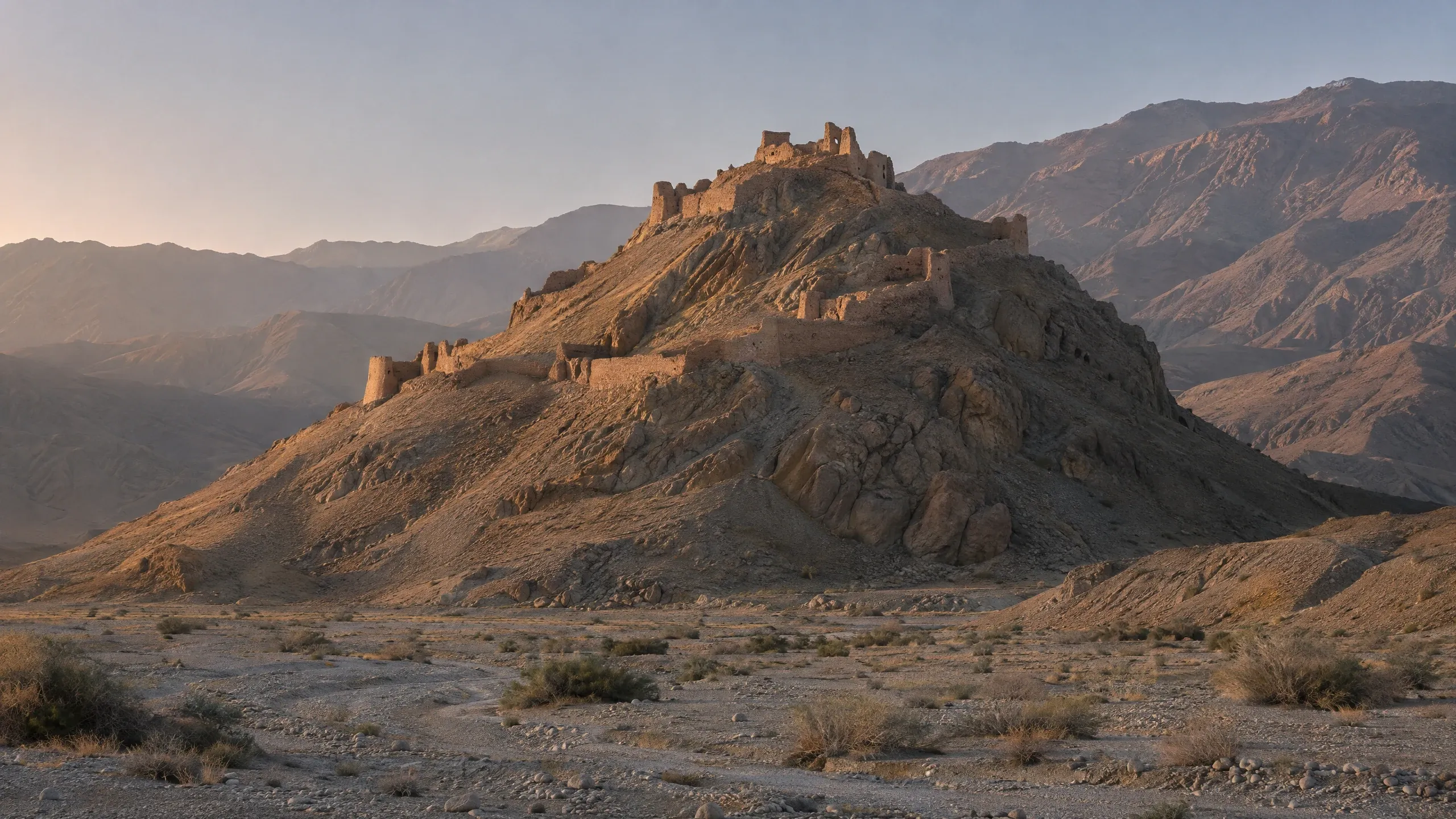
Girdkuh, known in the Middle Ages as Diz-i Gunbadan, is a fortress on the summit of an isolated rocky hill in the Alburz, about 18 kilometres west of Damghan in the medieval region of Qumis. Daftary’s The Isma’ilis places it about 15 kilometres north-west of the town. It overlooked the main road between western Persia and Khurasan. From 1096 it was the chief Nizari stronghold in Qumis, one of the three main territories of the Nizari state, alongside Rudbar and Quhistan.1 It is best known for its resistance to the Mongols. Mongol forces first surrounded it in 1253, and it held out until December 1270, fourteen years after the fall of Alamut, as the last Nizari outpost in Persia.2 (The coordinates given here are approximate.)
Before the Nizaris
Daftary’s dictionary says the castle was built in early Islamic times, or possibly earlier. Qumis lies south of the Alburz and reaches down to the edge of the Dasht-i Kavir. Damghan and Simnan are its main towns. From the early tenth century it slipped out of caliphal control and was contested by Daylami lords and by the Buyids, Samanids and Ziyarids.3
Acquisition, 1096
The castle passed to the Nizaris through a high official who had secretly converted. Mu’ayyad al-Din Muzaffar b. Ahmad al-Mustawfi, the ra’is of Damghan, had been won to the da’wa by ’Abd al-Malik b. ’Attash. In 489/1096, during the Saljuq civil war, Muzaffar persuaded his superior, the amir Amirdad Habashi, to ask Sultan Barkiyaruq for Girdkuh. Habashi received it and made Muzaffar its lieutenant.4
Juvayni describes what followed. Muzaffar “expended large sums on repairing and fortifying the castle” and moved his superior’s treasuries into it. Once Girdkuh was well supplied, he made his conversion public. Juvayni says he then held the castle for Hasan-i Sabbah for forty years.5
Muzaffar’s open break came in 493/1100. He led 5,000 Ismailis in support of Habashi and Barkiyaruq against Sanjar, and Habashi was killed. Muzaffar then moved Habashi’s treasure to Girdkuh and openly declared himself an Ismaili. His son Sharaf al-Din Muhammad succeeded him as commander.4 Muzaffar is also named as the man on whom Hasan-i Sabbah drew the 3,000-dinar draft paid to the former holder of Alamut in 1090.6
The well in the rock
Juvayni records a story about Girdkuh’s water supply. Muzaffar “dug a well in the solid rock on the ramparts of Girdkuh; but having gone down 300 ells (gaz) without reaching water he abandoned it. Years after his death there was an earthquake, and a spring gushed out in that well.” Daftary repeats the account. Whatever its literal truth, it shows how much effort the Nizaris put into water storage. Daftary’s dictionary notes that every major Nizari castle had many deep, roofed cisterns lined with limestone, and that the Nizaris were skilled water engineers.7
Daftary’s dictionary describes Girdkuh as a “massive complex”, the largest kind of Nizari fortification, in contrast to the small clusters of fortified sites in Khurasan and Syria. It groups Girdkuh with Alamut, Lamasar and Qa’in as the great Persian castles.8
A refuge for Hasan-i Sabbah’s family
During the long Saljuq campaign against Rudbar under Anushtagin Shirgir (1109–1118), Hasan-i Sabbah sent his wife and daughters to Girdkuh. Juvayni quotes his letter to Muzaffar: “Since these women work the spindle on behalf of our propaganda, give them their needs as wages therefor.” He adds that from then on Nizari governors would not keep women with them in their castles. Daftary notes that Hasan’s family never returned to Alamut.9
The toll and the Saljuq peace
After 1118 the Nizaris and Sultan Sanjar reached an unofficial peace. Juvayni writes that he saw Sanjar’s decrees in the Alamut library. Among the concessions, Sanjar granted the Nizaris a pension of 3,000 dinars from the taxes of their lands in Qumis and let them collect “a small toll on travellers passing beneath Girdkuh, a custom which has survived to this day”, as Juvayni wrote in the 1250s. Because of its position on the Khurasan road, the castle brought the Nizaris income as well as defence.10
The seventeen-year siege
In 650/1252 Hülegü sent an advance army of 12,000 men under the Nestorian Christian general Ket-Buqa. After taking several castles in Quhistan, Ket-Buqa arrived below Girdkuh in Rabi’ I 651 / May 1253 with about 5,000 men. He surrounded the hill with walls and other siege works, left his officer Büri in command, and moved on against Mihrin and Shahdiz in Qasran.11
The garrison fought back. In Shawwal 651 / December 1253 it made a night attack on the siege lines and killed a hundred Mongols, Büri among them. In the summer of 652/1254 cholera spread through the garrison, and the fortress came close to falling. Ala al-Din Muhammad sent reinforcements from Alamut, and the siege went on.12
When Hülegü arrived in 1256, Rukn al-Din Khurshah ordered his commanders in Girdkuh and Quhistan to submit. The vizier Shams al-Din Gilaki brought the governor of Girdkuh, the qadi Taj al-Din Mardanshah, to Hülegü, but the castle itself kept fighting. Juvayni says Shams al-Din, muhtasham of Quhistan, was to begin the demolition of the remaining Quhistani castles “with Girdkuh”. It did not surrender. After Khurshah went to Mongolia in 1257, the Great Khan Möngke refused to see him because Girdkuh and Lamasar still held out.13
The last outpost, 1270
Lamasar fell to cholera in late 1257, leaving Girdkuh as the only Nizari stronghold in Persia still resisting. It held for thirteen years after the fall of Alamut. The garrison finally gave up for want of clothing on 29 Rabi’ II 669 / 15 December 1270, in the reign of the Ilkhan Abaqa, seventeen years after the Mongol advance guard first surrounded it. The Mongols, who had built permanent quarters around the hill, killed the survivors as they came down. They did not demolish the castle and went on using it under Abaqa’s successors.14
Daftary uses Girdkuh to question how complete the Mongol triumph was. Juvayni and Rashid al-Din praised the speed with which Möngke and Hülegü took the Nizari castles. Daftary argues that Girdkuh shows the key fortresses could have held out for a long time on their own resources, which suggests the rapid surrender of 1256 was a political decision, not a military collapse. Hodgson, writing in the Cambridge History of Iran, makes a similar point. He notes that no traitors are recorded and that Girdkuh chose to resist even after Khurshah surrendered. He suggests that Muhammad III may have been right to think the Ismailis could resist the Mongols as they had resisted the Saljuqs, and that Khurshah listened instead to foreign scholars at his court such as Nasir al-Din Tusi.15
Footnotes
-
Farhad Daftary, Historical Dictionary of the Ismailis (Scarecrow Press, 2012), s.v. “Girdkuh”; Farhad Daftary, The Isma’ilis: Their History and Doctrines, 2nd ed. (Cambridge University Press, 2007), p. 321. ↩
-
Daftary, The Isma’ilis, p. 398; Daftary, Historical Dictionary, s.v. “Girdkuh”. ↩
-
Daftary, Historical Dictionary, s.v. “Girdkuh”, “Qumis”. ↩
-
’Ata-Malik Juvayni, The History of the World-Conqueror, tr. J. A. Boyle (Manchester University Press, 1958), vol. 2, p. 678. ↩
-
Daftary, The Isma’ilis, p. 314. ↩
-
Juvayni, World-Conqueror, vol. 2, p. 678; Daftary, The Isma’ilis, p. 321; Daftary, Historical Dictionary, s.v. “Architecture”. ↩
-
Daftary, Historical Dictionary, s.v. “Architecture”. ↩
-
Daftary, The Isma’ilis, pp. 337, 343–344; Juvayni, World-Conqueror, vol. 2, p. 679. ↩
-
Daftary, The Isma’ilis, p. 342; Juvayni, World-Conqueror, vol. 2, p. 681. ↩
-
Daftary, The Isma’ilis, p. 391. ↩
-
Daftary, The Isma’ilis, p. 391. ↩
-
Daftary, The Isma’ilis, pp. 394, 396; Juvayni, World-Conqueror, vol. 2, p. 636. ↩
-
Daftary, The Isma’ilis, p. 398. ↩
-
Daftary, The Isma’ilis, p. 398; M. G. S. Hodgson, “The Isma’ili State”, in J. A. Boyle (ed.), The Cambridge History of Iran, vol. 5 (Cambridge University Press, 1968), p. 481. ↩