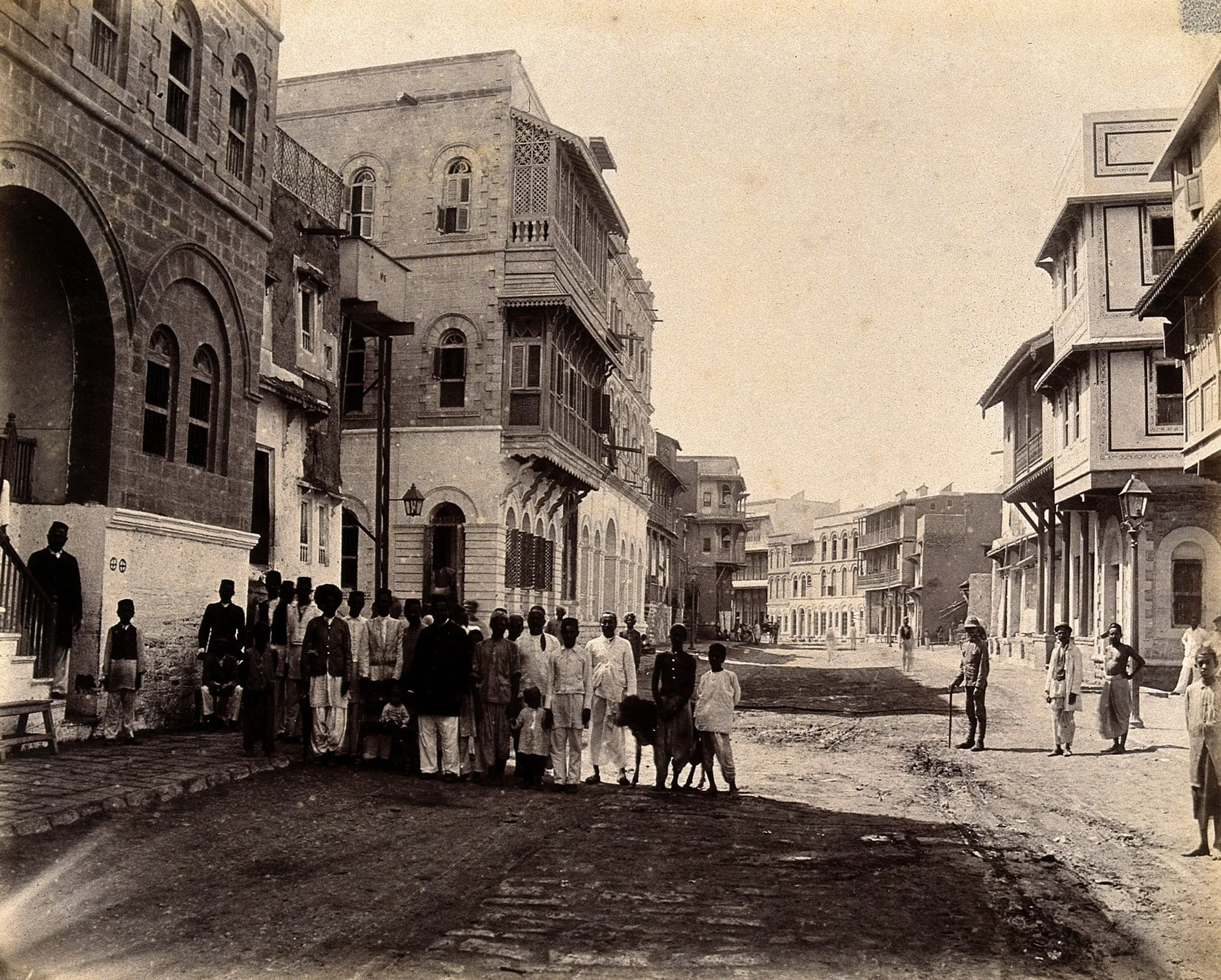
Karachi, the port of Sind on the Arabian Sea, has been an Ismaili centre since the nineteenth century. Aga Khan I passed through it on his way from Sind to Bombay in 1844. His son Aga Khan II lived there for a time, and Aga Khan III was born there in 1877. After Partition in 1947 Karachi became the seat of Pakistan’s government and the headquarters of the Ismaili councils of the new state. The Platinum Jubilee of 1954-55 was celebrated there, Aga Khan IV was installed there in 1957, and the Aga Khan University opened there in 1985.1
Aga Khan I and Sind
Karachi enters Ismaili history through the British conquest of Sind. Daftary records that Aga Khan I, having left Persia, served the British in Sind in the early 1840s. He placed his cavalry at their disposal and tried to persuade Nasir Khan, the Talpur amir of Kalat, to cede Karachi to the British. When Nasir Khan refused, the Aga Khan disclosed his battle plans to the British political agent, Major James Outram, and the British camp was saved from a night attack. In Ramadan 1260 AH/October 1844 Aga Khan I left Sind by the port of Karachi for Bombay, travelling through Kutch and Kathiawar and visiting Khoja communities on the way.2
Sind already had a large Khoja population, the product of the Satpanth preaching of earlier centuries. Its towns were among the communities whose jamatkhanas the Imam’s heir organized in the following decades. The Khojas are described in The Khojas.3
Birthplace of Aga Khan III
After joining his father in Bombay in 1853, Aqa Ali Shah, the future Aga Khan II, regularly visited the Khoja communities of Sind and Gujarat and organized their jamatkhanas. He lived for some time in Karachi, where his third son, Sultan Muhammad Shah, was born in Shawwal 1294 AH/November 1877. Aga Khan III gives the date in his memoirs as 2 November 1877 and adds that he spent his boyhood and youth in Bombay and Poona. Greenwall names the house as Honeymoon Lodge, Karachi, and the mother as Lady Ali Shah, of a Persian family.4
Before Partition
Under British rule Sind was governed as part of the Bombay Presidency. In his memoirs Aga Khan III supports its separation from Bombay. He argues that the connection had been an anachronism that explained much of Sind’s “so-called backwardness” and produced rivalry between Bombay, “the older city which ruled”, and Karachi, “the younger city which was ruled”. Sind differed from the rest of the province, he wrote, in race, language and culture.5
Karachi also had a small group of Khoja dissidents. Greenwall reports the claims of a Khoja reform party that, on a visit to Karachi in 1920, the Aga Khan collected large sums from his followers during a short stay. The memoirs refer to “a small group in Karachi and in India” who called themselves reformers while claiming to be Ismailis, and state that the community excommunicated them. These accounts come from the two sides of the dispute and are not independent.6
Partition and the Pakistan councils
At Partition Karachi became the seat of the government of Pakistan. Aga Khan III describes the new state’s administration being built “from the very beginning”: Karachi and Dacca “doubled and redoubled their size overnight”, and every facility had to be created anew. He had supported the Pakistan movement and was close to its leader; see Jinnah and the Aga Khan.7
Daftary records that after 1947 the Ismailis of Pakistan received a separate constitution, alongside those of India and East Africa. Religious policy, publications and the supervision of religious teachers in Pakistan were entrusted to an Ismaili Tariqah and Religious Education Board, with headquarters in Karachi. Until the late 1970s these bodies acted with considerable autonomy, especially in publishing. The framework is described in The Ismaili Constitutions.8
The Platinum Jubilee
The Platinum Jubilee, marking seventy years of Aga Khan III’s Imamat, was held during 1954 and 1955 in Karachi and elsewhere. Daftary treats the jubilees as expressions of the community’s devotion to the present (hazir) Imam, Mawlana Hazar Imam, and as a means of raising funds for welfare institutions. See The Diamond Jubilee.9
Aga Khan IV and Karachi
After the death of Aga Khan III in July 1957, Aga Khan IV interrupted his studies at Harvard for a year to visit his communities. He was installed in a series of takht-nishini ceremonies at Dar es Salaam, Nairobi, Kampala, Karachi and Bombay. Karachi remained the main Ismaili centre of Pakistan, with the national council and religious education board.10
In 1985 the Aga Khan University was inaugurated in Karachi, with faculties of medicine, nursing and education and an affiliated hospital. Its Institute for the Study of Muslim Civilisations was later established in London. Daftary presents the university, with the Institute of Ismaili Studies in London (1977) and the University of Central Asia in Khorog (2000), as the Imamat’s main ventures in higher education.11
Other Ismailis in Karachi
Karachi is also a centre of the Daudi Bohras, the Tayyibi Musta’li Ismailis. Daftary records that after Partition Karachi became the Daudi community’s second most important centre in South Asia, with about 30,000 Bohras living mainly in the city. In 1983 the Bohra da’i set up a branch of the Jami’a Sayfiyya seminary there. See The Musta’li Tayyibi Bohras.12
Footnotes
-
Farhad Daftary, The Isma’ilis: Their History and Doctrines, 2nd ed. (Cambridge University Press, 2007), pp. 472, 477, 484, 497, 503, https://archive.org/details/bk692. ↩
-
Daftary, The Isma’ilis, pp. 470-472. ↩
-
Daftary, The Isma’ilis, pp. 442-445, 477. ↩
-
Daftary, The Isma’ilis, pp. 477, 480; Aga Khan III, The Memoirs of Aga Khan: World Enough and Time (London: Cassell, 1954), ch. 1, https://archive.org/details/memoirsofagakhan00agak; Harry J. Greenwall, His Highness the Aga Khan, Imam of the Ismailis (London: Cresset Press, 1952), p. 9, https://archive.org/details/his-highness-the-aga-khan-imam-of-the-ismailis. ↩
-
Aga Khan III, Memoirs, p. 230. ↩
-
Greenwall, His Highness the Aga Khan, p. 77; Aga Khan III, Memoirs, p. 187. ↩
-
Aga Khan III, Memoirs, p. 321; “Ismailism xvi. Modern Ismaili Communities”, Encyclopaedia Iranica, https://www.iranicaonline.org/articles/ismailism-xvi-modern-ismaili-communities/. ↩
-
Daftary, The Isma’ilis, pp. 484-485, 500. ↩
-
Daftary, The Isma’ilis, p. 484; Aga Khan III, Memoirs, list of illustrations. ↩
-
Daftary, The Isma’ilis, pp. 496-497, 500. ↩
-
Daftary, The Isma’ilis, p. 503. ↩
-
Daftary, The Isma’ilis, pp. 290-294. ↩