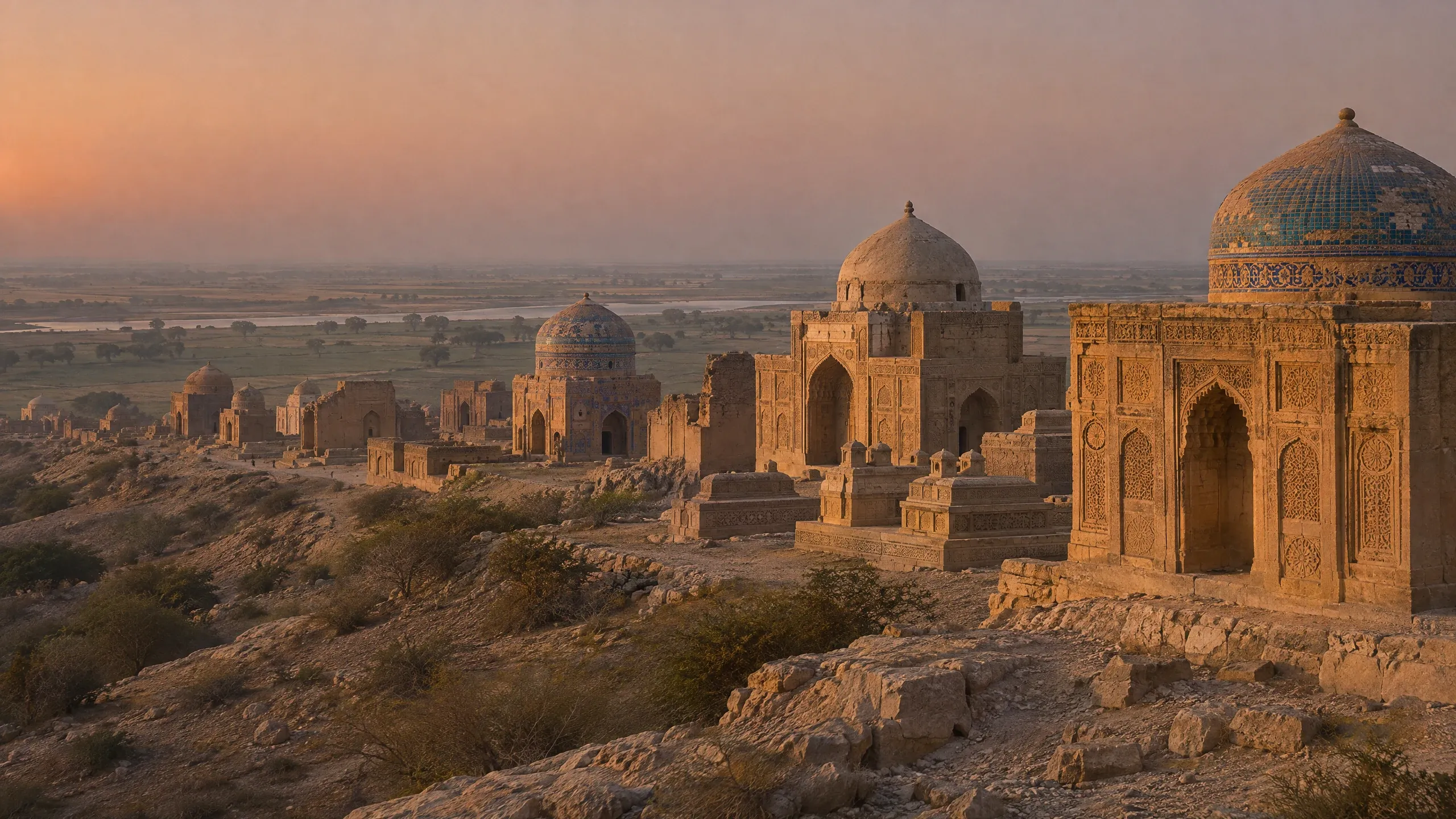
Thatta is a town in Sindh province, Pakistan, just west of the Indus and inland from Karachi and the Arabian Sea coast. For about five centuries it was the capital of Lower Sindh. Its place in Ismaili history comes from its first dynasty, the Sumras. Daftary writes that they adopted Fatimid Ismailism and ruled from Thatta for almost three centuries. Kassam’s reconstruction ties the early Nizari da’wa of Multan and Uch to them. Beside the town lies the necropolis of Makli Hill, listed by UNESCO in 1981. It is one of the largest cemeteries in the world.123
The Sumras and Ismailism
Ismailism reached Sindh in the Fatimid period. Daftary records that a ruler of the Habbarid dynasty at Mansura turned to Fatimid Ismailism around 401 AH, apparently making it the state religion. He was overthrown by Mahmud of Ghazna, who invaded Mansura in 416/1025. Mahmud had already crushed the Ismaili rulers of Multan. Despite these setbacks and continuing Ghaznavid hostility, “Fatimid Isma’ilism survived in Sind and later became the creed of the Sumras”. The Sumras rose against the Ghaznavids in 443/1051 and founded an independent dynasty with Thatta as its seat.4
How long the Sumras kept their Ismaili allegiance, and whether they followed the Nizari or the Musta’li line after the succession dispute of 1094, the sources do not say directly. Kassam argues that the Nizari da’wa in Multan and Uch kept “connections or identification with the Sumrahs who were centred in the Thatta district in Lower Sind”. In her view, the Nizaris of Upper Sindh, under pressure from the Ghurids and from the growing Sufi orders, could count on a friendly power in the south. This is the setting in which she places the activity of Pir Shams.5
The Sammas
Around 752/1351 the Sumras were replaced by the Sammas, who ruled Lower Sindh from Thatta until the sixteenth century. Daftary notes that the Sammas became Sunnis. Their rise therefore removed the dynastic sympathy the Ismailis had enjoyed. Daftary links this to the period of Pir Sadr al-Din, whose da’wa relied on the caste networks of the Lohanas and on jamatkhanas such as the one at Kotri.67
The greatest Samma monument is at Makli. UNESCO singles out the stone tomb of Jam Nizam al-Din II, who reigned from 1461 to 1509. UNESCO describes the Makli monuments as combining Gujarati Hindu architecture with Mughal and Persian influences in a local style, and this tomb is among the most important of them. Jam Nizam al-Din’s reign overlapped with the careers of Pir Hasan Kabir al-Din at Uch and Imam Shah in Gujarat. The same Gujarat–Sindh cultural zone shaped both the Satpanth and the architecture of Thatta.8
Tarkhans and Mughals
After the Sammas, Lower Sindh was ruled by the Tarkhan family, whose tombs stand at Makli, and from 1591 by the Mughals. UNESCO lists the tombs of Isa Khan Tarkhan the Younger and of his father Jan Baba, both built before 1644, among the outstanding stone buildings of Makli. It also notes the tile-covered tomb of Diwan Shurfa Khan (d. 1638) as the most colourful. In the town itself, the Mughal emperor Shah Jahan built the Jama Mosque between 1647 and 1649. In 1854 the British made Thatta a municipality.910
The Makli necropolis
UNESCO describes Makli as “an enormous cemetery possessing half a million tombs and graves in an area of about 10 km²”. It lies along the 6.5-kilometre edge of the Makli plateau near the head of the Indus delta. Kings, queens, governors, saints, scholars and philosophers are buried there in brick or stone monuments, some decorated with glazed tiles. The listing stresses the mixture of styles: Gujarati Hindu architecture, Mughal imperial architecture, and Persian and Central Asian terracotta traditions, together with a local style of carved stone ornament. UNESCO also records the site’s decay. Earthquakes, salt-laden winds, heavy rain, shifts in the river’s course, encroachment and theft all threaten the monuments, and it calls for urgent stabilisation of Jam Nizam al-Din II’s tomb.11
Thatta in Satpanth history
No Satpanth shrine of the first rank survives at Thatta, and the town is rarely named in the ginans, which centre on Multan, Uch and Gujarat. Its importance for Ismaili history is political. As capital of the Sumras, it was the centre of the only South Asian dynasty that, according to the sources Daftary uses, adopted Ismailism after the fall of Multan. Its change of rulers, from Sumra to Samma, marks the point at which Satpanth in Sindh lost its royal patrons. Later Khoja centres in Sindh, such as Kotri and Tando Muhammad Khan, where the Kadiwala sayyids settled around 1194/1780, grew up without that patronage. When Aga Khan I reached Sindh in the autumn of 1842, he lived at Jerruck, where his house still stands. He sided with the British in their conquest of Sindh in 1843.121314
Footnotes
-
“Thatta,” Encyclopaedia Britannica, https://www.britannica.com/place/Thatta. ↩
-
Farhad Daftary, The Isma’ilis: Their History and Doctrines, 2nd ed. (Cambridge: Cambridge University Press, 2007), p. 167. ↩
-
UNESCO World Heritage Centre, “Historical Monuments at Makli, Thatta” (inscribed 1981), https://whc.unesco.org/en/list/143/. ↩
-
Daftary, The Isma’ilis, pp. 166–167. ↩
-
Tazim R. Kassam, Songs of Wisdom and Circles of Dance: An Anthology of Hymns by the Satpanth Isma’ili Saint, Pir Shams (PhD dissertation, McGill University, 1992), ch. 4, section on the Ghurids, https://archive.org/details/bk038. ↩
-
Daftary, The Isma’ilis, p. 443. ↩
-
“Thatta,” Encyclopaedia Britannica. ↩
-
UNESCO World Heritage Centre, “Historical Monuments at Makli, Thatta,” brief synthesis and criteria. ↩
-
UNESCO World Heritage Centre, “Historical Monuments at Makli, Thatta,” brief synthesis. ↩
-
“Thatta,” Encyclopaedia Britannica; “Sindh,” Encyclopaedia Britannica, https://www.britannica.com/place/Sindh-province-Pakistan. ↩
-
UNESCO World Heritage Centre, “Historical Monuments at Makli, Thatta,” brief synthesis, integrity, and protection and management requirements. ↩
-
Daftary, The Isma’ilis, pp. 443, 447. ↩
-
Kassam, Songs of Wisdom and Circles of Dance, ch. 4. ↩
-
Daftary, The Isma’ilis, pp. 470–471. ↩