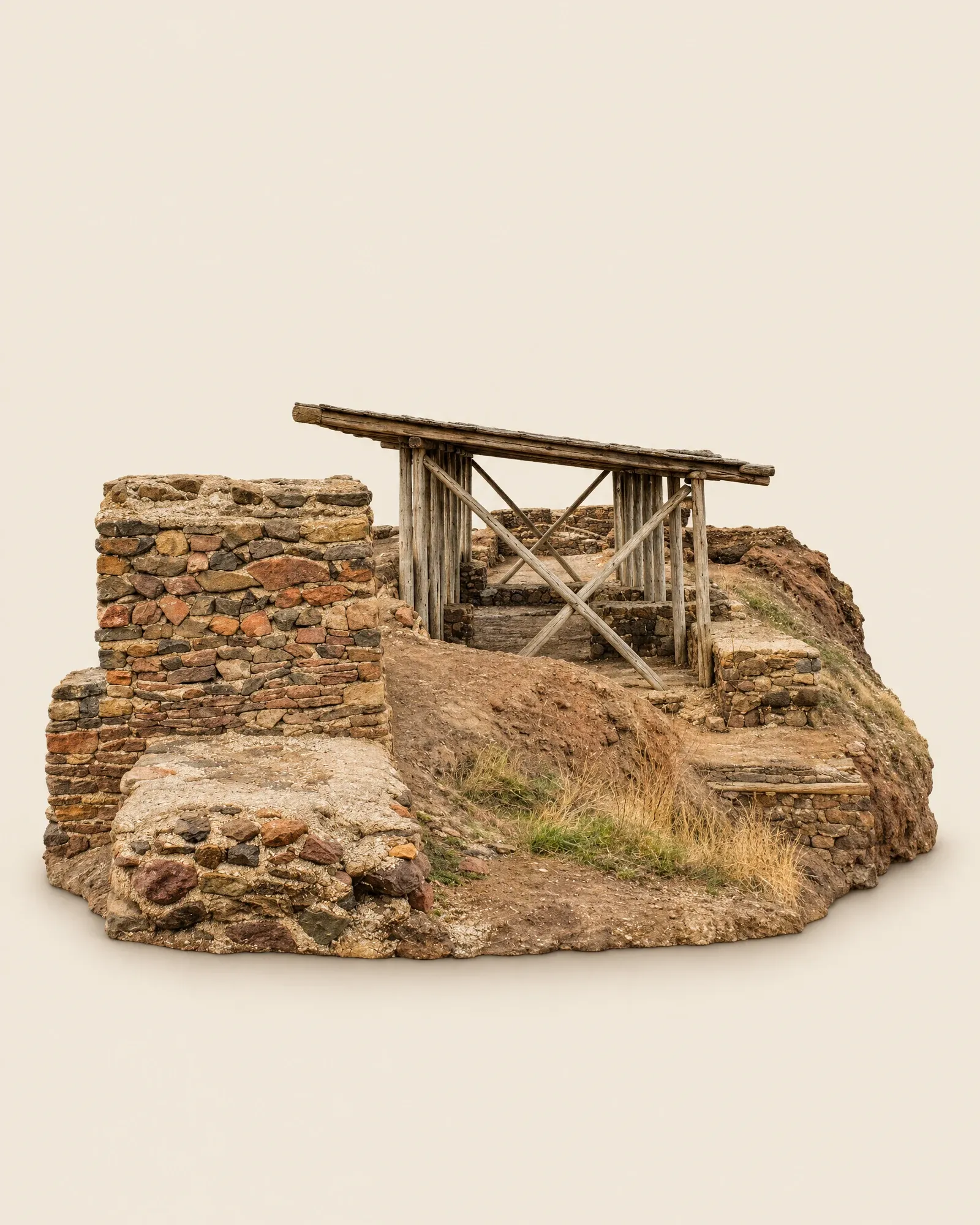
Ali al-Hadi is counted by the Nizari Ismailis as their twentieth Imam, the son and successor of Nizar. He is the first of three Imams, with Muhammad al-Muhtadi and Hasan al-Qahir, whom Nizari tradition holds to have lived in concealment between Nizar’s death in 1095 and the public appearance of Hasan II as Imam at Alamut in 1164. Almost nothing about him can be established historically. Even Daftary’s standard list of Nizari Imams gives no dates for him, only his name.1
How he is known
Ali al-Hadi’s name comes from the genealogy that circulated among the Nizaris after Hasan II and his son Nur al-Din Muhammad were recognised as Imams. Daftary summarises it: there were three generations between Hasan II and Nizar, and Hasan was “the son of al-Qahir b. al-Muhtadi b. al-Hadi b. Nizar”. In this lineage al-Hadi is Nizar’s son, the link between the Fatimid line in Egypt and the Imams who later ruled from Alamut.2
This genealogy was put forward some seventy years after Nizar’s death. Daftary notes that the line of Nizari Imams “emerged openly” only with Hasan II, after which the Nizaris recognised the lords of Alamut as their Imams. Before then the Imams had been hidden from their followers, and Alamut had been ruled only by their hujjas and da’is.3
The period of concealment
The Nizaris call this period the dawr al-satr, the era of concealment. After Nizar’s defeat and death in Cairo in 488/1095, the Persian Ismailis under Hasan-i Sabbah recognised Nizar as Imam and broke with the Fatimid da’wa in Cairo. They had no access to an Imam, however. Daftary stresses that Hasan-i Sabbah and his next two successors at Alamut “did not name any imams after Nizar”.4
In the absence of a manifest Imam, Hasan-i Sabbah, as head of the Nizari da’wa, came to be recognised as the Imam’s hujja, his “proof” or chief representative. Daftary records that the earliest surviving Nizari treatise, from about 596/1199, says Hasan-i Sabbah had predicted the coming of an Imam-qa’im and held the rank of hujja himself. In Nizari terms, Ali al-Hadi’s imamate falls in this era. The Imam’s existence was an article of faith, and leadership in practice lay with the lord of Alamut.5
Alamut under the hujja
If the Nizari reckoning is followed, the decades of al-Hadi’s concealment were the years in which Hasan-i Sabbah built the Nizari state. From 503/1109 the Saljuq commander Anushtagin Shirgir besieged Lamasar and Alamut and destroyed the crops of Rudbar year after year. The siege was lifted only in 511/1118, when news came of Sultan Muhammad Tapar’s death.6 Afterwards Sultan Sanjar tolerated the Nizaris and paid them a pension from the taxes of Qumis.7
In 515/1121 the Fatimid vizier al-Afdal, who had set Nizar aside in 1094, was assassinated in Cairo. Nizari sources attribute the killing to three fida’is from Aleppo, and Hasan-i Sabbah ordered seven days of celebration. Hasan died in 518/1124. He was succeeded by Buzurg-Ummid, who also ruled as head of the da’wa rather than as Imam.8
Evidence of the coins
The only near-contemporary evidence for loyalty to Nizar’s line during these decades is numismatic. For about seventy years after Nizar’s death, through the reign of the third lord of Alamut, Muhammad b. Buzurg-Ummid (1138–1162), coins were struck at Kursi al-Daylam, Alamut, bearing Nizar’s name and his title al-Mustafa li-Din Allah. Daftary notes that their inscriptions “generally” bless Nizar’s descendants without naming them.9
The coins therefore show a public commitment to Nizar’s line, but they do not name al-Hadi or any other successor. The hidden Imams appear in the record only later, through the genealogy of Hasan II.9
Traditions of the escape from Egypt
According to the Persian historians, many Nizaris already believed in Hasan-i Sabbah’s lifetime that a son or grandson of Nizar had been smuggled from Egypt to Alamut and kept there in secret.10 Juvayni and other Persian historians also record later, differing versions. In one, in 488/1095, a year after al-Mustansir’s death, a qadi named Abu’l-Hasan Sa’idi went from Egypt to Alamut, secretly taking with him Nizar’s grandson al-Muhtadi. The secret was shared only with Hasan-i Sabbah, who protected the child as he lived in hiding near the castle.11
In that version it was al-Hadi’s son, not al-Hadi himself, who reached Persia. The traditions differ on the details and cannot be checked against independent evidence. That uncertainty is why the hidden Imams are known today almost entirely by name.11
Musta’li polemic
The idea of a hidden Nizarid line was contested from the start. In 516/1122 the Fatimid court in Cairo issued al-Hidaya al-Amiriyya, the caliph al-Amir’s epistle defending the succession of al-Musta’li and addressed to the Ismailis of Syria. Daftary notes that it “ridicules” the belief that a descendant of Nizar had been brought to Alamut.12 The epistle caused uproar among the Nizaris of Damascus, and their leader wrote a refutation. The existence of Nizar’s line was, in effect, the central point in dispute between the two branches of Ismailism.13
The historical question
Nizar did leave sons. Daftary records Nizarid revolts against the later Fatimids in Egypt, the last of them led by a grandson of Nizar in 556/1161.14 Descendants of Nizar were alive and politically active, so a Nizarid line was not impossible. But no source contemporary with the period of concealment names al-Hadi or describes his life, residence or death.
Modern scholarship therefore treats al-Hadi as a figure of Nizari genealogical tradition rather than of documented history. For the Nizari community he is a link in the unbroken chain of the Imamate from Ali b. Abi Talib to the present Aga Khan.1
Footnotes
-
Farhad Daftary, Historical Dictionary of the Ismailis (Scarecrow Press, 2012), appendix “Nizari Imams”; Farhad Daftary, The Isma’ilis: Their History and Doctrines, 2nd ed. (Cambridge University Press, 2007), pp. 363–364. ↩ ↩2
-
Daftary, The Isma’ilis, p. 364. ↩
-
Daftary, The Isma’ilis, pp. 363–364. ↩
-
Daftary, The Isma’ilis, pp. 242–243, 326. ↩
-
Daftary, The Isma’ilis, p. 326. ↩
-
Daftary, The Isma’ilis, p. 337. ↩
-
Daftary, The Isma’ilis, p. 342. ↩
-
Daftary, The Isma’ilis, pp. 342–344. ↩
-
Daftary, The Isma’ilis, p. 326. ↩
-
Daftary, The Isma’ilis, p. 326. ↩
-
Daftary, The Isma’ilis, p. 245. ↩
-
Daftary, The Isma’ilis, pp. 325–326. ↩