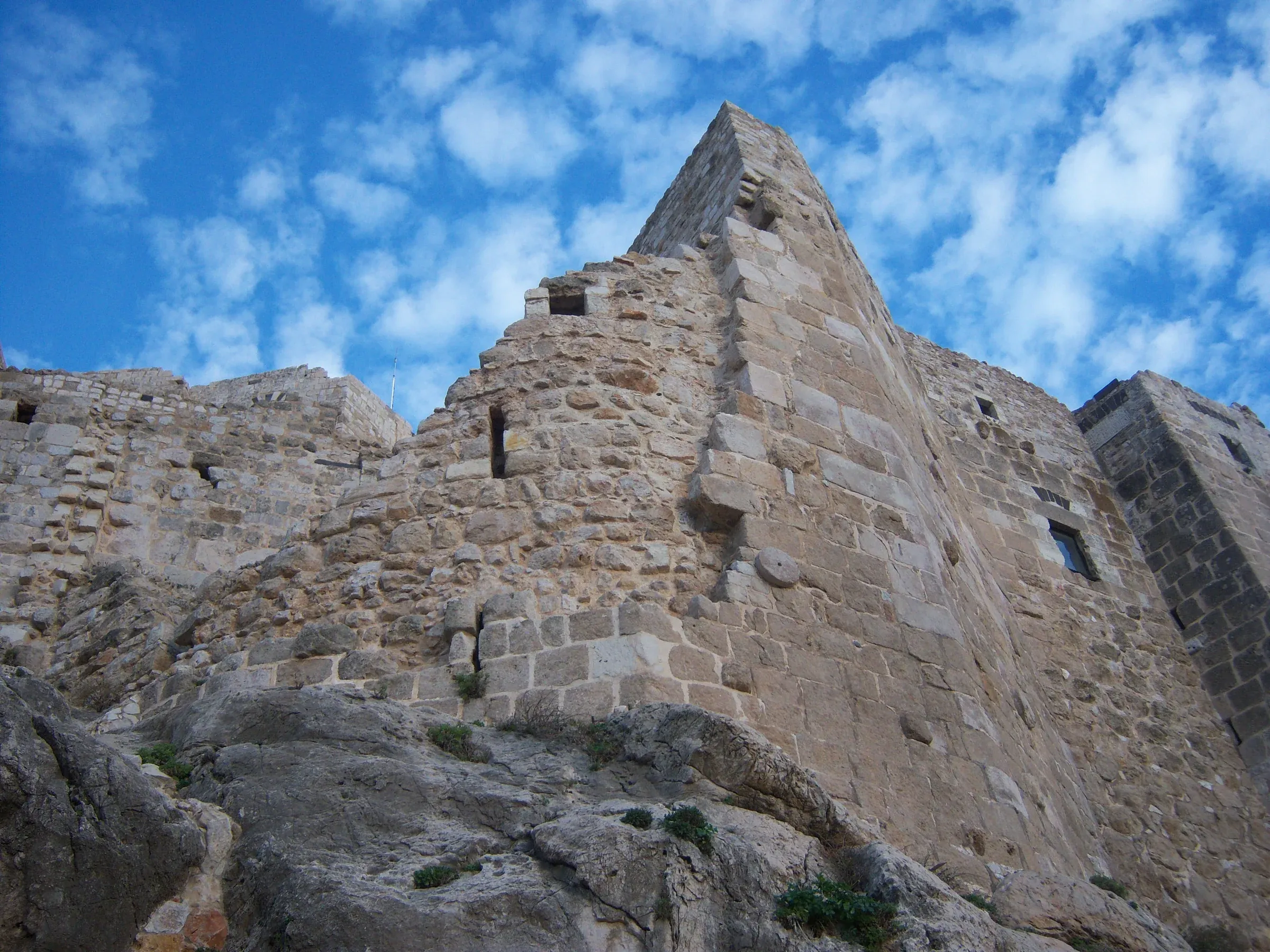
Syria has had Ismailis longer than almost anywhere else. The early da’wa had its headquarters at Salamiyya in the ninth century. In the twelfth and thirteenth centuries the Nizaris held a chain of mountain castles, among them Masyaf and Qadmus, in the Jabal Bahra west of Hama. Most of the Syrian community did not, for several centuries, follow the line of Imams that later became the Aga Khans. In the late nineteenth century the majority transferred its allegiance to Aga Khan III, and today the Syrian followers of the Aga Khan, about 80,000 people, are concentrated in Salamiyya and its surrounding villages. A separate group of about 15,000, the Ja’fariyya, lives around Masyaf and Qadmus.1
Before the modern period
The high point of Nizari power in Syria came under the da’i Rashid al-Din Sinan, who led the community for about thirty years until his death in 1193 (589 AH) at the castle of Kahf. Daftary calls him the ablest of the Syrian Nizari chiefs and the only one who achieved effective independence from Alamut. European writers of the Crusades called him the “Old Man of the Mountain”. After the fall of Alamut in 1256, rivalries among senior da’is and the independence of individual castle governors weakened the Syrian Nizaris. They submitted to the Mamluk sultan Baybars I (r. 1260-1277). The fuller story is told in The Nizaris of Alamut and on the pages for the castles.2
The Syrian Nizaris remained loyal subjects of the Mamluks and then of the Ottomans, to whom they paid a special tax. In the dispute over the Imamate in the fourteenth century, which split the Nizaris into Qasim-Shahi and Muhammad-Shahi branches, almost the entire Syrian community followed the Muhammad-Shahi line. The Syrian adherents called themselves the Mu’miniyya, after Ala al-Din Mu’min Shah, with whom, in their tradition, the split began. Much of what is known of the Muhammad-Shahi Imams survives only as names preserved in Syrian oral tradition. On this division, see The Muhammad-Shahi and Qasim-Shahi Split.3
Feuds and decline, 1700-1840
From the late eighteenth to the early nineteenth century the Nizaris were repeatedly in conflict with their more numerous neighbours, the Nusayris (Alawis), who occupied Nizari castles more than once and destroyed their religious books. Rivalry between the two Nizari ruling families, based at Masyaf and Qadmus, weakened the community further. In 1808 the Nusayris killed Mustafa Mulhim, the Nizari amir of Masyaf, by a trick and took his fortress. The senior da’i at Masyaf, Shaykh Sulayman ibn Haydar, left with many Nizaris for Homs, Hama and other places. The Nizaris later recovered Masyaf through Ottoman intervention.4
In the 1830s an expedition led by Ibrahim Pasha did heavy damage to Nizari castles and villages. By the 1840s Isma’il ibn Muhammad, the amir of Qadmus, had brought most of the Syrian community under his authority and had won the favour of the Ottoman government of Sultan Abd al-Majid I (r. 1839-1861).5
The resettlement of Salamiyya, 1843
Amir Isma’il decided to gather his community at Salamiyya, the former headquarters of the early da’wa, which then lay in ruins on the edge of the steppe east of Hama. In 1843 he petitioned the Ottoman authorities for permission to restore the town for permanent Nizari settlement. The request was granted. Nizaris from various places were settled in Salamiyya and the villages around it, and in 1850 the Ottomans exempted them from military service. Daftary regards the resettlement as the start of a new era in the modern history of the Syrian community. The Nizaris of Salamiyya farmed the plains, which yielded better harvests than the mountain land around Masyaf and Qadmus.6
From Muhammad-Shahi to Qasim-Shahi
The Syrian Muhammad-Shahis had lost contact with their Imam. They had heard nothing since 1796 (1210 AH) from their fortieth Imam, Amir Muhammad al-Baqir, who, like his predecessors, lived in India. In 1887 (1304 AH) they sent a delegation to India to find his descendants. It failed. Soon afterwards most of the Syrian Muhammad-Shahis accepted the Qasim-Shahi line, then represented by Aga Khan III in Bombay. A minority stayed with the Muhammad-Shahi line, although it had apparently come to an end.7
The two groups then developed differently. The Muhammad-Shahis remained in the mountains west of Hama, around Masyaf and Qadmus, lacked strong leadership and organisation, and suffered further clashes with the Nusayris. The last such attacks, in 1919-1920, briefly took Qadmus and did much damage. Locally known as the Ja’fariyya, they still await the return of their hidden Imam, presumably Muhammad al-Baqir, follow the Shafi’i school in legal matters, and number about 15,000. Daftary believes them to be the only surviving Muhammad-Shahi Nizaris.8
Aga Khan III and Syria
Daftary sets the Syrian community alongside those of Persia, Afghanistan and Central Asia. By the early twentieth century these non-Khoja Nizari groups had largely lost their earlier prominence. They lived mainly by farming and had traditionally been led by hereditary families of pirs, amirs or mirs, not by the merchant councils that were developing among the Khojas.9
The new allegiance brought the Syrian Nizaris into the network of Aga Khan III. In his memoirs he writes that on his first visit to Egypt, around the time of the battle of Omdurman in 1898, one of his aims was to make “personal contact with the large Ismaili community of Syria”. He also writes that Syrian deputations, with others from Kashgar, Bukhara, Iran, Yemen and the African coast, came to Bombay after Aga Khan I settled in India.10
In Syria, as in Central Asia and Iran, the community was led by hereditary local representatives rather than by the elected councils of India and Africa. The memoirs state that the Imam’s representatives in Syria were called amirs, and that one Syrian family of representatives had “retained an unbroken connection with my family for more than a thousand years”. He wrote that Syrian deputations had once come regularly to India. By the 1950s members of his family visited Syria, or Syrian followers came to him in Egypt.11
The Imam paid for schools and welfare. Daftary records that Aga Khan III built several schools in Salamiyya and elsewhere, including an agricultural school, and sent religious teachers from Africa. The memoirs say that most of the tribute given to the Imam in such countries was spent on schools, prayer houses and religious and social institutions. They also record the introduction of trained midwives and modern childbirth care in Syria and Iraq, “so far as general conditions permitted”. In the memoirs, finished in 1954, he listed Syria among the countries where the financial institutions built in East Africa would be harder to establish.12
Aga Khan III visited his Syrian followers in 1951, the same year as his only visit to Persia. The memoirs record a visit to Damascus, where “a great number of my followers came to pay their respects”. During the Second World War his son Prince Aly Khan served in Syria with the Allied forces. In the memoirs, the Imam also describes the Druze of the Jabal Druze as originally Ismaili, though not his followers.13
Syrian texts and scholarship
Syria also preserved Nizari literature, and its manuscripts were among the first Ismaili sources to reach European scholars. Daftary records that an Arabic life of Rashid al-Din Sinan, composed around 1324, was discovered in Syria in 1848 and given to the Societe Asiatique in Paris. Stanislas Guyard rediscovered it some thirty years later and published it with a translation. In later Syrian Nizari literature Sinan is presented as a saintly hero of cosmic rank. In the twentieth century two Syrian Ismaili scholars edited many texts of Syrian origin: Arif Tamir (1921-1998), of the Muhammad-Shahi community, and Mustafa Ghalib (1923-1981), a Qasim-Shahi. Daftary notes that their editions were often imperfect.14
Since 1957
Prince Aly Khan, passed over in the succession of 1957, died in a car accident in 1960. In 1972 he was buried in a permanent mausoleum at Salamiyya. Iranica’s survey of modern Ismaili communities lists Syria, with East Africa, Tajikistan, Iran and Afghanistan, among the crises through which the community was guided under Aga Khan IV, and in which refugee relief and resettlement often came first.15
Under the 1986 constitution, Syria became one of the territories with a National Council, joining the worldwide system of councils, religious education boards and conciliation and arbitration boards. Asani notes that the Imamat has encouraged closer contact between the Khoja communities and the Ismailis of Central Asia, Afghanistan, Syria and Iran. As a result, Persian and Arabic qasidas are now often recited in Khoja jamatkhanas, while non-Khoja communities have adopted Khoja institutions and titles.16
The Syrian community has a distinct place among the Ismailis. It is Arabic-speaking, mainly agricultural and concentrated in a single district, and it lives in the region where the Fatimid da’wa began. Its documented history connects the early Ismailis of Salamiyya, the castles of the Nizari period and the modern Imamat. Daftary’s figures of 80,000 followers of the Aga Khan and 15,000 Ja’fariyya were published in 2007. Reliable figures for the period since have not been found in the sources consulted here.17
Footnotes
-
Farhad Daftary, The Isma’ilis: Their History and Doctrines, 2nd ed. (Cambridge University Press, 2007), pp. 488-490, https://archive.org/details/bk692. ↩
-
Daftary, The Isma’ilis, pp. 372, 398. ↩
-
Daftary, The Isma’ilis, p. 489 and ch. 6, sections on the Nizari schism and on the Muhammad-Shahi imams. ↩
-
Daftary, The Isma’ilis, p. 489. ↩
-
Daftary, The Isma’ilis, p. 489. ↩
-
Daftary, The Isma’ilis, pp. 489-490. ↩
-
Daftary, The Isma’ilis, p. 489. ↩
-
Daftary, The Isma’ilis, p. 490 and ch. 6, section on the Muhammad-Shahi imams. ↩
-
Daftary, The Isma’ilis, p. 488. ↩
-
Aga Khan III, The Memoirs of Aga Khan: World Enough and Time (London: Cassell, 1954), pp. 60-61, 181-182, https://archive.org/details/memoirsofagakhan00agak. ↩
-
Aga Khan III, Memoirs, pp. 182-185. ↩
-
Daftary, The Isma’ilis, p. 490; Aga Khan III, Memoirs, pp. 182, 188, 288. ↩
-
Daftary, The Isma’ilis, pp. 484, 490; Aga Khan III, Memoirs, pp. 180, 182, and ch. “The War Years”. ↩
-
Daftary, The Isma’ilis, pp. 27-28, 32, 372. ↩
-
Daftary, The Isma’ilis, p. 496; “Ismailism xvi. Modern Ismaili Communities”, Encyclopaedia Iranica, https://www.iranicaonline.org/articles/ismailism-xvi-modern-ismaili-communities/. ↩
-
Daftary, The Isma’ilis, p. 501; Ali S. Asani, “From Satpanthi to Ismaili Muslim: The Articulation of Ismaili Khoja Identity in South Asia”, in Farhad Daftary (ed.), A Modern History of the Ismailis (London: I.B. Tauris, 2011), p. 121, https://archive.org/details/bk861. ↩
-
Daftary, The Isma’ilis, pp. 489-490. ↩