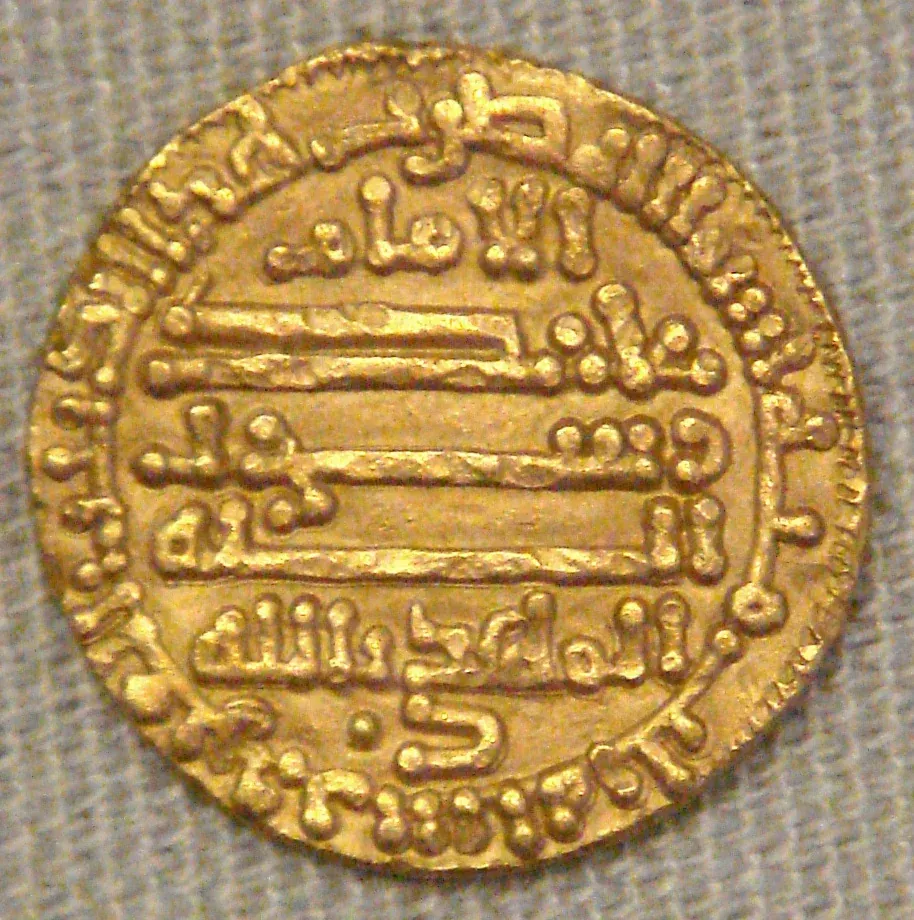
In the medieval Islamic world two acts announced whose sovereignty a territory recognised: the mention of the ruler’s name in the Friday sermon, the khutba, and the striking of coins in his name. The history of Fatimid coinage is therefore also a map of Fatimid power, from the first coins of the da’wa in Ifriqiya in 909 to the coins struck in the twelfth century by viziers, rivals and pretenders.123
Fatimid gold was also an economic achievement. Sanders writes that the Fatimid state produced coins of such fineness and reliability that they served as an international currency, and that this fineness was kept almost to the end of the dynasty.4 This page sets out what the sources used here say about Fatimid coins. It does not describe the dies or legends of individual issues, which belong to the specialist numismatic literature listed at the end.56
Coins as a mark of sovereignty
Brett describes the monetary system the Fatimids inherited. The copper fals was the lowest coin; above it was the silver dirham, valued at about a tenth of the gold dinar. He argues that copper and silver were the usual money, and that the dinar was largely a money of account, a way of stating a value rather than an actual sum.1
A principal purpose of the dinar as a coin, in Brett’s account, was to serve as a mark of sovereignty for the ruler in whose name it was struck.1 That is why the earliest Ismaili coins appear at moments of political assertion rather than as part of an established fiscal system.
Coins before the caliphate
Daftary records that when the sons of the da’i Zikrawayh briefly seized towns in Syria in the name of Abd Allah al-Mahdi, it was in the name of the Ismaili Imam, and not of the Abbasid caliph, that for the first time the khutba was read and coins were minted.2 The Qarmatis of Bahrayn, who did not recognise the Fatimid Imams, also struck coins; Daftary notes that Qarmati coins survive from the second half of the tenth century.7
Coins also record the divisions within the early movement. Daftary cites the coins of the Musafirid ruler Wahsudan ibn Muhammad, minted in 343/954–955, whose inscriptions show that these rulers in northwestern Iran acknowledged Muhammad ibn Isma’il as Mahdi rather than the imamate of the Fatimid caliphs.8
Ifriqiya, 909–969
When Abu Abd Allah al-Shi’i took Raqqada in 909, he appointed new governors, introduced the Shi’i call to prayer and added blessings on the ahl al-bayt to the khutba. His new coins heralded the arrival of the hujjat Allah, “God’s proof”, an expression that earlier Imami Shi’i tradition used as a synonym for the Imam.3 The coins thus announced the Imam before al-Mahdi himself had arrived in Ifriqiya.
The rebel Abu Yazid also understood the coin as a claim. After taking Qayrawan in 333/944, Brett records, he struck coins in his own name.910
Gold itself came to Ifriqiya from the Sahara. Brett connects the rise of the Sijilmasa route in the mid-tenth century to Fatimid demand: the caliph needed gold for war as well as treasure, and under al-Mu’izz the supply became large enough to be used for political ends.1 A tradition reported for the same period holds that Abd al-Rahman III of Cordoba paid for the marble of Madinat al-Zahra’ in “dinars of Sijilmasa”.11 See Sijilmasa.
The Mu’izzi dinar in Egypt
Egypt on the eve of the conquest of 969 was in a monetary crisis, and its Ikhshidid coinage was seriously debased. Sanders records that Jawhar minted new gold coins, called Mu’izzi dinars, of very high intrinsic value, withdrew the debased coins from circulation and required taxes to be paid only in the new dinars.12
Sanders links the success of this policy to the centralisation of tax collection under Jawhar and the financial officials of the new regime, including Ya’qub ibn Killis, who gathered tax collection in an administrative complex near the mosque of Ibn Tulun. In her account the fineness of the coinage was kept throughout the Fatimid period, even in the economic crises of al-Mustansir’s reign, and was an important element of the state’s economic stability.12
The supply of gold
One reason the Fatimids could keep their coins fine was a plentiful supply of gold. When al-Mu’izz came to Egypt in 361/972, Sanders writes, he brought a hundred camels laden with gold bars shaped like millstones.4 The state also worked the gold mines of Upper Egypt and Nubia until the cost of production outstripped the yield.4
Both those mines and the pharaonic tombs, which had been a major source of gold for the Tulunids, began to run out in the eleventh and twelfth centuries. Even so, Sanders concludes, the state maintained the fineness of its coins until almost the end of the Fatimid period.4
Sanders places this in the setting of the tenth- to twelfth-century Mediterranean, where merchants and goods moved with remarkable freedom despite political borders and wars, and where the Fatimid government exercised a right of first purchase through its Commerce Bureau (matjar).13 In that market, she notes, coins were a commodity as well as a currency, and the reliability of Fatimid gold made it an international medium of exchange.4
Coins, khutba and the reach of the empire
Daftary’s narrative repeatedly treats the khutba as the measure of Fatimid recognition, and the two marks of sovereignty usually moved together. In Cairo in 969 Jawhar dropped the name of the Abbasid caliph al-Muti’ from the Friday sermon.14 Around 354/965 the da’i Halam ibn Shayban openly proclaimed the sovereignty of al-Mu’izz in Multan, where the khutba was read for the Fatimids.15
Under al-Aziz the khutba was read for the Fatimids from the Atlantic to the Hijaz, Yemen and Syria, also in Multan and, briefly in 382/992, in Mosul.16 In 401/1010–1011 Qirwash ibn al-Muqallad, the Uqaylid ruler of Mosul, Kufa, Mada’in and other towns had it read in the name of al-Hakim.17 In Sicily the Kalbid amirs still named the Fatimid caliph on their coins in the reign of al-Zahir.18
The high point came under al-Mustansir. In Dhu’l-Qa’da 450/December 1058 al-Basasiri entered Baghdad, where the Shi’i call to prayer was introduced and the khutba pronounced for the Fatimid caliph, a result Daftary credits in large part to the diplomacy of al-Mu’ayyad al-Shirazi.1920 In Yemen the Sulayhid Ali ibn Muhammad instituted the Fatimid khutba wherever he conquered.21
Losses were registered the same way. The Zirid al-Mu’izz ibn Badis renounced Fatimid suzerainty, and the khutba in Zirid lands was read for the Abbasids.22 In 462/1069–1070 the sharif of Mecca told the Seljuk sultan Alp Arslan that the khutba would now be read for the Abbasid caliph and the sultan, and in 462/1070 the rebel commander Nasir al-Dawla had it read for the Abbasid caliph in Alexandria.2324
Heirs, rivals and pretenders on the coins
Coins also recorded disputed claims within the dynasty. In Safar 404/1013 al-Hakim proclaimed his cousin Abd al-Rahim ibn Ilyas heir apparent as wali ’ahd al-muslimin, and coins were minted in Abd al-Rahim’s name in 404.2526
After al-Mustansir’s death in 487/1094, his son Nizar was proclaimed caliph and Imam at Alexandria with the title al-Mustafa li-Din Allah. Daftary notes that this proclamation is attested by a unique gold dinar minted in 488, discovered in 1994 and now held by the Institute of Ismaili Studies Library in London.27 Walker, by contrast, dismisses a later Nizari argument about coinage in the succession polemics as showing a lack of historical knowledge.28
Coins remained part of the struggle over Nizar’s line. When the vizier al-Ma’mun al-Bata’ihi fell from favour, one charge was that he had instructed an amir in Yemen to strike coins in the name of “al-Imam al-Mukhtar Muhammad ibn Nizar”.29 In Alamut, Daftary writes, Nizar’s name appeared on coins for about seventy years after his death, while his descendants were blessed anonymously.30
After the assassination of al-Amir in 524/1130 the vizier Kutayfat, an Imami Shi’i, deposed the dynasty. In 525–526/1130–1131 he issued coins naming the hidden twelfth Imam of the Twelver Shi’a, with himself as his representative (na’ib).313233 After Kutayfat’s death the future al-Hafiz returned as regent, a title that appears on coins from 526.34
Beyond the Fatimid lands
Fatimid allegiance also appears on the coins of client dynasties. Daftary records coins of the Zuray’id ruler Imran ibn Muhammad, minted in Aden in 556, that bear the name of the Fatimid caliph al-Adid on one side and that of Imran on the other.35
Studying the coins
The coins are among the few dated documents produced continuously by the Fatimid state. Canard’s article in the Encyclopaedia of Islam lists the older catalogues of Fatimid coins, including the work of H. Sauvaire, J. Farrugia de Candia on the Bardo Museum in Tunis, M. Troussel on Constantine, and G. C. Miles on the collections in Philadelphia and of the American Numismatic Society.5
Daftary’s bibliography adds later studies, including Nicholas Lowick on the Fatimid coins of Multan and on the dinars of the Sulayhids and Zuray’ids, and Norman D. Nicol’s A Corpus of Fatimid Coins (2006).6 Those works, not this page, should be consulted for the inscriptions and types of individual issues.6
Footnotes
-
Michael Brett, “The Fatimid revolution (861–973) and its aftermath in North Africa”, in J. D. Fage (ed.), The Cambridge History of Africa, vol. 2 (Cambridge University Press, 1978), p. 618. ↩ ↩2 ↩3 ↩4
-
Farhad Daftary, The Isma’ilis: Their History and Doctrines, 2nd ed. (Cambridge University Press, 2007), p. 123. ↩ ↩2
-
Farhad Daftary, The Isma’ilis: Their History and Doctrines, 2nd ed. (Cambridge University Press, 2007), p. 127. ↩ ↩2
-
Paula A. Sanders, “The Fatimid state, 969–1171”, in Carl F. Petry (ed.), The Cambridge History of Egypt, vol. 1 (Cambridge University Press, 1998), p. 162. ↩ ↩2 ↩3 ↩4 ↩5
-
Marius Canard, “Fatimids”, Encyclopaedia of Islam, 2nd ed., vol. II (Brill, 1965), bibliography, p. 862. ↩ ↩2
-
Farhad Daftary, Historical Dictionary of the Ismailis (Scarecrow Press, 2012), bibliography, section on numismatics. ↩ ↩2 ↩3
-
Farhad Daftary, Historical Dictionary of the Ismailis (Scarecrow Press, 2012), s.v. “Qarmatis”. ↩
-
Farhad Daftary, The Isma’ilis: Their History and Doctrines, 2nd ed. (Cambridge University Press, 2007), p. 121. ↩
-
Michael Brett, “The Fatimid revolution (861–973) and its aftermath in North Africa”, in J. D. Fage (ed.), The Cambridge History of Africa, vol. 2 (Cambridge University Press, 1978), p. 609. ↩
-
Farhad Daftary, The Isma’ilis: Their History and Doctrines, 2nd ed. (Cambridge University Press, 2007), p. 146. ↩
-
A. M. Di Tolla, “Midrār (Banū) ou Midrārides”, Encyclopédie berbère, vol. 32 (Peeters, 2010), pp. 5005–5019, https://journals.openedition.org/encyclopedieberbere/599, section “Al-Šākir-li-llāh et l’apogée de Sijilmāsa”. ↩
-
Paula A. Sanders, “The Fatimid state, 969–1171”, in Carl F. Petry (ed.), The Cambridge History of Egypt, vol. 1 (Cambridge University Press, 1998), p. 158. ↩ ↩2
-
Paula A. Sanders, “The Fatimid state, 969–1171”, in Carl F. Petry (ed.), The Cambridge History of Egypt, vol. 1 (Cambridge University Press, 1998), p. 167. ↩
-
Farhad Daftary, The Isma’ilis: Their History and Doctrines, 2nd ed. (Cambridge University Press, 2007), p. 159. ↩
-
Farhad Daftary, The Isma’ilis: Their History and Doctrines, 2nd ed. (Cambridge University Press, 2007), p. 167. ↩
-
Farhad Daftary, The Isma’ilis: Their History and Doctrines, 2nd ed. (Cambridge University Press, 2007), p. 176. ↩
-
Farhad Daftary, The Isma’ilis: Their History and Doctrines, 2nd ed. (Cambridge University Press, 2007), p. 185. ↩
-
Marius Canard, “Fatimids”, Encyclopaedia of Islam, 2nd ed., vol. II (Brill, 1965), p. 854. ↩
-
Farhad Daftary, The Isma’ilis: Their History and Doctrines, 2nd ed. (Cambridge University Press, 2007), p. 196. ↩
-
Farhad Daftary, The Isma’ilis: Their History and Doctrines, 2nd ed. (Cambridge University Press, 2007), p. 204. ↩
-
Farhad Daftary, The Isma’ilis: Their History and Doctrines, 2nd ed. (Cambridge University Press, 2007), p. 199. ↩
-
Farhad Daftary, The Isma’ilis: Their History and Doctrines, 2nd ed. (Cambridge University Press, 2007), p. 201. ↩
-
Farhad Daftary, The Isma’ilis: Their History and Doctrines, 2nd ed. (Cambridge University Press, 2007), p. 198. ↩
-
Farhad Daftary, The Isma’ilis: Their History and Doctrines, 2nd ed. (Cambridge University Press, 2007), p. 194. ↩
-
Paul E. Walker, “The Ismaili Da’wa in the Reign of the Fatimid Caliph al-Hakim”, in Fatimid History and Ismaili Doctrine (Ashgate Variorum, 2008), p. 29. ↩
-
Paul E. Walker, “Succession to Rule in the Shiite Caliphate”, in Fatimid History and Ismaili Doctrine (Ashgate Variorum, 2008), p. 17. ↩
-
Farhad Daftary, The Isma’ilis: Their History and Doctrines, 2nd ed. (Cambridge University Press, 2007), p. 242. ↩
-
Paul E. Walker, “Succession to Rule in the Shiite Caliphate”, in Fatimid History and Ismaili Doctrine (Ashgate Variorum, 2008), p. 35. ↩
-
Paul E. Walker, “Succession to Rule in the Shiite Caliphate”, in Fatimid History and Ismaili Doctrine (Ashgate Variorum, 2008), p. 33. ↩
-
Farhad Daftary, Historical Dictionary of the Ismailis (Scarecrow Press, 2012), s.v. “Hasan-i Sabbah”. ↩
-
Farhad Daftary, Historical Dictionary of the Ismailis (Scarecrow Press, 2012), s.v. “Kutayfat, Abu ’Ali Ahmad”. ↩
-
Farhad Daftary, The Isma’ilis: Their History and Doctrines, 2nd ed. (Cambridge University Press, 2007), p. 247. ↩
-
Paul E. Walker, “Succession to Rule in the Shiite Caliphate”, in Fatimid History and Ismaili Doctrine (Ashgate Variorum, 2008), p. 42. ↩
-
Paul E. Walker, “Succession to Rule in the Shiite Caliphate”, in Fatimid History and Ismaili Doctrine (Ashgate Variorum, 2008), p. 43. ↩
-
Farhad Daftary, The Isma’ilis: Their History and Doctrines, 2nd ed. (Cambridge University Press, 2007), p. 257. ↩